12 Jul 2016 - {{hitsCtrl.values.hits}}

It is learnt that the Cabinet would be make a decision on essential consumer items, so that the Consumer Affairs Authority (CAA) would be directing traders a maximum price for such identified items.
Currently there are 15 such items, declared as essential, and a decision will be taken by the Cabinet/Minister to increase or decrease the number of items based on the needs and challenges of consumer, which gives a broader meaning in the Sri Lankan context compared to the definition worldwide. (Section 74- of the Act- Any actual or potential user of any goods or services made available for consideration by any trader or manufacturer)
This was a matter that should have been taken by the Governance at the introduction of the VAT to ease the burden on the consumer. Now, even the implementation of the budget proposals on VAT is not finalised as the draft bill is to be presented to the Parliament to give legal states.
It is tactically a mistake to increase VAT without amending the tax structure with the approval from  Parliament.
This indicates how disorganised the implementation process is and the future strategies of both line Ministries concerned, namely Finance and Consumer Affairs.
The Cabinet of Ministers may decide but the procedure in declaring the items essential is long, cumbersome and complicated and is subject to litigation. Activist groups are planning to seek redress on VAT.
It is time for the Ministers of Finance, Industries, and of Consumer Affairs to work together with a common plan to avert unrest and agitations by consumers, by a smooth and careful implementation of VAT and CAA systems with one voice.
Concept and procedure of price control under Consumer Protection Act, and Control of Prices Act is replaced by the Consumer Affairs Authority Act, which empowers regulation of prices under normal circumstances and special procedure on identified essential items if and when, the line Minister declares the item or items essential.
This follows that the price control and maintaining standards will be implemented by regulatory process under Section nine to Section thirty three of the Consumer Affairs Act, which deals with issue of directions, determining standards, Inquire into complaints, enter into agreements, acts against refusal to sell and many other regulatory powers not looked into and implemented by the CAA to ease the burden on the consumer.
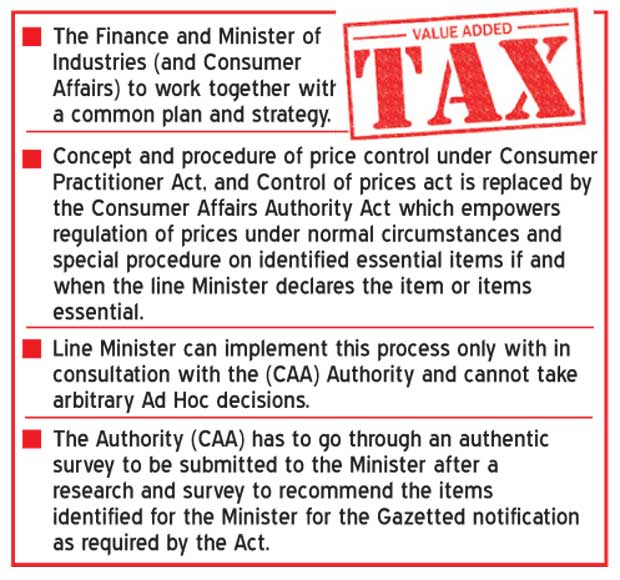
The line Minister can implement this process only with in consultation with the (CAA) Authority and cannot take arbitrary Ad Hoc decisions.
The CAA has to go through an authentic survey to be submitted to the Minister after a research and survey to recommend the items identified for the Minister for the Gazetted notification as required by the Act. It seems the Government was not ready and has not done its homework with the sudden decision to increase VAT for consumer items without realising its complexities.
There is no quick solution as citizens and organisations may intervene in the decision-making process. Fortunately the consumer is not organised in Sri Lanka as in the developed economies.
In this process the CAA can control the Maximum Price (MPC) of the identified consumer items only and the rest to be controlled by regulatory process, which is the main difference of the CAA formulated on Western Australian/European and Canadian models, which is replaced by the previous jurisprudence, based the on English Law.
Civil society and Non-Governmental Organisations are busy with Human Rights with foreign funding, though Consumer Rights too are rights recognised by the UN and our Constitution as Human Rights of Consumer. But it is not considered as essential and they form one of the most neglected sections of Sri Lankan society. It is the duty of the CAA to organise and encourage Consumer Societies as required by Section Eight of the Act which states as follows:
The functions of the authority shall be:
(F) To promote assist and encourage the establishment of consumer organisations.
It is a pity that all over the world except Sri Lanka consumerism and consumer organisation is a powerful power base of citizens and civil society organisations with a voice of the consumer consisting of world citizens worldwide. Consumer organisations linked to Education
(K) Promote consumer education with regard to good health safety and security
of consumers.
How many such organisations are in existence and active is a moot issue for the average consumer waiting for assistance in the resolution of the grievances.
According to Section 18 of the Consumer Affairs Authority, when the Minister is of the opinion that any good or any service is essential to the life of the community, steps could be taken having taken the appropriate steps legally to avoid litigation and protests by interested parties. The 15 consumer items declared essential include sugar, dhal, onions, sprats, milk powder, and canned fish, which is shown in the
CAA website.
Will making some consumer items essential and adjusting the VAT ease the citizen and bring down the cost of living is a moot issue and a dilemma/dream. To the consumer, the root cause of reasoning of cost of living is not confined to essential consumer items alone.
It is unlikely that this will be a viable solution as the issue lies elsewhere. It may give a temporary relief, but will not be a permanent solution to the main issue of high cost of living, which needs an overall solution based on a joint strategy, with the participation of the traders/manufacturers and consumers and the Government.
We must create the atmosphere for an alert consumer, reasonable trader / industrialist, effective consumer organisation with proper consumer education, and giving teeth and vision to the Consumer Affairs Authority with necessary amendments.

The consumer must be educated on priorities. The main expenses of the family today may be tuitions/education, communication, consumer goods and not necessarily healthy food (non-junk) and other essentials for a healthy living.
Implementation of the decisions taken by the CAA may not be an easy task with the staff of few hundred with full of sheer inefficiency, which is cancerous all over State machinery. Will a few hundred staff be in a position to implement a decision to cover 22 million consumers? Obviously No! The only and the best way to implement the process country wide is by way of education, organisation of the consumer and civil societies and to work on a proper strategy with organisations, the media and extended civil society-which is now busy with politics and looking for others’ blood and faults.
In India the legal system has helped the process by setting up of Consumer Courts and it is a good idea for us to set up similar Consumer Courts. Our Consumer Law is a mixture of Western, Australasian and European models. It is a good idea to consider reintroduction of the concept of price control as before, which is more effective and easy to implement. Until permanent solutions are found, it is the duty of the consumer, trader/industries and the Government to work together towards a viable solution for the consumer.
30 Jun 2026 3 hours ago
30 Jun 2026 3 hours ago
29 Jun 2026 9 hours ago
29 Jun 2026 9 hours ago
29 Jun 2026 29 Jun 2026