13 May 2026 - {{hitsCtrl.values.hits}}
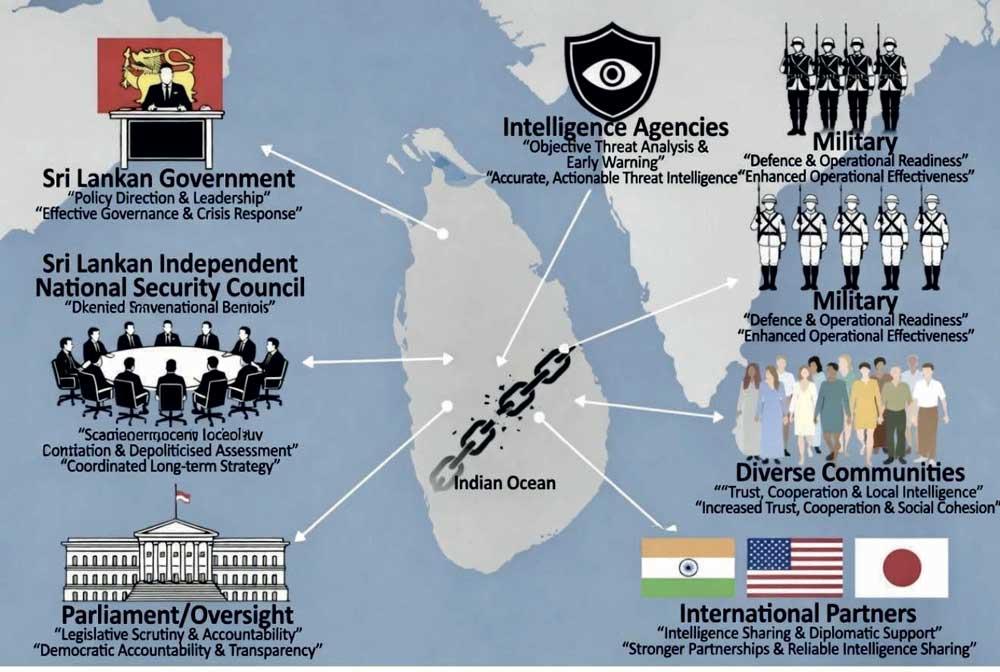
 Sri Lanka can finally build intelligence services worthy of its people and its strategic location. The draft National Security Strategy must now become binding law and practice. Half-measures will only mortgage the future. Professional, depoliticised institutions are the foundation on which Sri Lanka’s security, stability and prosperity must rest
 Sri Lanka in 2026 finds itself at a dangerous crossroads. Its commanding position in the Indian Ocean should be a strategic asset, yet it remains a vulnerability. The civil war ended in 2009 and the economy has begun recovering from the 2022 crisis, but the island faces intensifying great-power rivalry, internal divisions, and new threats ranging from cyber attacks to climate disasters. The deepest problem, however, is home-grown -the chronic politicisation of intelligence and security institutions.
This deliberate distortion weakens threat assessment, destroys public trust, and leaves Sri Lanka ill-equipped to handle a turbulent region. The most practical remedy lies in establishing a robust, independent National Security Council (NSC) with real statutory power. India’s post-Kargil reforms offer compelling lessons on how institutional redesign can professionalise intelligence and strengthen sovereignty.
Geopolitically, Sri Lanka is trapped in the crosshairs of India-China-US competition. Debt legacies such as Hambantota, competing port and infrastructure offers, and constant demands for maritime domain awareness force Colombo into a perpetual tightrope walk. Naval incidents near Sri Lankan waters remind us how easily the island could become a theatre for proxy rivalries. In such an environment, objective intelligence is not a luxury, it is survival. Yet when agencies are politicised, accurate analysis becomes impossible.
Reports are shaped to please the government of the day rather than reflect reality. Appointments go to loyalists, not professionals. Surveillance targets Opposition figures, journalists, activists, and minority communities instead of terrorists, drug lords, or foreign agents. This is not a bureaucratic accident; it is deliberate design repeated across successive governments.
The 2019 Easter Sunday attacks remain the bloodiest proof. Credible warnings about Islamist extremism were ignored or poorly coordinated because of political rivalries and interference. Two hundred and sixty-nine people died in an atrocity that could have been prevented. In the North and East, continued intimidation of Tamils, Muslims, human rights defenders and war victims’ families has poisoned community relations and created dangerous intelligence black holes.
Resources are wasted watching critics while organised crime, gun violence, human trafficking, drug smuggling and hybrid disinformation flourish. The new Protection of the State from Terrorism Act (PSTA) risks becoming another tool of abuse unless accompanied by genuine safeguards.
Cyber vulnerabilities, climate-driven unrest and economic fragility only multiply these risks. Politicised intelligence does not protect the state, it hollows it out.
The NSC as institutional firewall
Sri Lanka’s 2026 National Security Strategy draft finally recognises the need for an empowered NSC. This must not become another decorative body. It should be established by law with the following core features:
 Statutory independence and fixed-term, merit-based appointments for key leadership, insulated from electoral cycles
A clear legal distinction between the permanent State and the temporary Government
A professional secretariat for real-time coordination across intelligence, military, police, foreign affairs and cyber agencies
Parliamentary oversight committees that include opposition members and require regular redacted public reporting
Strong protections for officers who deliver objective analysis, even when it is politically inconvenient
Such an NSC would integrate political direction with professional assessment, end fragmented decision-making, and prevent partisan capture. It would allow Sri Lanka to craft long-term strategy rather than lurch from crisis to crisis.
Learning from India’s Post-Kargil reforms
India’s experience is directly relevant. Before 1999, India suffered from the same fragmentation and coordination failures Sri Lanka faces today.
The Kargil Review Committee exposed glaring intelligence and structural weaknesses after the border conflict with Pakistan. In response, India created a permanent National Security Council headed by the Prime Minister. At its heart is a powerful National Security Advisor (NSA) supported by the National Security Council Secretariat (NSCS) and the Joint Intelligence Committee (JIC). The system coordinates inputs from the Intelligence Bureau (internal security), RAW (external intelligence), military intelligence and other agencies.
The Strategic Policy Group brings senior officials together for integrated advice, while the National Security Advisory Board draws independent experts for long-term thinking.
These reforms did not eliminate all political influence; no large democracy is immune but they dramatically improved coordination, professionalised assessment, and enabled more assertive and coherent diplomacy. India’s ability to handle complex Indian Ocean challenges, respond to crises, and balance major powers has visibly strengthened since the reforms.
Sri Lanka, being smaller and more compact, can adapt this model even more effectively. A well-designed NSC here would be easier to manage than India’s vast apparatus, yet it could deliver the same benefits: continuity, centralised coordination, merit-based leadership, and reduced politicisation.
The key difference is political will. India acted decisively after a major shock. Sri Lanka has had multiple shocks, the Easter attacks being the most painful yet structural reform remains elusive.
Countries that succeed, such as Singapore and Israel, maintain strict firewalls between intelligence and partisan politics. They recruit and protect competent professionals who serve the nation, not the ruling party. Their agencies earn both domestic trust and international respect. Politicised systems, by contrast, breed repression, repeated failures and eroded sovereignty.
The path forward
Implementing genuine NSC reform will require courage from the highest levels of leadership. Superficial changes designed only to satisfy donors will achieve nothing. Sri Lanka must enshrine merit, oversight and professional culture in law. This will rebuild trust with minority communities, restore credibility with international partners (India, the US, Japan and others), and allow balanced diplomacy in a contested ocean. It will also free resources to tackle real threats terrorism, organised crime, cyber attacks and climate-induced instability instead of chasing political opponents.
The cost of continued inaction is painfully clear: more intelligence failures, deeper ethnic divisions, investor flight, and a permanent loss of strategic autonomy. The reward is equally clear a professional security apparatus that converts Sri Lanka’s geographic gift into genuine national strength, economic confidence and regional respect.
In 2026, Sri Lanka’s most important battle is not against an external enemy but against the internal politicisation that turns protectors into political instruments. Establishing a strong, independent National Security Council is not institutional tinkering; it is a patriotic necessity.
By learning from India’s proven reforms and committing to merit, coordination and accountability, Sri Lanka can finally build intelligence services worthy of its people and its strategic location. The draft National Security Strategy must now become binding law and practice. Half-measures will only mortgage the future. Professional, depoliticised institutions are the foundation on which Sri Lanka’s security, stability and prosperity must rest.
“Sri Lanka’s future will not be decided in the Indian Ocean, but in Colombo’s willingness to build institutions that place the State above the Government of the day. A strong, independent National Security Council is not merely a reform, it is the decisive step towards turning strategic vulnerability into enduring national strength. The time for excuses is over. The time for action is now.”
(The author is the former Head of the Counter-Terrorism Division of the State Intelligence Service of Sri Lanka, and has served as Head of the Sri Lankan Delegation at three BIMSTEC Security Conferences. He currently serves as the Managing Director to a leading security service provider. With over 40 years of experience in policing and intelligence, he writes on regional security, interfaith relations, and geopolitical strategy)
29 Jun 2026 2 hours ago
29 Jun 2026 3 hours ago
29 Jun 2026 3 hours ago
28 Jun 2026 28 Jun 2026