02 Aug 2025 - {{hitsCtrl.values.hits}}
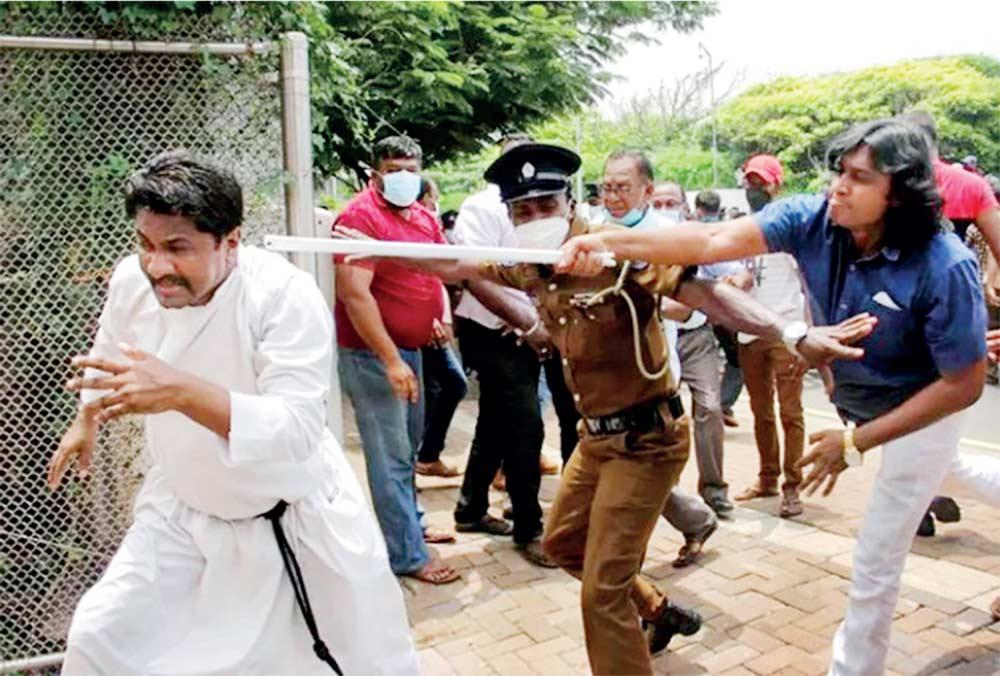
Plenty of arson and violence in the recent past, including the attack on peaceful protestors in the Aragalaya, yet as the writer states, no authoritative study of Sri Lanka’s political violence and thuggery has been found.
FILE PHOTO
 While researchers have worked hard over the years to study a plethora of socio-economic, archival and archaeological phenomena – from cults to beggary, ghosts, ola leaf manuscripts and ancient inscriptions, to mention just a few – I have not found yet an authoritative study of Sri Lanka’s political violence and thuggery.
This is puzzling since these two intertwined subjects are a dominant and all-pervasive feature of our political culture. Only a very few of our elections have not been tainted by them. Violence before and after general elections, especially after, has resembled civil wars – burnt houses, torched vehicles, physical injury and even loss of life.
For the sake of argument, let’s treat political violence and thuggery as one factor, and call it thuggery, though one can draw a (not so fine) line between them. Thugs are used by politicians during elections and in between to harass and intimidate the opposition. But not all political violence is carried out by thugs. Seemingly sane and law-abiding citizens go berserk when infected with political fervour, whereas thugs with no political convictions whatsoever can be hired to do the dirty work.
Fine lines apart, the damage done by political thuggery to a country and its culture can be considerable and long-lasting. The July 1983 anti-Tamil riots are a prime example of politically instigated violence initiated by thugs escalating into a nationwide riot, drawing in normally law-abiding citizenry into a macabre free-for-all where it became impossible to tell thugs apart from ‘normal’ people.
Nor was this the first race riot involving thugs this country has seen. This ethnic violence did not directly involve elections. The funeral in Colombo of 13 soldiers killed in an LTTE ambush was the starting point and excuse for a racist onslaught aimed at driving all Tamils out of Colombo. That goes to demonstrate that thuggery can be used by politicians to devious political ends at any time. But let’s look at thuggery as used in the direct political process of national elections.
Interestingly, the word thug is believed to have originated from the Indian word ‘thuggee’, though modern scholarship has disputed this claim. According to this narrative, Thuggees were groups of robbers who strangled their victims and robbed them. But they were not politically motivated. Accounts from different parts of the world suggest that politically-motivated thuggery is as old as Graeco-Roman times.
Hypatia of Alexandria, a prominent female mathematician, astronomer, and philosopher, was killed by a Christian mob in Alexandria, Egypt, in 415 CE. She was brutally murdered after being dragged from her chariot and attacked in a church. One can argue that this was religious thuggery rather than political, but religion and politics are, as we know well enough in Sri Lanka, often inseparable. That’s why modern constitution makers were at pains to separate the two and make the state secular. In Sri Lanka, unfortunately, this is no longer the case.
Therefore, political thuggery is not something limited to this subcontinent, but has been used to silence or harm opponents in many parts of the world. It has been, and still is, part of a universal political culture. The 18th-century French satirist, writer and philosopher Voltaire was often on the run, trying to stay ahead of thugs sent by nobles (politicians of the era) to attack him.
Perhaps Nazi Germany offers the best example of political thuggery in 20th-century Europe when Hitler used his Brown Shirts to silence opponents. In 1933, they set fire to the Reichstag (German parliament) and blamed it on the communists. This incident was used as a pretext to issue the Reichstag Fire Decree, which suspended civil liberties and allowed the Nazis to consolidate their power.
In Stanley-Kubrick’s 1971 British-American film “A Clockwork Orange,” a group of juvenile delinquents in a futuristic setting are sent by a politician to attack a rival and his wife. Though such violence disappeared from British politics long ago, the film is strangely prescient, as we saw gangs of racist British youth attacking immigrants in the streets within the past year. These mobs were motivated by far-right politics.
The point here is that political thuggery is nothing new, nor limited to this part of the world. One can perhaps argue that, at least in democracies, political institutions become stronger and independent in parallel with economic development and citizen empowerment and prosperity. Some European nations, post-WWII Japan, contemporary South Korea, Australia, New Zealand and the U.S. can be cited as examples where politicians no longer resort to violence and thuggery as power-maintaining devices.
But we have historical examples of mob (i.e. citizenry plus thugs, as in July 1983) violence against minorities, political or religious opponents (Against Jews, Catholic vs. Protestant, etc) in many of these countries. Modern Israel can’t claim to be free of political thuggery as long as Jewish settlers keep attacking Palestinians.
One can see, too, how quickly one can fall from this ‘developed country’ high ground. The US is a prime example—Donald Trump’s supporters storming Capitol Hill after his electoral defeat shows how easily the rot of undemocratic practices can set in. As for historical precedents of American mob power, the ‘tarring and feathering’ of opponents could be interpreted as thuggish violence. Tarring and feathering was a form of public punishment and humiliation used during the American Revolution against those deemed loyal to the British crown. The victim was stripped, covered in hot tar and then feathers were stuck on the tarred body before he was paraded in public. This was a political act. As Clausewitz said, war is politics by other means.
But we in Sri Lanka can’t speak of political thuggery as a thing of the past. Recent elections have been violence-free, but we have seen a recurring pattern of violence in our politics since independence, and not enough research has been done to trace its origins.
As such, I am not able to determine how and when it started. The mob attack on King Sri Wickrama Rajasinghe and his retinue after he fled Kandy can be seen as an early recorded instance of politically instigated violence. There could have been others which have gone unrecorded (the Mahavamsa was not given to recording mob violence, except when thugs became kings).
Back to our post-independence democratic political history, it’s hard to determine when the first acts of organised thuggery happened, as research is lacking. There seems to be a consensus that the UNP started it. But where is the evidence? Were the leftist parties and the centrist SLFP merely victims or did they retaliate? Certainly, the UNP was the capitalist ‘big money’ party with the means to hire thugs, but it doesn’t always take money to retaliate, as we learned from the JVP in the 1980s.
I can remember stories from my school days – my father telling how the SLFP candidate’s campaign vehicle in Bandaragama was attacked by two opposition vehicles carrying thugs in the 1960s. The worst stories came after the SLFP-led coalition’s defeat by the UNP in 1977 – writer Karunasena Jayalath’s house was torched, and the Ranatunga family’s property was damaged (World-Cup winning captain Arjuna’s mother, Mrs. Ranatunga, was my economics teacher, and I remember her telling this story). At the Werahera CTB workshop, leftist trade unionists were forced to eat rice dumped in drains. Defence Minister Lakshman Jayakody saved his home by threatening the mob with an iron bar. Apparently, newly elected President J. R. Jayawardene had sent the police on an unofficial holiday.
This wasn’t the worst, either. The 1980s (JVP and the civil war in both north and south) saw worse than arson – mass murder. At some point, men in uniform and political activists, too, become thugs, and law-abiding citizenry jump on the bandwagon with a license to kill. President Chandrika Kumaratunga kept the lid down as much as possible, though her tenure isn’t blameless (and that includes the sophisticated Mangala Samaraweera, too).
The Rajapaksa era, which followed, saw the refinement of thuggery almost to the level of crude art. Women were not spared. One woman candidate was stripped and paraded in her town. Even the gang rape of a Ukrainian woman and the murder of her British boyfriend by a pro-Rajapaksa provincial counsellor and his gang in 2011 can be interpreted as a political act. These thugs acted with impunity only because they felt above the law due to their political connections. After the non-violent Aragalaya against Gotabhaya Rajapaksa was infiltrated by political parties, we saw plenty of arson and violence at the end.
Recently, instances of mob activity against a veteran politician were reported from Jaffna. It’s mild compared to the rabid violence of the past, but I’m not sure if we are entirely free from it, and it’s important to establish the root causes, and someone should write an accurate history of thuggery and political violence in Sri Lanka.
08 Jun 2026 5 hours ago
08 Jun 2026 5 hours ago
08 Jun 2026 5 hours ago
08 Jun 2026 5 hours ago
08 Jun 2026 6 hours ago