07 Mar 2026 - {{hitsCtrl.values.hits}}
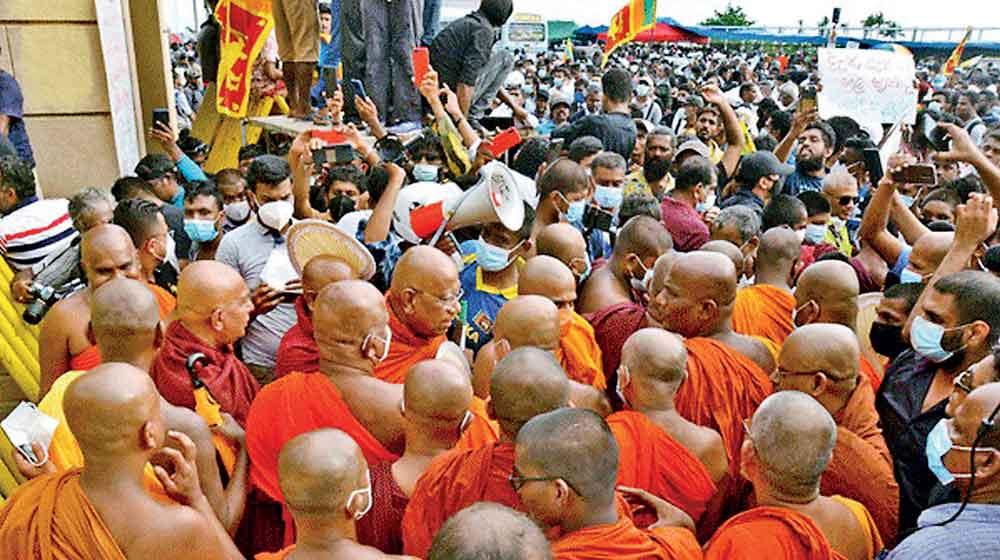
There is a general belief among the Maha Sanga that the government had neglected them and disrespected the Buddha Sasana
 Perhaps the third approach of looking at the Sangha convention is as a mix of both. It is a political project, but also a reality check for the government. It might help the government take note of the concerns raised by the monks, mend bridges, and not play into the hands of opportunists
 Two weeks ago, hundreds of Buddhist monks descended on Colombo to protest against the alleged government disrespect of the religion and the clergy. There are three ways to view the Maha Sanga Convention– the first salvo of the Buddhist clergy, or at least an influential section within it, against the government.
The first, and most convenient, approach is to term it an effort by a section of monks to revive the declining fortunes of the Rajapaksa dynasty. In many ways, it sounds convincing, for the main organisers of the event were erstwhile supporters of the Rajapaksa administration. They were also the chief proponents of Gotabaya Rajapaksa’s presidential campaign. Ven Muruttuwatte Ananda Thera, one of the chief organisers of the Sanga convention, previously turned his temple, Abayaramaya of Narahenpitiya, into a veritable campaign office for Mahinda Rajapaksa when his chips were down during the Yahapalanya. The same group of monks was also reluctant to speak up during the height of the economic crisis.
That seemed to be the government’s preferred interpretation of the monks’ protest. Minister Lal Kantha, whose invectives against the chief prelate of Mihintale temple were partly responsible for the recent stand-off between the monks and government, has now lampooned the Sanga convention as a ‘burnt light bulb’. He claimed that the event was poorly attended and was a failure in the post -- Aragalaya evolving consensus against racism.
The usual devious style of Sri Lankan politics has always been to ride the bandwagon, no matter how retrograde the underlying objectives are. Sajith Premadasa, the opposition leader, has done exactly that, though in all likelihood, the organisers seemed to be plotting to create a launching pad for the Rajapaksa scion, Namal, and not for him. He graced the event and spoke to the media, echoing the same talking points.
Therefore, one way to view the Sanga conventionis as a political project on behalf of the Rajapaksas, though Mr. Premadasa seemed to think he could somehow sneak through.
Secondly, though, a more dispassionate approach might suggest it as a reality check on the JVP/NPP government.
The Sanga convention endorsed a ten-point declaration, much of which underscored the country’s historical Sinhala Buddhist heritage, the historical role of the monks in guiding rulers, and the call to maintain the status quo.
However, the underlying grievances were palpable and seeped through the pages. There is a general belief among the Maha Sanga that the government had neglected them and disrespected the Buddha Sasana. The declaration demanded that “No action showing disrespect to Buddha statues should be carried out by the government or any other social institution” – an allusion to an incident in Trincomalee where a campaign by a group of monks to plant a Buddhist statue in a disputed land has now spiralled into a legal battle. It also called on “…derogatory statements, the spread of hostile opinions, ridicule, insults and accusations by social media activists must not be allowed to take place under the authority of the state.”
Some of these grievances emanate from the government’s own mishandling of the situation, gaffes, and neglect.
So here are a few missteps by the government that need to be corrected.
The government, an amalgam of Marxists and social justice warriors, seems to find it had to come to terms with demographic reality and the historical heritage of Sri Lanka as a predominantly Sinhala Buddhist civilisation, just as the UK and the European Union are founded on a Judeo-Christian foundation. That has not denied any individual, regardless of faith or race, equal rights in the Sri Lankan state. However, trying to overlook the historical and demographic reality is ill-advised and is bound to boomerang as the European experience has now revealed.
The false equivalence of Buddhist pilgrims visiting a disputed temple in Jaffna, and the politically mobilised protestors demonstrating in front of it every Poya day is not the most intelligent comparison -- but the president did it anyway. Thousands of churches, mosques, and kovils coexist in the South, and the failure to accommodate a handful of temples in the North is an extension of the same ideology that bred a generation of terrorists. Calling out that might not be politically convenient, but it would help in the long term.
Second, the war victory should not be discredited, no matter how tempting it might be. The government could not consult the public before it waged war, as Prime Minister Harini complained, because the war was thrust upon it. This country was held hostage by nihilistic terrorists for twenty-five years. Sri Lanka should not apologise for defeating terrorism.
Third, even the best intentions could be misconstrued. The government’s education reforms are a step forward. However, its inability to get priorities right could have a toll on it. The sexual health education for children is an innocuous, forward-looking measure; however, that might not be the most pressing concern, considering the pushback it has received from conservative circles, including monks. In theory, it is a good idea, but in practice, its outcome could well be statistically insignificant.
Teenage pregnancies are primarily a cultural problem. In America, no amount of safe sex education and moonlight basketball has helped change the fact that 80 per cent of African -American kids are born out of wedlock and raised by single-parent families.Probably, two extra hours of mathematics and English would contribute to better long-term outcomes for our children.
Fourth, the hubris could be costly. The government seemed to indulge in lampooning and belittling the contributions of a succession of governments that predated it. At the same time, it could hardly point to any salient achievement of its own. A degree of commonsense humility would help the government in the long term.
Perhaps the third approach of looking at the Sangha convention is as a mix of both. It is a political project, but also a reality check for the government. It might help the government take note of the concerns raised by the monks, mend bridges, and not play into the hands of opportunists, some of whom seem eager to ride to political office on the monks’ shoulders.
13 Jun 2026 7 hours ago
13 Jun 2026 7 hours ago
13 Jun 2026 9 hours ago
13 Jun 2026 9 hours ago
13 Jun 2026 13 Jun 2026