26 Mar 2025 - {{hitsCtrl.values.hits}}
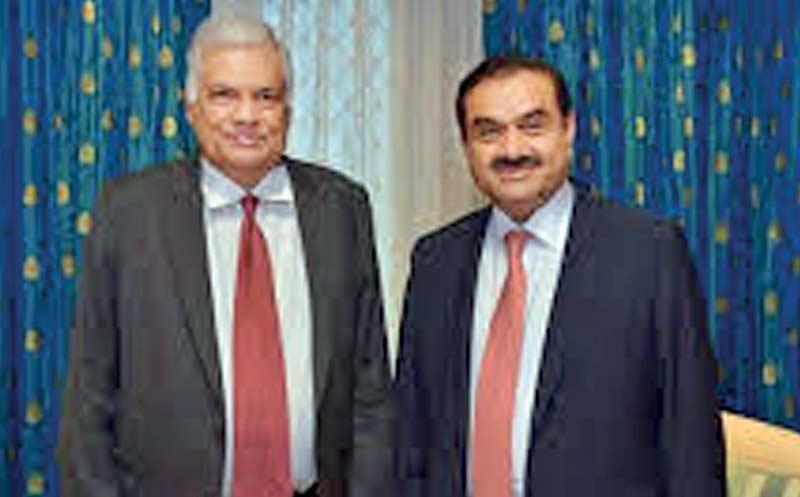
President Ranil Wickremesinghe (left) with Gautam Adani, founder and chairman of the multinational conglomerate Adani Group. The Adani wind power project was an unsolicited bid that was fast-tracked under the Wickremesinghe administration
 Last month, Adani Green Energy announced that it would ‘respectfully withdraw’ from two proposed wind power projects in Mannar and Pooneryn after the government sought to lower the tariff in the power purchasing agreement.
The decision came after the cabinet appointed a committee to renegotiate the price from an earlier hurriedly agreed $. 0.08 to about $0.06 or less per kilowatt-hour (kWh). The Adani group has said the government’s proposed rates are ‘financially unviable’.
The two Adani Green Energy projects and the construction of two transmission lines were tipped to bring in an estimated investment of $ 1 billion. However, the project ran into controversy during the election campaign, with then-presidential candidate Anura Kumara Dissanayake raising concerns over its inflated prices and promising to renegotiate the deal.
The concerns over excessive tariffs were further amplified by the lower unit cost of the CEB-commissioned 103.5 MW Thambapavani Wind Power plant. The unit cost of the Thambapavani wind farm, which has been in operation since 2020, is about $ 0.04 per kWh.
To make matters worse, the CEB tender committee delayed the opening of tenders for another 50 MW wind farm, also in Mannar, until the government finalized its power purchasing agreement with Adani Green Energy at a unit cost of $ 0. 0826 per kWh for 20 years.
Finally, when the tenders for the 50 MW wind farm were opened, it transpired that the CEB had received bids as low as $ 0.0486 per kWh. The tender was finally awarded at even a lower cost ($ 0.0465 per kWh) to a local conglomerate, Hayleys Fentons – after a government appeal board approved the Hayleys Fentons for the lowest bid.
Considering vast price disparities, many observers have raised concerns over potential vested interest in holding back the tender procedure until the Adani deal was finalized. Had the tenders been opened earlier, the government negotiators would have had access to pertinent price information, which should have strengthened their hand in negotiating the power purchase agreement.
Civil society groups and anti-corruption activists, including those in the government when they were in the opposition, have regularly raised concerns about a CEB mafia profiting from inflated power purchasing tenders.
There is no gainsaying that Adani’s tariffs, reached without a competitive bidding process, are bad for the economy and bad for the local consumers. Yet, the government’s indecisiveness in approaching the controversy is perhaps worse.
Despite its opposition to inflated prices, the government seems devoid of a strategy to navigate the controversy.
The government claims it plans to renegotiate with Adani Green Energy. The Adanis, on their part, have repeatedly stated their refusal to budge from the initially agreed tariff.
Recent media reports have indicated an emerging compromise of $ 0.07 per kWh, effectively giving the government a face-saving.
Whether such a compromise would offer the country a competitive price is open to question. A face-saving for the government, though, depends on how loudly its spin doctors sell the embarrassment as a victory.
The President himself has described Adani’s tariff as ‘excessive’.
“We awarded a tender to a 50 MW wind power project for US $ 0.0465 per unit. In this context, awarding a project at an excessive tariff of around $ 0.0826 cannot be justified,” he said in Parliament.
However, neither he nor any other member tells how the government plans to resolve the dispute.
Swiss Challenge
The government’s indecisiveness and vacillation are not due to the absence of a mechanism that it can resort to obtain a competitive market price. Adani wind power project was an unsolicited bid that was fast-tracked under the Wickremesinghe administration. Given its insulation from a competitive tender process, Adani was in a privileged position when it came to price negotiations.
This is where the Swiss Challenge comes into play- to obtain a competitive price for products and services when the countries evaluate unsolicited bids.
A Swiss Challenge is a form of public procurement which requires a public authority which has received an unsolicited bid for a public project (such as a port, road or railway) or services to the government to publish the bid and invite third parties to match or better it.
Once the government obtains the bids from third parties, the government can offer the initiator (in this case, Adani Green Energy) to match the best counter bid. Where the initiator is not willing to proceed with the rates offered in the best counter bid, the tender should be offered to the one among the third-party bidders who have made the lowest bid.
ADB and IMF have continuously advocated for the government to adopt the Swiss Challenge procurement procedure. Swiss Challenge also made headlines during the Yahapalanaya government when the Chinese loan-funded projects undertaken by the Rajapaksa administration were accused of inflated costs. Swiss Challenge was suggested as a solution. However, there was a hitch on that particular occasion, considering that the Chinese loan-funded projects were required to pick from a group of contractors recommended by the lender as part of loan conditions.
Such conditionalities do not exist in the Adani Wind power project. The current dispute, which revolves around the price per unit of power, at best, should be decided through a competitive market process.
The government can now call competitive bids for the project under the Swiss Challenge process in order to obtain the best price for local consumers.
Once the bids are collected from third-party competitors, the government can offer Adani the opportunity to match the most competitive bid.
If Adani Green Energy is disinclined to proceed with those rates, the party who made the lowest bid should be offered the tender.
A Swiss Challenge on the Adani Windpower project could have two outcomes. Either it would bring in a lower bid or prove Adani’s claim that a lower price is economically unviable.
Political capital that the government accrue through such a mechanism would be far greater than just saving its face. It would enshrine its commitment to transparency, and the reputational benefit for the government and the country at large would be immense.
However, the government’s response so far to Adani’s withdrawal is indecisiveness and vacillation. One does not need to look further than the Yahapalanaya administration to gauge the destructive potential of policy inconsistency and uncertainty. Yahapalanaya’s suspension of the Colombo Port City, and then a host of other foreign loan-funded projects, heralded a period of policy uncertainty, which drove away foreign investors and killed the high-growth economy.
Yahapalanaya’s calculations were petty political. NPP government, though, has a legitimate claim. However, how it approaches the problem should not aggravate it or contribute to an economy-wide uncertainty.
Sri Lankan politics is also petty and opportunistic. The opposition MPs who once opposed the Adani tariffs now cry blue murder that the investors are fleeing the country. As the JVP itself should know, it is the perception that matters, not exactly the truth.
Finally, there are geopolitical concerns, though, that two other mega projects- also undertaken by the Adani conglomerate - A Colombo Port terminal and a Cement plant- would assuage some of them. Not to mention the US Department of Justice and the Securities and Exchange Commission (SEC) indictment of Gautam Adani and his associates over alleged bribery and fraud amounting to $265 million in securing solar energy contracts in India. A Swiss Tender would enable the government to ride over these challenges while securing the best deal for Sri Lankan consumers. Why is it waiting for?
19 Jun 2026 42 minute ago
19 Jun 2026 48 minute ago
19 Jun 2026 59 minute ago
19 Jun 2026 1 hours ago
19 Jun 2026 2 hours ago