25 Jul 2025 - {{hitsCtrl.values.hits}}

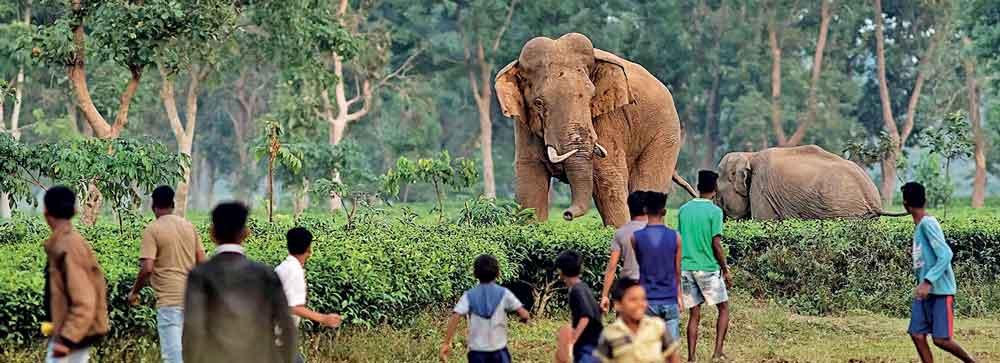
Assam comprises a population of over 5,000 wild elephants in the region and is considered a crucial conservation zone for Asian elephants in India (pic courtesy: hatibondhu.org)
By Gamini Akmeemana
Sri Lanka is at the forefront of the human-elephant conflict (HEC), with 130 people and 380 elephants dying as a result last year. This is the highest HEC death toll reported from anywhere. But we are not the only country affected by this issue, and this is an attempt to take a comparative look at other affected countries.
We can start with neighbouring India, with an estimated 27,000 wild elephants. The northeastern state of Assam is the worst-affected. Assam has an estimated 5828 wild elephants, or about 20 per cent of India’s total, and the state comprises 78,438 sq. km. and a population of over 31 million people (compared to Sri Lanka’s 64,639 sq km and just over 23 million people), with an estimated 7000 wild elephants or fewer.
But Assam seems to have tackled this problem better than Sri Lanka. Its elephant population is said to be stable, while ours is declining according to reliable, unofficial estimates. Assam’s 2024 elephant count was 109 more than the last estimate made in 2017. According to a study published by the Asian Elephant Specialist Group, community-based elephant monitoring combined with non-lethal methods of containing wild elephants is behind this success.
In Assam, too, villagers began retaliating against wild elephant attacks by killing them. Poisoning and electrocution are two principal methods used. Studies were carried out in Sonitpur and Goalpara, two of the worst-affected districts. After identifying the effectiveness of elephant monitoring, two different methods of doing so—expensive satellite telemetry studies and the low-tech approach of field-based human monitoring, were considered. Using the latter method, elephant groups are followed in the study area on foot or by vehicle using a relay system, with field monitors responsible for recording all movement and conflict in their zone of land until the elephants move into the zone of another field monitor. A drawback of this visual tracking is that this monitoring cannot be done inside dense forests.
The data collected is transferred to a GIS database for special analysis, and analysed for elephant migration routes, conflict hotspots and seasonal variations. Despite its drawbacks, this low-tech method is suited for a community-based approach because it is cheap and sustainable and easily introduced to other affected areas. Field monitors stationed throughout these study areas visit crop-raiding and property damage incidents as they occur, recording their locations with a GPS unit. Details such as elephant group size, composition or herd identity, time of incident, damage to crops and property, and if any crop protection methods are being used are recorded along with the locations of elephant herds or single elephants. People are also taught how to identify individual elephants.
In Assam, crop and property protection methods such as early warning systems (trip wires, watchtowers), barriers (trenches, electric fence, chilli fence, buffer zone), deterrents (chilli smoke, spotlights) have been used, and it has been found that they work better in combination and in irregular rotation, as elephants, being intelligent animals, can outsmart barriers and early warning systems.
Of all these methods, hand-held spotlights were the most popular. Due to fluctuations in the local electricity supply, a spotlight with a voltage regulator was developed. This was effective when combined with noise, fencing and chilly smoke. Another method was to construct simple 2.2 metre high electric fences with two strands of electrified wire, powered by solar photovoltaic panels. This was expensive, but very effective in the worst-affected villages. The community was expected to provide materials plus labour, and NGOs and other organisations provided wire and energisers. The villagers were taught how to maintain the fence. If the village has no electricity, solar power is used—the village thus benefits from an electricity supply.
Chilli smoke, too, has been used. In this case, dried red chillies, tobacco leaves and dry straw or grass are placed inside a rolled-up cardboard and fastened with wire. A stick put into the tube’s centre serves as a handle. Chilli smokers work in teams of at least three and have to be prepared in advance. When caught off guard, villagers simply throw chillies into a fire made along the edges of the village. But this method is less effective.
Chilli fences (made of ground chilli and tobacco leaves mixed with automobile grease and smeared on a rope) have proven to be highly effective at one project village. Sri Lanka, with its human-elephant resources going from bad to worse, and wildlife authorities unable to protect villagers as well as elephants adequately (and to treat injured elephants), should take a serious look at Assam’s community-based approach.
The Asian Elephant Specialist Group is a global network of experts focused on the conservation of Asian elephants. It is part of the Species Survival Commission (SSC) of the International Union for Conservation of Nature (IUCN).
11 Jul 2026 44 minute ago
11 Jul 2026 58 minute ago
11 Jul 2026 4 hours ago
10 Jul 2026 5 hours ago
10 Jul 2026 5 hours ago