15 Dec 2016 - {{hitsCtrl.values.hits}}
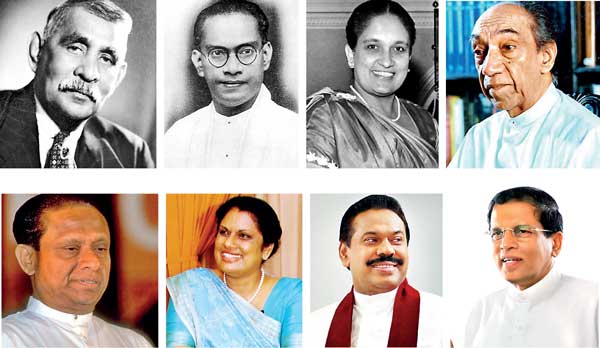
The story of Ceylon’s journey from Independence to a crescendo of corrupt family rule.
“The only time you should ever look back is to see how far you’ve come.”
~Anonymous
 It should be a captivating story. It is a story that can be told and listened to without a wink.
Pundits would theorise, historians would relish and cynics would say ‘I told you so’.
All political chicanery played out to a finish, trickery and deceit employed by the players to such an exquisitely consummate level, the level of deceit had all hallmarks of Ceylon’s growth to nationhood; An uncanny human drama enacted and historians would salivate, for chronicling of such curious events is a privilege, not a mere exercise in penning thoughts on paper.
This is the story of Ceylon’s journey from Independence to a crescendo of corrupt family rule.
It had its usual sordidness while at the same time, was exclusively poignant and entertaining.  However, the last ten years of the drama were unique. Its pathos and intrigues, its conspiracies and their exposés had a bizarre and inexplicable canter; Sri Lanka has been limping towards an end that exists only in the imprecise theatres of the uncertain and mediocre.
From a Westminster style democracy to an Executive Presidency on the one hand and from an elite-based mercantilism to ruinous socialist/capitalism-based mixed economy to crony-capitalism on the other hand, Sri Lanka seems to be stalled in a pothole of mediocrity and sub-standards.
Corruption, nepotism, absence of accountability and transparency at political structures and each level of the bureaucracy, have retarded the country’s progress towards what one calls a ‘dynamic equilibrium’, equilibrium between clashing economic and social forces. Reconciliation between these clashing forces seems improbable. Its political profile is lamentable while possibilities towards a realistic attainment of a balanced socio-economic evolution appear remote.
Time has passed when everything was blamed on British colonialism and its preceding Dutch and Portuguese occupation of the country.
Ceylon, after gaining Independence, has voyaged towards greater assuredness and more independence from the crutches of foreign powers of the colonial kind.
Yet, all indices that measure a country’s economic heartbeat are down; statistically they may issue clues towards a rapid development of the Gross National Product, but in a real sense, whether that growth has manifested itself in the day-to-day lives of the common man is acutely questionable.
The evolution of Sri Lanka as a reckonable national and socio-economic power could be chronologically broken into four broad stages. I will deal with the first phase, from D S Senanayake to S W R D Bandaranaike period in this column and follow up with the next three stages in separate columns and a final one is dedicated to the nagging cause of the Northern and estate Tamils and the rise and fall of the Liberation Tigers of Tamil Elam (LTTE).
1. From DS Senanayake to SWRD Bandaranaike (1947 – 1959)
2. From Sirimavo Bandaranaike to JR Jayewardene (1960 – 1989)
3. From Ranasinghe Premadasa to Chandrika Bandaranaike Kumaranatunga (1990 – 2005)
4. Mahinda Rajapaksa to Maithripala Sirisena (2005 – Present)
Rise of Tamil agitation-politics culminating in the LTTE, Prabhakaran and the 27-year war
In the late nineteen forties, Ceylon had a fairly robust, friendly bi-cameral legislature, the House of Representatives and the Senate. Among the majority ethnic group, Sinhalese, there was a wide gulf between the two main political philosophies at the time, namely social-capitalism led by the DS Senanayake-stalwarts and socialism/communism led by Dr. S A Wickremasinghe, NM Perera, Phillip Gunawardane, yet the usual business of government was conducted without the degrading vituperative politics of today.
Even between the Sinhalese and Tamils, the political leadership had not wilted to the level of resorting to desperately harsh, downright racism and name-calling. SWRD Bandaranaike, still hanging on to the identity of his Sinhala Maha Saba, was part and parcel of the United National Party (UNP) founded by DS and was the Leader of the House, a post whose holder is the theoretical successor as next Prime Minister.
This de jure position, however, was eclipsed by the presence of both Sir John Kotalawela and Dudley Senanayake, who were nephew and, elder son of DS respectively. While Dudley was a relative newcomer, Sir John was an old hand close to the ‘old man’, DS and quite ambitious to succeed him, when the time came.
Bandaranaike was no novice to political trickery. He knew that DS would never offer him a chance to be the leader of the UNP and the country so long as there were close relatives of his holding high Cabinet positions in his government.
Apart from this foresight into the succession spectacle of political leadership, Bandaranaike also chartered a carefully calculated move to get to power in a short time. Although DS may not have treated Bandaranaike’s defection from the UNP as a ‘big’ issue, the country, especially the Sinhalese Buddhists, salted this move as one made in the exclusive interest of the Sinhalese-Buddhists of Ceylon who had been sinned against by successive colonial powers, the Portuguese, the Dutch and the British.
Bandaranaike made the right move at the right time and to date it remains the only defection-move from a major party that bore the desired results.
Breaking away from the UNP and forming the Sri Lanka Freedom Party (SLFP) as a viable alternative to the UNP had its historic and historical significance.
The traditional left led by ‘NM and the gang’ never recovered from this political master-stroke by Bandaranaike.
These traditional leftists, who were considered at the time as the alternative to the UNP, ceased to be such and could enjoy real power only within the hallways of SLFP-led governments as coalition partners and the significant role they played as the leading protagonists of the ‘have-nots’ in the country and with the birth of the Janatha Vimukthi Peramuna (JVP) and Rohana Wijeweera’s oratorical brilliance, suffered a further setback.
Historians have not rendered much kudos to this move by SWRD, yet the facts are transparent.
The traditional left that existed in Ceylon in the nineteen forties, fifties and sixties suffered an irrecoverable defeat because of the birth of the SLFP and SLFP’s representation in Parliament in successive elections grew rapidly.
The ‘have-nots’ who were represented by the traditional left acquired a new garb of nationalism flanking on chauvinism; the average worker attained a tangible ‘place in the sun’ and the branding of the UNP as a ‘rich man’s party’ took deep root in the minds of the voter, at least until 1977.
The trickeries and conspiracies that were hatched by the shrewdest and highest minds of the country at the time, the Governor, Chief Justice and the super elite of the land, Lake House group’s Chairman L. M. D. de Silva and Managing Editor Esmond Wickremasinghe (Present Prime Minister’s father) to select the successor to the dying DS Senanayake after his fatal horse-ride on the Galle Face green on the morning of 22 March 1952, are most lucidly recounted in the biography of ‘JR Jayewardene of Sri Lanka’.
How Sir John was sidelined in preference to Dudley Senanayake, JR’s involvement in securing Dudley’s consent to be the next Prime Minister, rounding up the members of the UNP were all the ingredients that went into making a new Prime Minister.
Subsequently, Dudley, succumbing to the pressures of the job, the famous ‘Hartal’ organized by the leftists, Sir John assuming Premiership and making a mockery of politics and fine-tuning of the national platform by Bandaranaike with the ready and willing assistance of the Buddhist clergy of the day, coupled with a real and dire need in the country for a socio-cultural shift, a shift so diametrically opposed to the one existing at that time, contributed to the sweeping electoral success in 1956 for Bandaranaike.
The first paradigm shift in post-Independence politics in Ceylon occurred in 1956 and its effects have engendered a new socio-cultural mindset, which, when positive, was extremely creative and when it assumed a negative persona, catastrophic changes occurred. That positive creativity produced pioneering works of art such as Sarathchandra’s Maname, Chithrasena’s Nala Damayanthi, Lester James Peiris’ Rekhawa and Amaradeva-Mahagama Sekera duo’s Madhuwanthi. That cultural resurgence which followed is continuing up to the present time.
Yet, the negative effects were disastrous. Among the direct manifestations of a mindset that was damaged, warped and hateful and distrusting were, polarization of the nation along ethnic lines, repeated eruptions of racial riots, standardization of student intake to the universities culminating in a brutal ethnic war that killed tens, if not hundreds of thousands and injured more.
An intellectual par excellence, a liberal at heart and an erudite authority on word-craft, Bandaranaike eventually proved to be, as James Manor wrote in his biography ‘The Expedient Utopian’, who could not match his rhetoric with his action.
SWRD Bandaranaike left behind a sad saga of ethnic tensions and an emergent generation who looked to government as a deliverer of all solutions. It was indeed a tragic beginning of a new era.
The writer can be contacted on [email protected]
28 Jun 2026 14 minute ago
28 Jun 2026 24 minute ago
27 Jun 2026 27 Jun 2026
27 Jun 2026 27 Jun 2026
27 Jun 2026 27 Jun 2026