22 Jun 2026 - {{hitsCtrl.values.hits}}
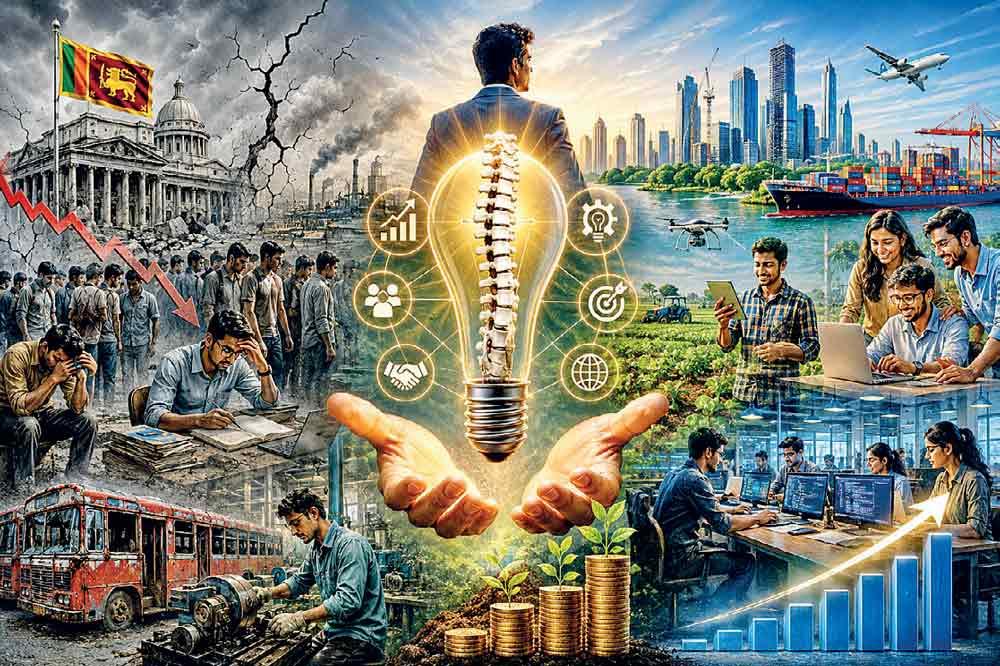
 For an economy to survive and thrive, entrepreneurship must be recognised as its spinal cord
To understand the alternative, one only needs to look at the economic trajectories of fast-developing nations like China, India, and Vietnam
 The modern business lexicon frequently centres around a single, powerful catalyst: entrepreneurship. Derived from the French word entreprendre, meaning “to undertake,” the concept was fundamentally shaped by the Austrian political economist Joseph Schumpeter often regarded as the father of entrepreneurship. Schumpeter introduced the groundbreaking theory of “creative destruction,” arguing that vibrant economies do not simply grow by doing more of the same; they evolve because daring individuals dismantle old, inefficient structures to create innovative, value-driven enterprises.
Today, this Schumpeterian vision is no longer just an academic theory; it is an urgent economic necessity. Globally, and specifically within developing nations, a harsh reality has surfaced: no government, regardless of its wealth, can provide public sector jobs to the continuous stream of youth graduating from universities, technical colleges, and vocational institutions. Attempting to use the state as an all-encompassing employment agency is a fast track to national insolvency.
For an economy to survive and thrive, entrepreneurship must be recognised as its spinal cord. When a nation fosters a culture of self-reliance and innovation, it transforms job seekers into job creators, shifting the economic burden away from the taxpayer and onto self-sustaining markets.
The Public Sector Illusion: Lessons from Sri Lanka’s Collapse
Sri Lanka serves as a textbook example of the catastrophic consequences of using public sector employment as a political tool. For decades, successive administrations practiced a unsustainable form of patronage, rewarding voters and loyalists with secure, non-productive government jobs. This created a hyper-inflated bureaucracy that drained national coffers without delivering equivalent public value.
State-Owned Enterprises (SOEs) became severely overstaffed. Institutions like the Ceylon Electricity Board (CEB), the Sri Lanka Ports Authority, SriLankan Airlines, and the Ceylon Petroleum Corporation (CPC) turned into massive fiscal black holes. The most staggering historical example rests with the Sri Lanka Transport Board (SLTB), where at one point, an absurd ratio of nearly 20 workers was maintained for a single bus. In an environment structured like this, turning a profit is mathematically impossible. Instead of generating revenue, these institutions became ineffective, deeply bureaucratic, and highly unfriendly to the public they were meant to serve all while forcing taxpayers to foot the bill.
During the presidency of Gotabaya Rajapaksa, whose administration launched a plan to enlist over 100,000 unemployed graduates and low-income individuals into the public sector. This policy was executed without a viable strategy for how to fund their salaries, pensions, or operational expenses over the long term.
Coupled with other major strategic blunders most notably the abrupt, overnight ban on chemical fertilisers in favor of an unmanaged organic farming theory this fiscal mismanagement accelerated a systemic collapse. When the state could no longer artificially sustain its bloated structures or print money without consequences, the country suffered severe economic hardships.
The resulting shortages of essential goods like fuel, cooking gas, fertiliser, and medicine sparked hyperinflation and intense youth frustration. This economic despair ultimately triggered widespread civil unrest, forcing the president to leave office prematurely. The lesson was clear: an economy built on public sector inflation rather than genuine value creation is a house of cards.
Global Parallels: How Modern Giants Avoided the Trap
To understand the alternative, one only needs to look at the economic trajectories of fast-developing nations like China, India, and Vietnam. These countries realised early on that state-sponsored employment could not scale alongside their populations. Instead, their governments focused heavily on developing robust entrepreneurial ecosystems.
China: Annually, millions of students graduate from Chinese universities. If the Chinese state attempted to absorb these individuals into government administrative roles, the system would collapse under its own weight. Instead, China positioned itself as a global hub for manufacturing, tech startups, and e-commerce. By lowering barriers to business creation, establishing special economic zones, and funding incubators, China empowered its youth to build small and medium-sized enterprises (SMEs) that now form the bedrock of its GDP. India and Vietnam: India leveraged entrepreneurship to leapfrog traditional industrial steps, building a world-class IT, software, and startup ecosystem (producing dozens of “unicorn” companies valued over $1 billion). Vietnam restructured its economy by cutting red tape, making it incredibly easy for local entrepreneurs to integrate into global supply chains.
In all three cases, the formula was identical: stop trying to employ the youth; instead, build the infrastructure that allows youth to employ themselves and others.
The Strategic Advantages of Entrepreneurship for Sri Lanka
For a country in recovery like Sri Lanka, shifting from a state-dependent mindset to an entrepreneurial framework offers deep structural advantages:
Sustainable Job Creation and Alleviation of Fiscal Burden
Small and Medium Enterprises (SMEs) traditionally contribute to over 50% of GDP and safe-guard the majority of private-sector employment in developing markets. When a young graduate starts a tech firm, an agri-processing plant, or a boutique tourism venture, they immediately remove themselves from the unemployment queue. As the business grows, they hire developers, laborers, and managers, directly relieving the government of the pressure to create artificial jobs.
Sri Lanka’s economic crisis was fundamentally a balance-of-payments crisis the country ran out of foreign currency. Traditional reliance on tea, garments, and worker remittances is no longer enough. Entrepreneurs are naturally agile; they can spot global niches. Whether it is exporting specialized software, value-added organic spices, or high-end sustainable fashion, entrepreneurs bring in crucial foreign exchange (USD) that stabilizes the local currency.
Public sectors lack the incentive to innovate because they rarely face competition. Entrepreneurs, driven by market survival, must optimize. An agricultural entrepreneur in Sri Lanka might introduce drone mapping or drip irrigation to maximize crop yields, directly fixing the systemic inefficiencies that top-down government mandates historically caused.
Analysing the Failure: Why Sri Lanka Stifled Its Own Creators
Despite the clear benefits, Sri Lanka has historically failed to build a thriving entrepreneurial culture. This failure is rooted in several systemic roadblocks:
A Roadmap for the Future: What Sri Lanka Must Do
To turn entrepreneurship into a true engine of growth and permanent solution to youth unemployment, Sri Lanka must implement a deliberate, structural blueprint.
Step 1: Radical Educational Reform
The current educational system is designed to produce administrators and employees, emphasizing rote memorization over critical thinking. Universities and technical colleges must integrate entrepreneurship, financial literacy, and coding into every curriculum. Higher education should be judged not by how many graduates find jobs, but by how many graduates start ventures within two years of leaving school.
Step 2: Drastic Reduction of Bureaucratic Obstacles
The country must aggressively digitize its administrative framework. Launching a business should take hours, not months, through a centralized online portal. By eliminating physical red tape, the state can reduce corruption and encourage informal, home-based businesses to transition into the formal economy.
Step 3: Financial Inclusivity and Alternative Funding
The Central Bank of Sri Lanka needs to encourage the development of venture capital, angel investor networks, and crowd-funding platforms. Rather than relying on traditional, collateral-heavy bank loans, early-stage startups should have access to unsecured, merit-based seed grants and equity-based financing.
Step 4: Policy Stability and Special Economic Zones
The government must commit to long-term consistency in fiscal and trade policies. Setting up dedicated entrepreneurial zones equipped with reliable internet, shared manufacturing spaces, and tax holidays for the first three years will provide early-stage companies with the stable environment they need to scale.
Conclusion: A Shift from Dependency to Defiance
The era of the state as the primary employer is over. The historic collapse of Sri Lanka’s over-allocated public sector proved that political patronage masquerading as job creation leads straight to national bankruptcy.
If Sri Lanka is to emerge from its historical economic hardships and build a stable future, it must unleash the creative energy of its youth. Entrepreneurship is not merely an alternative business path; it is the vital spinal cord required to support a modern, self-reliant economy. By dismantling bureaucratic barriers, reforming education, and rewriting financial rules, the nation can transform an underemployed generation into a dynamic force of self-starters ensuring that the country never again has to compromise its future on the altar of fiscal mismanagement.
The writer is a distinguished International Researcher, Author and analyst with a career spanning over 36 years of service in the Sri Lanka Army, including 20 years in active combat. A seasoned Infantry officer, Major General (Retd) Dr Boniface Perera holds a PhD in Economics and has authored 17 books and over 200 research articles. His multifaceted expertise bridges the gap between National Security, Global Politics and Economic strategy. As an entrepreneur and international analyst, he provides strategic insights into the intersection of security and economic policy. He can be reached [email protected]
23 Jun 2026 18 minute ago
23 Jun 2026 2 hours ago
23 Jun 2026 2 hours ago
23 Jun 2026 2 hours ago
23 Jun 2026 2 hours ago