Reply To:
Name - Reply Comment
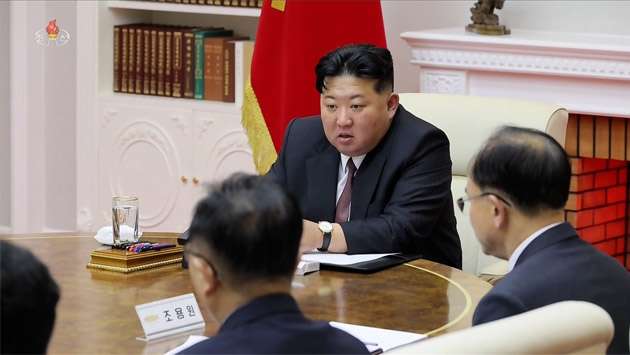
Korea Herald - North Korean leader Kim Jong-un on Tuesday doubled down on Pyongyang's nuclear weapons buildup and confrontational stance toward Seoul.
Experts believe the move is aimed at foreclosing future denuclearization talks and reframing any potential negotiations with Washington around arms control rather than disarmament.
According to the Korean Central News Agency on Tuesday, the ruling Workers' Party of Korea convened the second plenary meeting of its ninth Central Committee for three days beginning Saturday to review policy implementation in the first half of the year and discuss major tasks for the remaining months.
The party meeting reaffirmed North Korea's commitment to expanding and modernizing its nuclear arsenal, portraying nuclear weapons as the foundation of the country's national defense strategy and military deterrence.
The plenary session unanimously concluded that "to thoroughly exercise the position of a nuclear weapons state is the most correct and unique way to actively and confidently cope with the unpredictable international military and political situation getting complicated in multiple ways."
The report also said Kim called for the continued expansion of strategic military capabilities and set a goal of developing defense assets at a pace that would allow the country to "overtake the world."
Yang Moo-jin, a distinguished professor at the University of North Korean Studies, said the remarks reaffirm Pyongyang's rejection of denuclearization and appear intended to preempt renewed international efforts to address North Korea's nuclear program following the apparent easing of tensions surrounding Iran's nuclear issue.
"By declaring that it will thoroughly exercise its position as a nuclear weapons state, North Korea has once again confirmed that it has no intention of denuclearizing," Yang said. He added that Pyongyang appears to be signaling that denuclearization will not be on the table even if US-North Korea negotiations resume, while seeking to shift the framework of future talks toward nuclear arms control.
Yang also said North Korea's references to South Korea's pursuit of nuclear-powered submarines serve to justify its own military buildup. The regime's renewed designation of South Korea as its most hostile state also demonstrates its determination to continue its hostile two-state policy toward Seoul.
The North Korean report sharply criticized the South Korea-US alliance, including the sixth meeting of the Nuclear Consultative Group held in Seoul earlier this month. It denounced the NCG as "a nuclear war body whose purpose is to attack" North Korea and claimed the meeting "drew detailed nuclear war scenarios, including war mode, sequence of missions, drills and operation elements."
Hong Min, a senior research fellow at the Korea Institute for National Unification, said the criticism reflects Pyongyang's effort to portray South Korea and the US as escalating a "nuclear threat" in order to justify what it calls a proportional strengthening of its own deterrent capabilities.
"The logic is that North Korea must enhance its deterrent in proportion to perceived threats from Seoul and Washington," Hong said, noting that the regime specifically cited South Korea's nuclear-powered submarine initiative, military exercises focused on North Korea and ongoing surveillance activities.
According to Hong, Kim's direct intervention on the issue suggests Pyongyang has been closely monitoring developments since Seoul formally adopted its basic nuclear submarine plan in late May and is responding as the project becomes more concrete.
The KCNA report also emphasized that advances in North Korea's nuclear technology would enable "more extensive, innovative and encouraging plans" to be implemented at a faster pace.
Hong said the language likely refers to strategic weapons programs unveiled at the Ninth Party Congress in February, including land- and submarine-launched intercontinental ballistic missile systems, AI-enabled unmanned strike platforms, anti-satellite capabilities, advanced electronic warfare assets, and reconnaissance satellites.
"The phrase 'more sophisticated nuclear technology' suggests a focus on making nuclear weapons more operationally usable through improved missile accuracy, guidance systems and a wider range of delivery platforms," said Hong, adding that growing confidence stemming from military and technological cooperation with Russia may also be contributing to Pyongyang's ambitions.
The plenary meeting also pledged to accelerate construction of a 10,000-ton-class strategic guided missile cruiser, a project approved by the party in April.
Hong said the vessel should be viewed as part of North Korea's broader effort to modernize its navy and establish a counterweight to South Korea's expanding maritime capabilities, particularly its pursuit of nuclear-powered submarines. He added that Pyongyang may eventually unveil further details about its nuclear-powered ballistic missile submarine program, whose construction site Kim inspected publicly last year.
The meeting further reiterated North Korea's policy of treating South Korea as its principal adversary. According to KCNA, Kim stressed that the party must uphold its principle of struggle against the enemy while recognizing South Korea as the country's most hostile state.
Hong said the significance of the language lies in North Korea's effort to place inter-Korean relations within a broader ideological confrontation between what it calls anti-imperialist forces and imperialist powers.
"South Korea is no longer treated as a separate counterpart in an intra-Korean framework, but rather as a subordinate front within North Korea's broader confrontation with the US and its allies," he said.
Kim also called for strengthening the "southern border" and building new naval bases and military infrastructure. North Korea has increasingly emphasized fortifying its border with South Korea. Kim ordered the deployment of a new self-propelled howitzer to frontline units by the end of this year.
The plenary session additionally approved a major leadership reshuffle, promoting Jo Yong-won to secretary of the party's Central Committee while removing Kim Jae-ryong from several senior party posts. It also highlighted coal as a strategic sector, calling for a nationwide overhaul of the industry and mining communities as part of the country's broader economic development plans.