12 Jul 2016 - {{hitsCtrl.values.hits}}
The 16th Dudley Senanayake Memorial Lecture was delivered by Chito Gascon, Chairman of the Human Rights Commission in the Philippines. The event was held at the Bandaranaike Centre for International Studies and was attended by many dignitaries, including the Chairman of the Dudley Senanayake Foundation D. M. Swaminathan, State Minister of Defence Ruwan Wijewardene, Representative of the Friedrich Naumann (FNF)Foundation, Sagarica Delgoda and many other academics and politicians.
The lecture represents the tradition and eminence of the three-time Prime Minister of Sri Lanka, the late Dudley Shelton Senanayake, who so passionately espoused and promoted liberal democracy as a guarantor of human rights in society. He was a champion of the idea that liberal democracy and human rights are mutually interdependent and reinforcing.
This perspective finds relevance in today in a world that is currently experiencing both the scourge of terrorism as well as the surge of neo-authoritarian tendencies both manifesting themselves in different forms.’ Nonetheless, the emergence of these twin threats to freedom project a common message that we as liberals must confront and reject that human rights and democracy are no longer relevant in an unfolding narrative that suggests that only violence and might makes right regardless of the toll it exacts from ordinary people. Senanayake’s vision and resolve serves as a beacon for humanity to all of us at this critical political conjuncture.
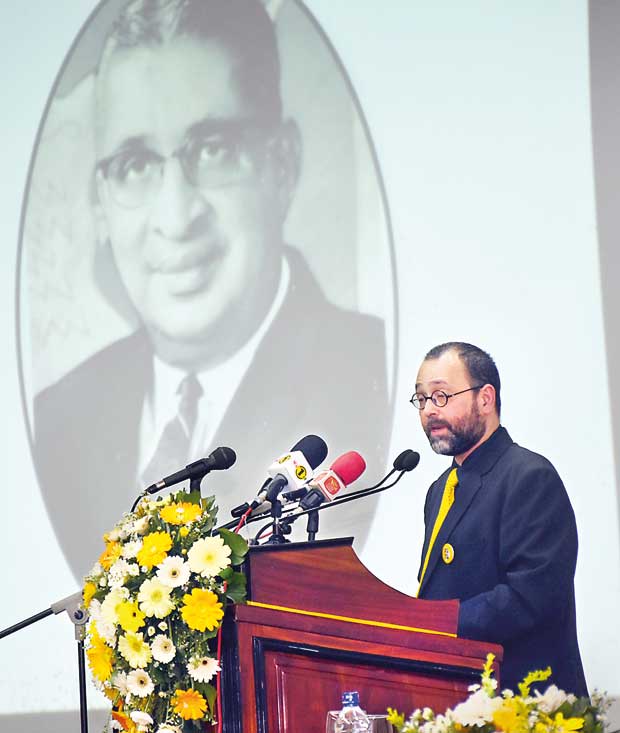 Chito Gascon
I am deeply honoured and humbled to be able to follow in the footsteps of those many others before me who have been given the distinctive privilege to keynote this Memorial Lecture bearing Dudley Senanayake’s name - among them, and I would be brief in this instance, the former Speaker of the Northern Ireland Parliament and President of Liberal International Lord Alderdice, and the late Chairman of both the Friedrich Naumann Foundation and the Free Democratic Party, Otto Graf Lambsdorff, who served long and well as Germany’s Federal Economics Minister. I pray that I may be worthy of this singular opportunity to speak before this gathering of distinguished people today.
This particular Senanayake Memorial Lecture is more significant and one that we all celebrate with profound enthusiasm and jubilation because it marks the formal reopening of the Friedrich Naumann Foundation (FNF) Offices in Colombo. Many of you are far more knowledgeable about the travails and obstacles that have been unfairly directed at our dear FNF friends as they persevered to pursue worthwhile programmes in Sri Lanka to advance freedom. It is for us to belabour these stories at this time. Suffice to say that thankfully they are now all matters of the past which shall ultimately as with all things have their reckoning - what is far more important for all of us to highlight today is that the future of freedom in this country is promising, all the more encouraging because as the FNF has come to settle here again for so time.
My own journey of freedom in my own country, my public career if you will, has been linked and intertwined with the ideas and principles that the FNF has so steadfastly promoted across the world, particularly the liberal values of responsibility, democracy and human rights. Almost 20 years ago, I was privileged to be designated executive director of the National Institute for Policy Studies (NIPS), my country’s premier liberal-oriented think tank and a principal partner of FNF-Manila. I have also been actively involved with and continue to engage very closely with two regional organizations - the Council of Asian Liberals & Democrats (CALD) and the Working Group for an ASEAN Human Rights Mechanism. These two initiatives share two things in common: they are partners of the FNF Regional Office for East and South East Asia, and are based in my home town, Metro Manila.
In my current role as the Chairperson of the Commission on Human Rights, an independent non-partisan constitutional office with the sacrosanct mandate to promote, protect, and fulfil all the human rights and fundamental freedoms of all people in the Philippines - I have been prepared and equipped to perform my duty by both the experience of struggling for the realization of freedom as well as the understanding its full meaning and significance from other practitioners in learning sessions many of which were supported by the FNF.
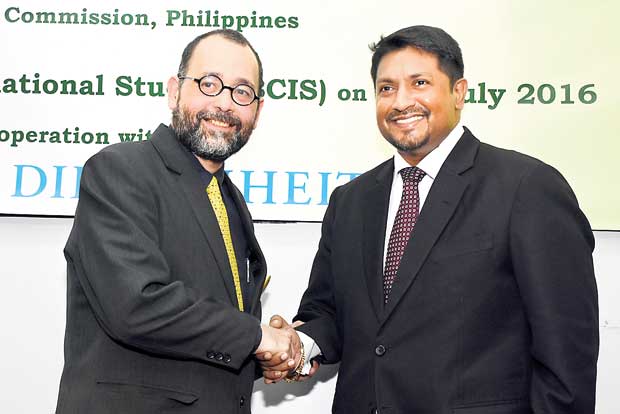 Chito Gascon with state minister of defence Ruwan Wijewardene
We continue to build upon these foundations in many ways such as, but not limited to, the ASEAN Intergovernmental Commission on Human Rights (AICHR), the first inter governmental human rights mechanism to emerge in Asia established with the adoption of the ASEAN Charter in 2009. Who would have imagined that both human rights language & institutions would have been included yet this was made possible by dogged and purposive advocacy across the sub-region human rights advocates encouraged in no small measure by the FNF. Even as we acknowledge that much work needs to be done, the success of this specific undertaking highlights what might be possible in other sub-regions of the Asian Continent and could augur well for a similar initiative within the South Asian Association for Regional Cooperation (SAARC) should human rights activists be able to come together perhaps as in South-east Asia with the partnership & encouragement from FNF among others.
Returning to my country, The Philippines, there is a strong liberal tradition in its political leadership whether from within the long-standing Liberal Party or even in other parties and even civil society. The immediate past president of our republic, Benigno Simeon “Noynoy” Aquino III, served a key role in advancing liberal-oriented programs in both the political & economic spheres. In the recently concluded elections, the Filipino people have decided by a significant plurality to discontinue Aquino’s liberal- inspired ‘straight path’ agenda to embrace a decidedly more populist approach to addressing the myriad number of problems facing contemporary Philippine society. Just last week at high noon of June 30, President Aquino presided over the peaceful transition of power to his successor President Rodrigo Roa Duterte who offers a new brand of ‘strong man’ leadership promising that ‘change is coming’. Still, even in his cabinet as well as in the new parliament there remain strong voices that will affirm and defend liberal values.
The importance of drawing lessons from these experiences for nation-building cannot be undervalued. This we have seen as well in the vision and life of Senanayake. Lord John Alderdice, when he spoke in this very forum eight years ago, described Senanayake as “an outstanding and genuine liberal.., not only a political and economic liberal, but also a man who inspired genuine public affection and support Sri Lanka would certainly have benefited from his broad genuine sympathies for all the people of this beautiful island had his vision of all sections living together in harmony been achieved, Sri Lanka would have been saved from the misery and heartaches it has experienced since then and experiences to this very day”
For my country, as we enter a new and as yet uncharted political phase, we are hoping that Senanayake’s spirit be embodied in Lord Alderdice’s words that all sections might still live together in harmony through the pursuit of freedom for everyone.
Reflecting upon Senanayake’s exemplary dedication to the common good, I am drawn to personal reverie upon the lives of three Great Filipinos in contemporary times who like him exhibited in their lifetimes a similar predisposition to justice, service, integrity, humility, public interest, and prudence. Please indulge me as I try to tell you parts of their stories.
Like Senanayake, they are all gone now. I encountered all three in different circumstances, yet each of them left an indelible mark in my heart, mind, and spirit. Their lives have made a profound impact upon countless Filipinos particularly from my generation as well as the very life of the nation itself. The stories of these three heroes of freedom recount how we value democracy and our desire for change through non-violence.
The first of them, was the freedom fighter against dictatorship, Senator Benigno ‘Ninoy’ Aquino - 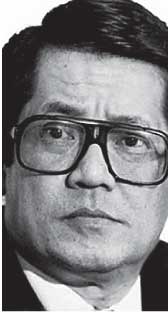 husband of President Cory Aquino and father of President Noynoy Aquino. I personally saw his terribly bruised dead body wearing a previously pristine white but now blood red bush jacket the day after he was brutally assassinated in broad daylight on August 21, 1983. I was a young 19-year-old, not yet fully aware of all the horrors and atrocities of martial law when I faced this stark reality that the dictatorship was prepared to kill anyone to maintain itself in power.
12 years earlier, on the very same day of infamy - August 21, the political rally of the opposition Liberal Party was bombed in Plaza Miranda the nation’s freedom park that killed and wounded many in the crowd. This event was used as one of the pretext to impose authoritarian rule and to round up all opponents including the very leaders that were victims of that attack over the next few years all dissent was muffled and the dictator imposed itself by use of brutal force.
Ninoy’s Assassination in 1983 - his sacrifice, ignited courage among all Filipinos to finally resist and lead the People Power uprising that restored freedom and democracy and catapulted his widow Corazon to power 3 years later in 1986. I was privileged to have been swept into this revolution and to have served in the early years of the transition.
As history would have it, Ninoy’s Legacy would include two Presidents from his immediate family to steer us through the transitions from dictatorship & misgovernance. Thus, the Filipinos elected his wife in 1986 and his son in 2010. A documentary film about this succinctly describes this phenomena, to wit:
“The national elections of 2010 was not just the usual democratic exercise prior to the changing of the guards Never since the People Power Revolt of 1986 and the snap elections that preceded it had there been such a state of euphoria in the Philippines, Alas history has determined that the two (Presidents) Aquinos both take over from unpopular rulers of questionable legitimacy who have ruthlessly manipulated and corrupted our institutions to suit their own political and economic interest Both Presidents Coryand Noynoy Aquino are children of destiny. Their candidacies were preceded by personal tragedies-the death of a loved one. Both were hesitant candidates whose victories were buoyed by the clamour of the people yearning for change. And both are known for their humility and simplicity—the very antithesis of arrogance and imprudence as embodied by the regimes that the two were tasked to replace.”
Earlier this year, on March 10, 2016, The Grand Old Man of Liberal Politics - Senate President Jovito 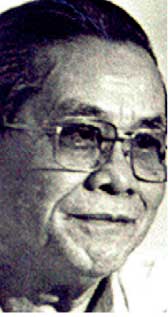 Salonga died. He would have turned 95 a fortnight ago. While He and I are three generations apart; we are brothers in struggle bound by common aspirations and causes Ka Jovy was a friend, mentor and father figure, and role model.
He was a consummate Statesman, Legal (Luminary) and Civil Society Leader. Like Ninoy, he too was a liberal leader. He assumed the leadership of the Liberal Party upon the untimely successive deaths of Gerry Roxas and Ninoy Aquino in 1983. Unlike Ninoy, who had been unscathed by the bombing at Plaza Miranda that I mentioned earlier, Jovy Salonga was one of the leaders worst hit by a grenade at that event. It had become a miracle that he had even survived. Throughout his life, he carried the scars, bent bones, shrapnel fragments in his body, and chronic pain that came with them. Yet, despite these injuries, he had an indubitable spirit - one that was unshaken and unbowed. Thus, he fought the dictator with all the energy he could muster and defended victims in court. When other leaders fell, he offered steadfast leadership in the darkest of days. In the transition to democracy, he headed Congress Upper Chamber’ of congress and steered the country in the right direction. He also knew when it was time to pass the baton the next generation.
The third hero from my country that I wish to tell you a short story about is a much younger man than 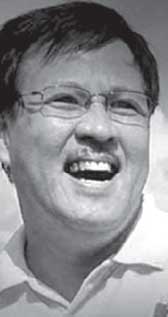 the first two mentioned. Actually he comes from my generation of activists that were inspired by Ninoy, Jovy, & other fight the dictator in our youth. His name is Jesse Robredo. He and I, together with so many others, rallied to the calls for justice, freedom, democracy, & human rights. Yet, when we had won he took a unique & special path in the democratic transition. He abandoned the security of a corporate career to immerse himself in local development and participatory governance by becoming Mayor of his small city far away from the capital. He became an exemplary leader introducing approaches and innovations never before seen in any municipality and produced fantastic results. He would win every local election with larger and larger margins. His strategies were replicated and promoted. He became the youngest recipient of the Magsaysay Awards in public service for “his giving credence to the promise democracy by demonstrating that effective city management is compatible with yielding power to the people. The Magsaysay Foundation narrated the following:
“Naga in 1989 was a dispirited provincial town of 120,000 (besieged) by traffic... vice syndicates... thousands of squatters... (and) dearth of jobs in the the city’s stagnant economy. Indeed, Naga’s revenues were low that it had been downgraded officially from a first-class to a third-class city. Robredo began with a strike again patronage. He introduced a merit-based system of hiring and promotion and reorganized city employees on the basis of aptitude and competence. He then moved again local vice lords ridding Naga of gambling and smut. Next he relocated the bus and jeepney terminals outside the city center, ending gridlock and spurring new enterprises at the city’s edge. In partnership with business he revitalized Naga’s economy. Public revenues rose and by 1990 Naga was a first-class city again. Robredo’s constituents took heart and re-elected him. Spurning bodyguards, Robredo moved freely among the people. By enlisting the support and active assistance of Naga’s NGOs and citizens he improved public services dramatically. He established day-care centres in each of Naga’s twenty- seven districts and added five new high schools. He built a public hospital for low-income citizens. He set up a dependable 24-hour emergency service. He constructed a network of farm-to market roads and provided clean and reliable water system in Naga’s rural communities. He launched programmes for youth, farmers, labourers, women, the elderly, and the handicapped -- drawing thousands into civic action in the process. No civic deed was too small, he told the people. He sometimes swept the streets himself.”
He was asked to join the Cabinet of Noynoy Aquino, to head the Department of Local Government in order to mainstream this innovative approach across all Provinces, Cities, years Municipalities so that the exception might become the norm. Unfortunately, he died two years into his term in 2012, as his small aircraft crashed into the sea in between two localities he was shuttling to and from. In life and even after his death, Jesse is the face of good governance, and his legacy is proof how transparency and public accountability tempered with people empowerment and grassroots participation can bring about meaningful transformations and considerable improvements in the lives of citizens.
The people have embraced and acknowledged this inspiring brand of leadership that Jesse has so passionately exemplified by electing his widow Leni Robredo to the second highest office of the land, the Vice-Presidency in a hotly contested match with the son of the dictator — Bongbong Marcos. Thus, pundits have quipped, the father and son (Marcos Senior and Junior) both lost the presidency and vice presidency, respectively, to widows who wore (yellow).
I tell you these stories from far away of real people like Dudley Senanayake, who because of their values, their character, and their action are able to make a difference and inspire others to dedicate themselves to a higher calling — the transformation of society for good. It is this spirit of heroism, the seed of which I believe is securely planted in the hearts of people of goodwill, that when nurtured and developed can overcome the apathy, cynicism, negativity, and violence that threatens to overwhelm us. We Must Not Let This Happen.
As I close, I wish to speak to you about the significance of Human Rights in preserving and promoting this heroic spirit. I can only speak from the experience in my country but I hope the lessons I have to share might find resonance among you as our two countries have so much in common and we struggle to find solutions to many similar problems. Our countries are both island nations in close proximity to several powerful states in two of the most highly charged geo-politically sensitive regions in Asia. We constantly struggle with many challenges bf social and economic development amidst significant constraints in the political system. There is a long-standing history of internal armed-conflict and despite the prospect of ending the same we are reeling from that experience and suffer for it in so many ways. And necessarily, accompanying possible humanitarian crisis are increasing incidences of human rights violations as well.
As a national human rights institution, established within the ambit of what are referred to as the Paris Principle, the Commission on Human Rights is committed to ensure the primacy of all human rights, their protection, promotion and fulfilment, on the basis of equality and non-discrimination, and in particular for those who are marginalized and vulnerable. Its goal is to be a prime mover in strengthening respect, understanding and practice of human rights as the essential cornerstone of peace, unity and nation-building.
Chito Gascon
30 Jun 2026 2 hours ago
29 Jun 2026 7 hours ago
29 Jun 2026 8 hours ago
29 Jun 2026 29 Jun 2026
29 Jun 2026 29 Jun 2026