03 Oct 2016 - {{hitsCtrl.values.hits}}
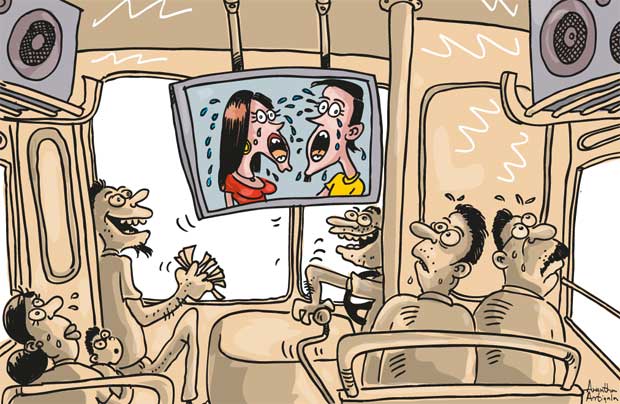
 aving to make a quick journey to Kurunegala, I decided to take the bus. This is usually my last option after road transport and train. But I thought I’d sit back and read a book on this occasion as time for reading has become critically short. I opted for the Red painted variety, this sentimental choice influenced by memories of red double-deckers from my school days.
I should have known better. As soon as the bus left its Pettah terminal, the young driver switched on a flat screen DVD which played contemporary Sinhala pop with accompanying visuals till I reached my destination. The non-stop show was only interrupted when itinerant beggars got on board and asked the driver to lower the volume so they could sing and scream out their laments. For once, I was grateful to the beggars.
Actually, these are visuals accompanied by songs. Sometimes, I get accused of living in the past. If so, that’s with a very good reason. The songs are so monotonous that after some time you feel you are listening to the same song over and over again. The visuals display an appalling lack of imagination – with lovers in tears or moping outside closed doors, or in exotic locations whose beauty is spoilt by people with distorted expressions contemplating suicide.
They routinely show domestic violence as the jilted lover imagines his ex-girlfriend being abused by her new heart throb. In the olden days, it’s women who burst into tears. Now, it’s a never-ending parade of young men. I suppose this will pass for gender equality in Sri Lanka. There were a few exceptions, and they were all worse than the norm except one set inside a garment factory, which was interesting.
The plaster foot goes to one which shows a girl kidnapped by a gang tied to a chair with ropes. The gang leader comes in from time to time to threaten her. In between, one of his pals steals in to give her water and feed her Vade. You can get the end. He helps her to escape. They become lovers but the gang catches up with them on a beach and the reformed gangster is murdered.
Whoever made these visuals should watch some African pop videos on You Tube. Devoid of high tech computer graphics, singers and their video makers from Kenya, South Africa, Uganda and elsewhere turn out simple, charming and effective videos where people sing, walk, talk, chant and dance. These are love songs but it’s hard to see anyone crying. Why are Sri Lankans crying all the  time? The visuals I saw on the bus would made Africans laugh.
Over the years, I have developed very good tolerance levels. Suffering fools is not an easy thing to do, but suffering visuals made by fools is possible if you keep contemplating your kids as the bus lurches along. The driver was young and I promised to find him better MP3 entertainment. Unfortunately, I have misplaced his hastily scribbled phone number so I may not be able to keep my promise.
It turned out to be a day of mistakes. Returning, I boarded a private bus as no SLTB buses were in sight. I had no idea this was taking another, longer route to Colombo via Minuwangoda. It took four hours to reach Colombo, waiting at Divulapitiya junction twenty minutes to pick up passengers. But the music was better (there were no visuals). These were mostly eighties and nineties songs by singers like T. M. Jayaratne and Sunil Edirisinghe.
They are better not because they are old; they are much better crafted. The music is much more melodious, the lyrics often marvels of transforming commonplace experiences into poetry, and with the greatest economy possible. The murder of lyricist Premakeerthi de Alwis is one of greatest blows delivered to this country’s culture by its murderous and despicable politics.
You need to be thankful for life’s little mercies. Four hours of terrible music on a lawless bus will make you feel like knifing the driver in the back. On the other hand, one may ask if anyone needs four hours of good music, either, on a bus journey. Isn’t there enough noise already? An existentialist thinker would say that this is free will taken to extremes, where all laws cease to operate. Still, I’m glad I got off the bus at Armour Street without killing the driver.
I was in a rush to see a concert in Colombo – The American Song Book, a pre-Bebop jazz rendering by a group of Sri Lankan-Americans. Luckily, it was due to start at eight pm. So I got there on time. They played like Americans, with panache, and I remember vaguely feeling a culture clash between my bus rides that morning and what I was getting now. Does everything depend on the price you pay? I paid Rs. 120 for a bus ticket (this was 121 on the return journey by private bus. Call it a free market absurdity if you will). The concert ticket cost Rs. 2000 (A complimentary, by the way, so a big ‘thanks to you’).
People pay Rs. 5000 at concerts to listen to what I got for Rs. 120 that morning. That’s what choice is all about. If culture is habitat, environment, learning, reasoning powers and conditioning, what the buses give us for the price of a bus ticket is what is right for the price of that ticket.
That there is a huge difference between what I listened to that morning and in the afternoon is an accident of history. The private bus driver is conditioned to make passengers suffer so that he and his employer can make more money.
But, in this instance at least, he has better taste in music (at least by my reckoning), and may think that four hours of his taste in music will alleviate the pain his passengers feel during an excruciatingly slow bus journey.
But the passengers are already numb. They have been anaesthetised by the conditioning imposed by this culture on them.
As such, they will endure all noise (extra loud horns, snarling engines, violent braking, barking conductors and stereo music, much of it quite terrible) for hours because they are all on bumpy operating tables, hearing the cacophony from a great distance as they come out of surgery.
This bus culture is now the bedrock on which every other culture is based – democracy, politics, the arts, films, books et al. That’s why, while governments come and go, while highways are built and megacities are planned, our buses remain the same. And when someone says our dirty, rattling and dangerous trains are preferable to the buses, you can understand the plight of our public transport users very well.
This maxim seems to apply very well to the annual international book fair, a books and noodles affair and now a staple of our cultural life as much as the Kandy Perahera.
It’s supposed to drive home the importance of literature, and above all of that of Sinhala literature. Everything else is mere jazz. But what is the level of culture thrust upon us by this mega show held by our publishers and book shop owners? Two women were cracking silly jokes on the stage facing entry to the main hall as I walked in. In between, artistes like Jayalath Manoratne sang to add some dignity to the proceedings.
In another stage a five-minute walk away, a pop group was captivating the crowd. In other words, the annual book fair is at the level of pop culture, the visuals no better than what I saw on that bus the other day. The country has several national orchestras, a symphony orchestra in Colombo, and talented classical musicians starved of an audience. Why aren’t they invited?
There were people everywhere. The restaurants were brimming. The problem is that there is no other sitting space available once you get tired, and you can’t go and hang around inside an eatery, as people can do at the book stalls. There’s no space for anyone to sit and read a book.
It’s very similar to our bus culture. People complain that no one reads anything in the buses, like they used to. It’s because the buses don’t create such an environment any more. People read papers or books in rickety old buses forty or fifty years ago because there was a conducive culture. Now, even if you offer seats for reading at next year’s book fair, the idea may not catch on because the very idea sounds alien.
The literary prizes focus on the novel, which is easier to sell than poetry, short stories and non-fiction. Poetry and book readings and literary discussions are conspicuous by their absence. A handful of celebrity Sinhala novelists (some of them are publishers in their own right) dominate the event. Even the Poetry Wall, a staple of the past years, had disappeared. Sri Lankan literature in English is totally neglected as publishers seem to be unanimous that it isn’t ‘marketable.’ If the organizsers can’t rise above pop culture, the book fair is a flop despite its lofty aims. I left feeling that the event reflected the same crude commercialism that defines our bus system. The only difference between them is that one doesn’t pretend to have lofty goals.
29 Jun 2026 27 minute ago
29 Jun 2026 2 hours ago
29 Jun 2026 2 hours ago
28 Jun 2026 9 hours ago