31 Jul 2025 - {{hitsCtrl.values.hits}}
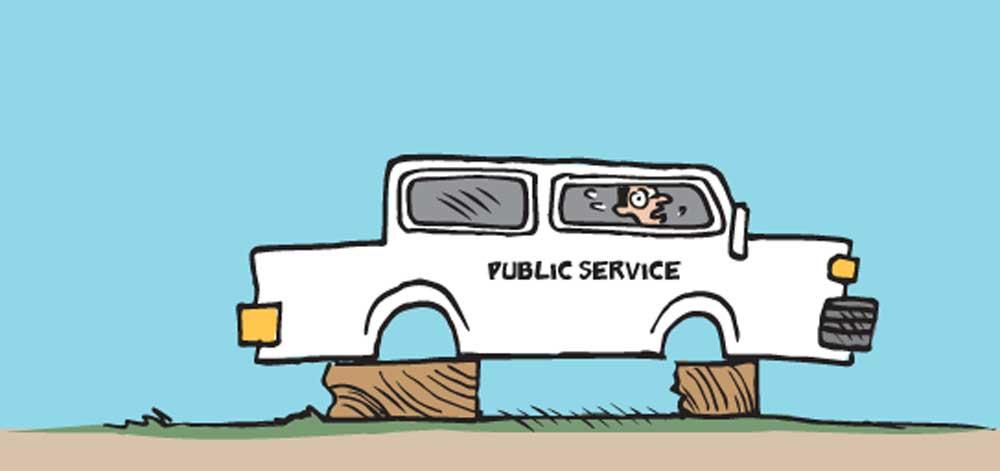
But what is quite shocking is that some of these behaviours and attitudes haven’t changed even after so-called corrupt regimes have been overthrown
Much has been spoken about Sri Lanka’s administrative service and its culture of lethargy and inefficiency. While certain citizens have had the privilege of getting the required services within a span of a few hours or in one day, most citizens have experiences of walking in to government offices on multiple rounds to obtain a simple document.
This is quite ironic given the fact that the Sri Lanka Administrative Service (SLAS) is built on a motto of ‘Service First!’ and a commitment to serve the nation. Its beginnings date back to 1802 when the British established the Ceylon Civil Service primarily for revenue collection and maintaining law and order. But what began as an establishment to maintain law and order, later became heavily politicised and a haven for bribery and corruption. Perhaps a handful of government servants may remain true to their service and retire as individuals who have carried out an exemplary service.
It is quite normal for people to relate unpleasant experiences when they walk into a government office. It has been the norm to keep people idling for some time until designated staffers return to their seats after a tea break or from a quick snooze. They usually have a habit of discouraging citizens who come to get their tasks done with tight deadlines. It is normal for citizens to keep waiting for long hours to get a signature from a designated officer. Some citizens complain of having to return on multiple days just to get an appointment!
But what is quite shocking is that some of these behaviours and attitudes haven’t changed even after so-called corrupt regimes have been overthrown. One of the most recent examples is one where a citizen travelled some 180 km from Colombo to somewhere off Matara to get a document from the Grama Sevaka and subsequently have it ranslated for an official purpose. When the individual went to the respective Divisional Secretariat around 11.00am, the lady in charge of translations had refused to do it within a span of a few hours as she had been getting late to go for a funeral! Her response had been to leave the document with her and that it would take 2-3 days to complete the task.
Is this the change that people have been demanding for? Is this the so-called ‘strengthening of the public service’ that many governments failed to achieve? On the other hand, while the world is now experimenting new methods of getting everything done with the help of AI, Sri Lanka’s government service continues to depend on manual work. They are inefficient when handling computers and getting simple tasks such as a translation done. Why is it so difficult for a Grama Niladhari official to fill the relevant details of an individual on an original form in PDF format and email it to the respective individual? Is this merely due to lack of training, funding or due to lack of interest?
Amongst several studies that have been carried out to analyse public sentiments with regards to the efficiency of the public service, a micro-level assessment carried out by the Centre for Policy Alternatives (CEPA) indicates that the Sri Lankan public perceives the public service as largely inefficient. They feel that it fails to effectively reach those in need, treats different social groups unequally, and inadequately addresses legitimate grievances of citizens. According to the study, the public holds the view that public institutions are not managed efficiently, and that public resources are not utilised satisfactorily for the collective public good, often resulting in wastage.
If any government is willing to do justice to the concept of ‘system change’ then this should be a priority. They need to understand that the government service or rather the administrative service reflects the efficiency of governance mechanisms carried out by the state. While we are already too late in streamlining these services and providing an efficient public service, public servants need to be reminded once again that breakfast, tea and lunch breaks, time for small talk, getting ready for funerals and intermittent naps come second and that SERVICE always comes FIRST!
‘Your Thought’ is a space, a right of the readers to support or contradict and discuss the issues highlighted in the editorial and other articles in the editorial and op-ed pages. Designed as the reader’s editorial; our readers can send in their writings, with a word count not exceeding 200, to ‘Your Thought’, Daily Mirror Political Features Desk, No 8, Hunupitiya Cross Road, Colombo 2 or email to [email protected]
13 Jun 2026 6 hours ago
13 Jun 2026 6 hours ago
13 Jun 2026 8 hours ago
13 Jun 2026 8 hours ago
13 Jun 2026 9 hours ago