29 Jul 2025 - {{hitsCtrl.values.hits}}
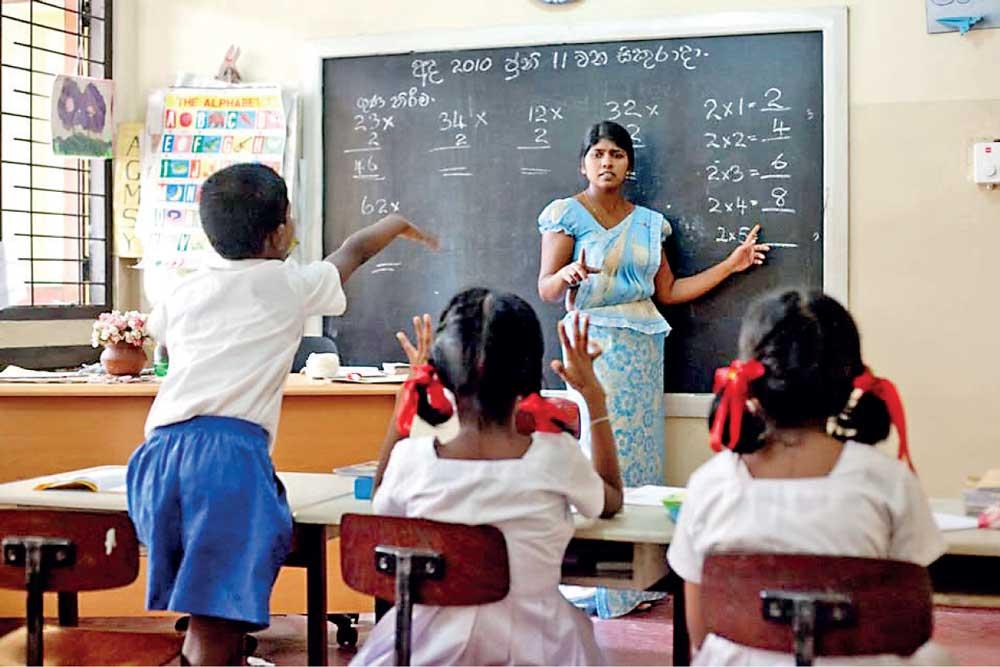
While the PM’s Reforms emphasise that teachers must be trained beyond just being graduates, reforms shouldn’t ignore the harsh reality of low pay, especially in rural schools where teachers earn only Rs. 10,000 or even Rs. 6,000.
FILE PHOTO
 Dr. Harini Amarasuriya, the Prime Minister holding the Education Portfolio, has made a bold foray into education reforms. We all know how grave and intractable the problems are, crying for urgent resolution. Right-thinking Sri Lankans wish her success.
She is more qualified than most Sri Lankans to tackle the problem. She has a doctorate, university teaching experience and, besides Sri Lankan and Indian studying experience, significant multi-continental European, American and Australian exposure.
As I demonstrate, our educational problems are a fallout of our corrupt society. We suddenly have a relatively clean government. The PM in such a government is well-positioned to succeed.
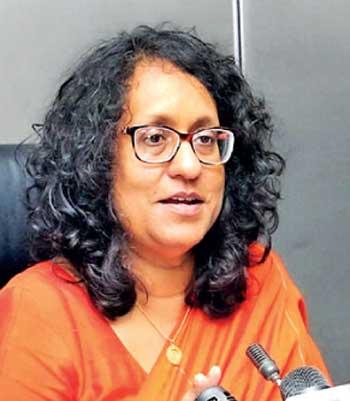 |
| From academia to Parliament, PM Amarasuriya carries education’s burden forward |
Qualifications of the PM to Lead Education
The PM’s qualifications as Minister of Education are unquestionable, even though some argue that better people were overlooked because she is a woman.
I argue that being a woman is part of her credentials to bring new insights. Except perhaps G.L. Pieris, I do not see any of our past education ministers being more academically qualified. In fact, many were charlatans. A Minister of Education minimally must have a first degree to judge the inputs necessary in education, and more if the portfolio involves higher education.
I have gone through the wiki pages of our Education Ministers, and the following seem not to have been degreed. Many have been so illiterate without a degree that they gamed the term alma mater (a nourishing mother in Latin). It is singular, and one cannot have more than one alma mater, as many of our ministers claim. Assuming our ministers with degrees would have them listed, those without degrees are:
Dullas Alahapperuma, M.D. Banda (DRO, CCS – a little far-fetched for a DRO to become CCS), Bandula Gunawardana, Wijeyananda Dahanayake (without a degree but controlling our universty as minister he got an honourary doctorate which he listed on his letterhead with honouris causa in parentheses but according to Prof. S. Mahalingam, the honouris causa was soon dropped as predicted by him and fellow dons), I.M.R.A. Iriyagolla, P.B.G. Kalugalla (Lawyer), C.W.W. Kannangara (Lawyer from Law College which cannot issue degrees), Karunasena Kodituwakku (listed as Lecturer but one does not need a degree to give lectures), E. A. Nugawela (Advocate, Army), Susil Premajayantha, Suranimala Rajapaksha and Chandrika Kumaratunga (who is listed as receiving her Education at Institut d’Études Politiques d’Aix-en-Provence and Institut d’Études Politiques de Paris presumably because she attended classes without graduating).
The PM is head and shoulders above these past ministers.
Father of Free Education
The claim that Kannangara is the father of free education is false (Prabhath de Silva, “Unsung And Forgotten Heroes of Free Education and Sri Lanka’s Missed Opportunities,” Island, July 11, 2020). From the beginning of British colonial rule, education in the Sinhalese-medium and Tamil-medium was free from kindergarten to the Senior School Certificate. But only English-medium schools constituting about 10-15% of schools charged fees.
It was A. Ratnayake of the State Council who favoured free education from kindergarten to university and moved the State Council that a Special Committee on Education be appointed to look into giving it. His motion passed. A Special Committee was accordingly appointed with Kannangara as Chairman.
Their report, however, recommended free higher education only to children passing the grade five scholarship examination. Ratnayake intervened and successfully moved that free education be given to all children.
Professor Carlo Fonseka has suggested that while Kannangara might be the “midwife who delivered the child,” A. Ratnayake was the “Father of free education”.
The Reforms
Dr. Amarasuriya’s goal is to deliver quality education in classrooms often with 50-60 students, limiting them to 25-30. Previous governments have sought to do this but failed.
Dr. Amarasuriya emphasised that the reforms would go beyond curriculum revision, and aim to restructure administrative systems and improve infrastructure to ensure equal access to quality education for all children, enhancing teachers’ professionalism, modernising curricula, and integrating vocational pathways into the mainstream.
To make education even more broad-based, incorporated were special needs and environmental issues and regional cooperation for a solar-powered future.
Opposition
However, there is heavy opposition (Island, July 21, 2025, “Education Reforms: Govt. forges ahead amidst widespread protests”). Teachers’ trade unions have sharply criticised the government for implementing reforms without adequate consultation, warning of countrywide protests unless all stakeholders are included in the process.
However, it is untrue that there have been no consultations. The announcement itself was made at a consultative session in the presence of a large number of officials, the press and public.
As a Sri Lankan cultural habit, Amarasuriya is under criticism, especially so, unfairly against women. A senior and respected writer has written an uncharacteristic article titled “PM Harini From Academia To The Hustings – A Disappointment!” (July 11, 2025). He says
“This is the first time that Sri Lanka had a woman as its Education Minister [No, Chandrika was]. It is absolutely depressing to write these unkind words about her performance to date. [I am] as disillusioned with her as must be the hundreds of thousands of women who reposed infinite faith in her”.
That claim has no basis in any study. There was even news of attempts to replace her, but subsequently denied by the government which I do not believe.
Biting off More than What One Can Chew
I am fully supportive of the aspects of the PM’s reforms listed above. But I caution her that some of her other reforms are good in principle at best but difficult, if not impossible. She should back off lest protests and failures act like one bad apple spoiling the barrel. I refer particularly to two.
Review of Private Education
Damintha Gunasekera (Daily Mirror, July 22, 2025) has written a thoughtful article defending private education.
I say that to ban private education is to return to the stubborn Marxist adage “Work according to ability. Pay according to need”.
It is not practical. Allowing private tuition is what permitted the Vavuniya Rambaikulam Girls’ School to have the stellar record of 23 Tamil-medium and 11 English-medium 9A GCE O. Level passes in the 2024 results, 89.3% qualifying for A/L. They outperformed by far St. John’s College Jaffna’s 18 9As and 84.4%.
It would be terrible to stop tuition and with that the social upward-mobility of previously backward communities like Vavuniya’s.
I let my children off private tuition except for Tamil as they were suddenly transplanted from the US into the Tamil-medium. Like me, they grew up on Tin-Tin, comics and Enid Blyton and were happy. While that is what I want for all children, I cannot deny upward mobility to poor children.
Indeed, Nanthaharan Mathura is a student from Jaffna Madduvil North Chandramouleesa Vidyalayam who scored 9As without private tuition. Such exceptional rural examples do not make the case for banning private tuition. If banned, the rich will get tutors to come home and give one-on-one tuition, making the situation worse for the poor.
When wealth is unequal, as it is and has to be for its creation, parents will work hard to advance their children. We will go by “Pay according to work” else no one will study, no one will work.
Moreover, the PM’s presumption is that state education is great. That wrongly presumes postgraduate education in state universities is private. Fees are collected, and these are paid to lecturers above their regular income. If the PM shows me 5 arbitrarily picked successful professorial applications, I will show that 4 of them (if not all) contain egregious cheat claims. These professorships are then the basis of huge and exploitative salaries from the state.
Master’s degree courses admit working persons for weekend classes. Imagine the quality with the usual 5 days of classes rolled into a weekend! Most pass because the system cannot afford to have too many persons failing, lest there are no enrollees next year. The fees collected go to the lecturers. Every successful M.Sc. thesis also goes for a cheat’s promotion towards the supervisor’s professorship. It is guaranteed that all will pass. Students see gaming as natural and carry on the tradition.
Similarly, many are recruited (some with unaccredited first degrees) for doctoral programs because the state university supervisor needs points for his professorship promotion.
The problem with private universities is that state lecturers teach their courses, neglecting their work at their home institution. That too is a terrible work ethic to bequeath to our students.
All Teachers to Be Graduates and Trained
Graduates with training as teachers are also a goal of the PM’s reforms. This is also the case in the West, even in the lower schools. It is so strictly imposed in the US that even PhD holders are refused a school teacher’s job because they are not trained as teachers.
The goal is a noble ideal, but it is feasible only in the long term. In many of our rural schools, poor girls (but rarely men) are asked to teach in private community-run schools. They are paid Rs. 10,000 (sometimes Rs. 6,000) per month, partly from government funds, and are asked to come well-dressed. Their saris cost more than their monthly salary. But there are many takers because that job helps them get married.
This goal should be put off or done slowly over several years as the cadre is built up and the funds are found for teacher-training colleges and salaries for degreed teachers, even in Grade 1. I wish Amarasuriya every success by cleaning up universities and ministry appointments first, stopping trickle-down state corruption.
13 Jun 2026 4 hours ago
13 Jun 2026 4 hours ago
13 Jun 2026 6 hours ago
13 Jun 2026 6 hours ago
13 Jun 2026 7 hours ago