28 Jul 2025 - {{hitsCtrl.values.hits}}
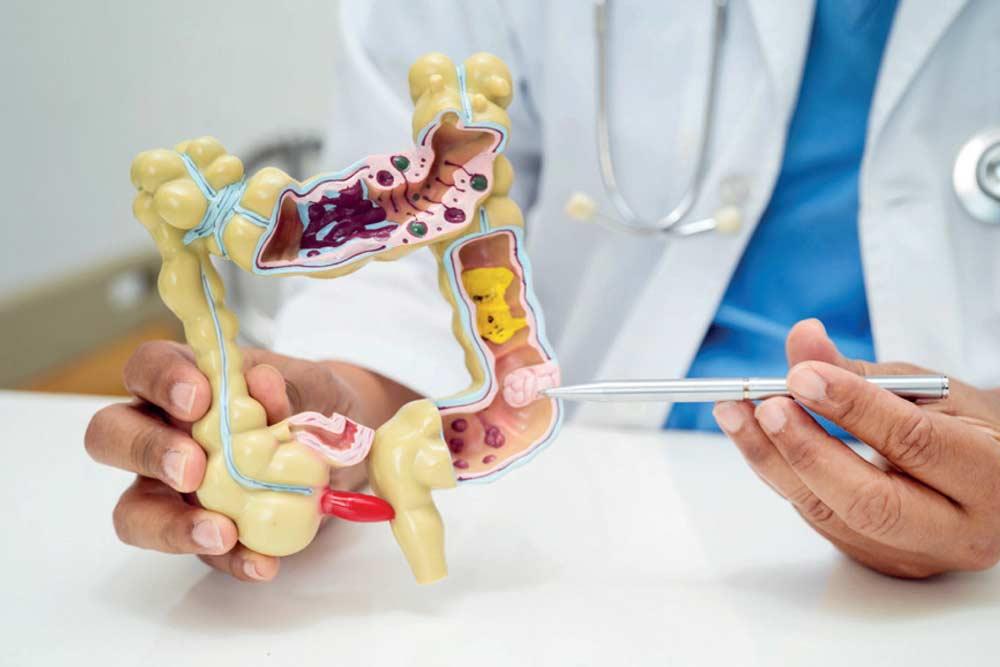
Colorectal cancer is a disease that begins with a noncancerous growth, called a polyp, which can become cancerous and spread across the body as time goes (Photo © curasia.com)
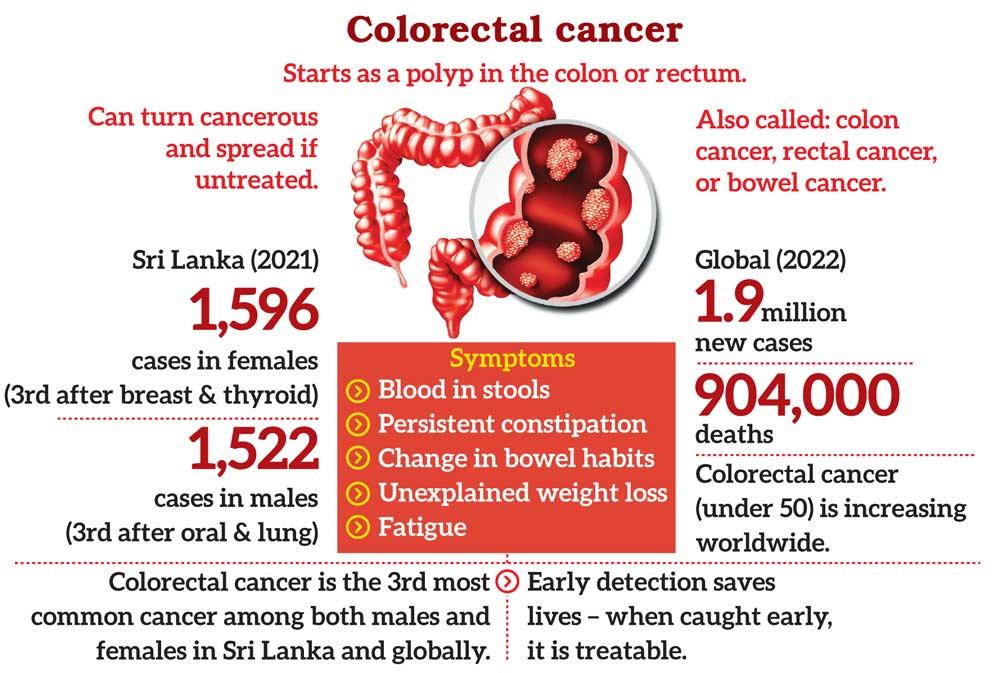
 Stools laced in blood is often dismissed as quite common and treated for hemorrhoids, anal fissures or ulcers; however, this can be an early symptom of colorectal cancer. While colorectal cancer is the third most common cancer among both males and females in Sri Lanka and globally, they are treatable provided the cancer is addressed at the early stages.
 What is Colorectal Cancer?
Colorectal cancer — also referred to as colon cancer, rectal cancer or bowel cancer — is a disease that begins with a noncancerous growth, called a polyp, in the inner lining of the colon or rectum. As time goes, these polyps can become cancerous and spread across the body.
Incidence in Sri Lanka
In Sri Lanka, colorectal cancers are the third common cancer among females after breast and thyroid cancer, and third among males after oral and lung cancers.
As per the National Cancer Registry 2021, “Cancer incidence and mortality data Sri Lanka 2021”, there were 1,596 reported cases of colorectal cancers diagnosed in females and 1,522 in males in the year 2021. Data shows that there are a considerable number of cases around 35 years and above.
Globally, according to “Global Cancer Statistics 2022” by Global Cancer Observatory, colorectal cancers are the second leading cause of cancer deaths, responsible for more than 1.9 million new cases and almost 904,000 deaths in 2022 across the world.
According to Dr. Hasarali Fernando, Consultant Community Physician at the National Cancer Control Program of the Ministry of Health, colorectal cancers which had high incidence among people above 50 years are now becoming increasingly common among people younger than 50 years.
Several studies have shown that the incidence of early-onset colorectal cancer, which affects individuals below 50 years of age, has doubled in many countries over the past twenty years.
According to a 2021 study, early-onset colorectal cancer is anticipated to become the leading cause of cancer death in individuals aged 20 to 49 in the US by 2030.
What prevents early detection?
General physicians and the public, are quick to brush off symptoms, such as per-rectal bleeding and constipation as caused by hemorrhoids. This may largely contribute to detection of colorectal cancers at its third or fourth stage, explained Dr. Fernando. “When people come in at late stages there’s very little that can be done,” she said.
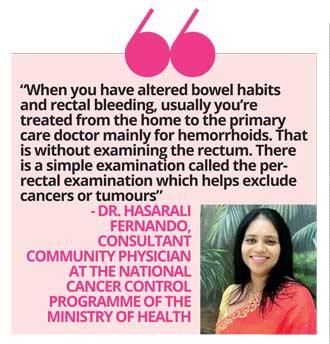
“When you have altered bowel habits and rectal bleeding, usually you’re treated from the home to the primary care doctor mainly for hemorrhoids. That is without examining the rectum. There is a simple examination called the per-rectal examination which helps exclude cancers or tumours. When a person visits a doctor with altered bowel habits and bleeding, the doctor has to perform a per-rectal examination and observe if there are any palpable lumps. After excluding colorectal cancer can the patient undergo treatment for hemorrhoids or ulcers,” Dr. Fernando emphasised.
In certain instances, the clinician will also decide whether the patient needs further investigations. This will be decided based on the medical history and examination.
Noting that most individuals opt for various home remedies for rectal bleeding, she stressed that it is not a condition that should be treated at home. “Visit a Gastroenterologist or at least a General Physician if you experience rectal bleeding or constipation for over two weeks. Ensure that a per-rectal examination is conducted by your doctor. It’s crucial that we take this seriously because colorectal cancers are on the rise in Sri Lanka and across the world,” she added.
Dr. Fernando also stated that programmes were organised to bring awareness to General Physicians to perform per-rectal examinations when patients complain of blood in stool or rectal bleeding.
For those who resort to home remedies or quick internet solutions for treating rectal bleeding due to fear or shame, Dr. Fernando had one important message: “Treating the disease late and losing your life is far worse than giving into fear or shame.”
Furthermore, those who have a family history of colorectal cancers should undergo a screening at least by the age of 45 - 50 years, whether or not symptoms present. “It is important that the family history is shared with the clinician who will decide how the screening should be done. Colonoscopy or sigmoidoscopy are the investigations that are typically used to detect early onset of colorectal cancer,” Dr. Fernando further stressed.
What causes colorectal cancer?
The answer is: multifactorial. It could vary from person to person and could be anything from environmental, age and genetic factors to diet and daily habits. However, the most common causes are thought to be related to lifestyle choices and dietary habits.
“We can’t state that just because a person eats processed meat, they will be diagnosed with colorectal cancer. But processed meat, red meat and low fibre diets are mainly linked to colorectal cancer. When there is high fibre in your diet you don’t experience constipation. Prolonged constipation could be a symptom of colorectal cancer,” Dr. Fernando noted.
It’s also particularly interesting to note that as per a study published in Aprilthis year titled: ‘Geographic and age variations in mutational processes in colorectal cancer’, there’s a strong link between childhood exposure to colibactin, a toxin produced by E. coli and other bacteria, and colorectal cancer in patients under the age of 40 years.
Increase high fibre intake
Dr. Fernando recommends an increase in a high fibre diet and water intake to keep colorectal cancer away. Vegetables including green leafy veggies, fruits like bananas and papaya, which most Sri Lankans can afford, and at least 2-2.5 litres of daily water intake could help prevent colorectal cancer.
08 Jun 2026 5 hours ago
08 Jun 2026 5 hours ago
08 Jun 2026 5 hours ago
08 Jun 2026 5 hours ago
08 Jun 2026 6 hours ago