25 Oct 2025 - {{hitsCtrl.values.hits}}
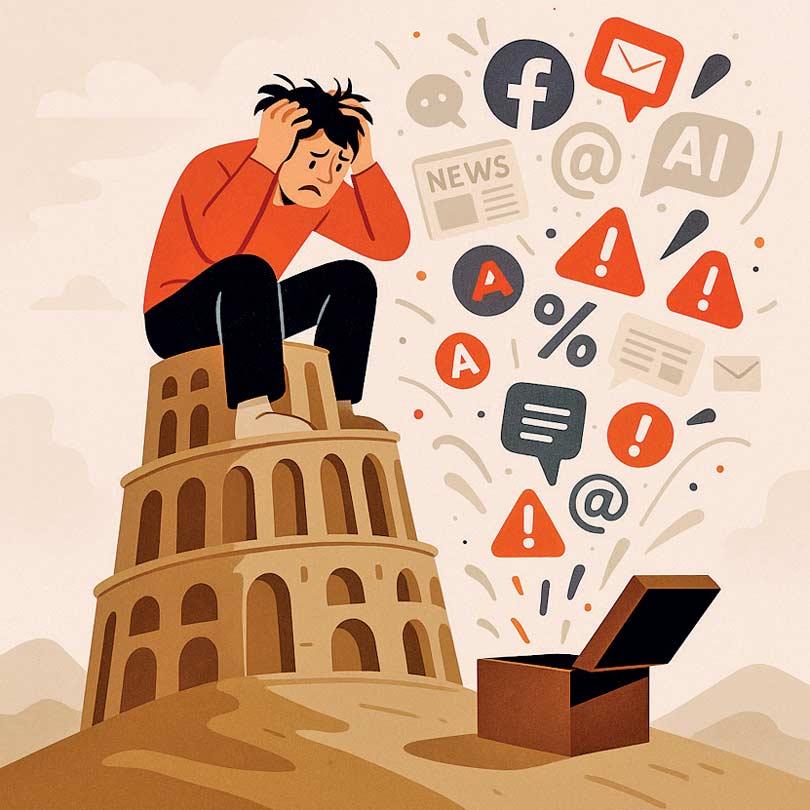
 Disinformation is rising in importance because social media platforms amplify it across the globe.
It is challenging for people to distinguish between disinformation and correct information. The line is blurred at times.
Journalists must cast aside personal views to present a broad overview for the benefit of readers.
The spread of false narratives is a serious assault on democracy and civic responsibility.
In Ljubljana, Slovenia, experts at #Disinfo2025 convened to tackle the escalating spread of misinformation and disinformation in an age dominated by social media and AI-driven narratives. From geopolitical rivalries in Europe to election campaigns in Sri Lanka, the summit highlighted how falsehoods manipulate public perception, distort democratic processes, and demand urgent solutions through media literacy, fact-checking, and responsible journalism.
In an ever changing landscape of globalization, social media platforms dominate the spread of information. People across the globe and from all walks of life are flooded with information, misinformation, and disinformation.
People grapple with too much information. The danger lies with disinformation and misinformation. The world is confronted with disinformation affecting mankind.
At times, it is a well-orchestrated dissemination of disinformation, triggered by geopolitical rivalries. In Europe, countries rev up their engines to brace for the new scenario, eventually resulting in the change of the traditional role of journalism from informing the public with proper information to countering disinformation and misinformation.
In the flood of false narratives on security, political, cultural, economic, or social fronts, what is lost by people can be what they really need for their social upliftment. Driven by disinformation, they may choose leaders whom they don’t know.
They may avoid eating what is healthy. False narratives tend to spread much faster than true narratives, making the job harder for those, particularly professional journalists, involved in countering them. The advancement of AI technology has made matters worse. AI-driven tools are used in the propagation of data for false narratives.
Against this backdrop, on 15–16 October 2025, the counter-disinformation community reunited at Cankarjev Dom in Ljubljana, Slovenia, to continue exchanging ideas, learning, and collaborating. Over the course of two days, #Disinfo2025 gathered leading specialists from varied backgrounds, tackling the most pressing issues in the disinformation landscape.
It was a great opportunity to connect and learn from leading voices and stakeholders throughout the community, through a programme of insightful panel discussions, inspiring interviews, keynotes, and workshops led by high-profile speakers, featuring four parallel tracks.
Internews, supported by the European Union, arranged a study tor of Europe for a group of Sri Lankan journalists in three different countries –Belgium, Slovenia, and Lithuania.
It was a unique opportunity for them to attend the summit in Slovenia during the tour.
In picking information, the human mind works differently. For example, as cited by an expert on cognitive science, the mind easily picks a red ball lying on an empty playground. Yet, the mind will not notice the same lying in a busy marketplace.
The mind is distracted by many things in such a place, and a red ball lying on the ground is hardly visible even then. This is exactly what happens when people receive too much information. Attention is distracted from what is needed. Players involved in the spread of disinformation can use such tactics to confuse public minds to achieve their ends.
It is challenging for people to distinguish between disinformation and correct information. The line is blurred at times.
European Union communication expert Agata Pyka, who was at the summit, shared her views with Daily Mirror in this regard.
Asserting that the line is sometimes blurred between information and disinformation, she said disinformation is an issue rising in importance because of the advent of social media platforms in the world.
People are inclined to believe in disinformation if it suits their belief systems. They have their echo chambers on social media platforms. An “echo chamber” is an environment where an individual’s beliefs, ideas, and opinions are reinforced through repetition and exposure to like-minded viewpoints, while dissenting views are not present or are silenced.
This often occurs on social media and news platforms, where algorithms personalize content based on a user’s history, creating a closed-off ecosystem that can lead to a distorted perspective and increased polarisation.
“The way to deal with this is obviously hard. The way to do it is to communicate with each other,” she said.
Here, she said, it is important for the media, NGOs, and civil society to make sure that people are not locked in such echo chambers.
Journalists are required to cast aside their personal views and present a broader overview of information for the benefit of their readers, she said. Fact-checking units and departments are now sprouting up all over to counter misinformation and disinformation.
The rise of geopolitical rivalries has become a major factor in the spread of false narratives. Europe is a classic example, gearing itself up to fight the trend. Europe believes its democracy is under threat because of external threats in the form of well-planned disinformation campaigns.
In Sri Lanka, the involvement of external elements in the creation and propagation of false narratives is not as grave as that in Europe.
But Sri Lanka is also a country making a tightrope walk in balancing its ties with major powers. The major powers – India, China, and the United States – have competing security interests in the region. As such, one cannot rule out that Sri Lanka will not be a victim of disinformation emanating from geopolitical interests.
It is not always geopolitics. During election times, Sri Lanka has witnessed how false narratives are created to outperform each other electorally. People often get misled.
In fact, politicians themselves are involved in the spread of disinformation to hoodwink the masses. What they say is not grounded in any theory or scientific basis. Back in office, they act in the opposite manner to what they said before.
Disinformation is a serious assault on democracy. The need of the hour is to increase media literacy among people who are always vulnerable to a flood of information, misinformation, disinformation, and too much information.
Debunking and pre-bunking should be done alongside. The enhancement of media literacy will help people sift the truth from a basket full of all kinds of information. It is a process that should begin with school children to make them responsible citizens one day.
07 Jun 2026 16 minute ago
07 Jun 2026 2 hours ago
07 Jun 2026 4 hours ago
07 Jun 2026 5 hours ago
07 Jun 2026 5 hours ago