11 Feb 2026 - {{hitsCtrl.values.hits}}
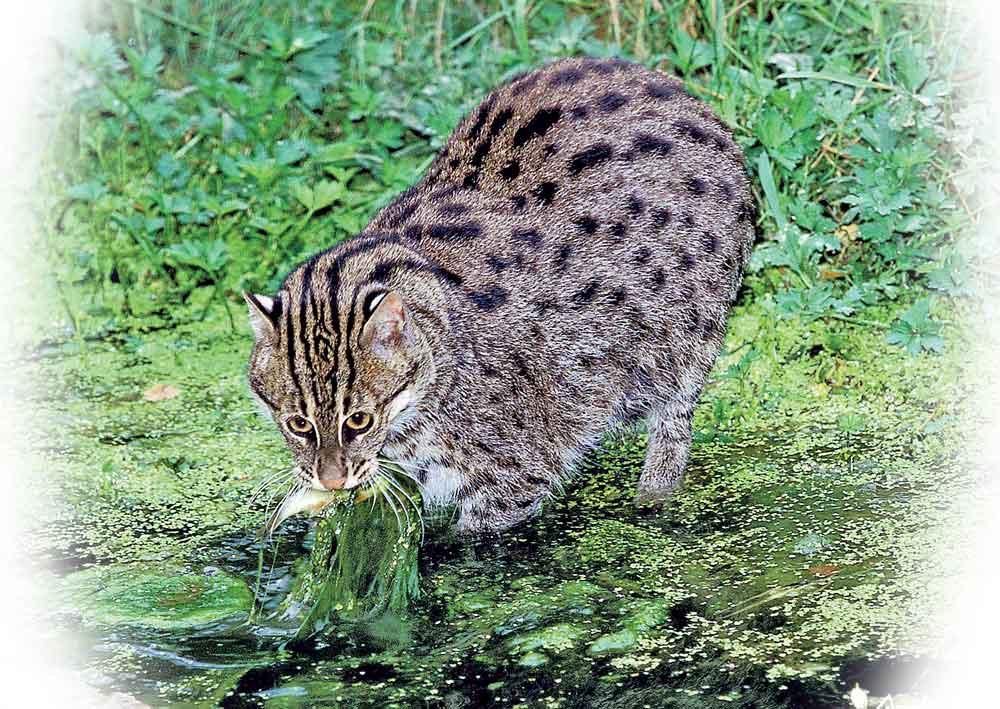
Fishing cats are closely tied to wetlands
By Anik Jayasekara
 |
|
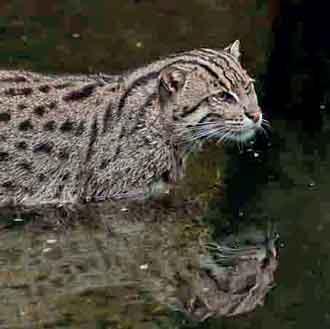
Fishing cat – soaked, alert, unimpressed |
At just past two in the morning, Colombo sounds different.
Traffic thins. Horns fall silent. Water gathers where it always has -- shallow drains, reed-lined edges, low ground between buildings where concrete never quite won the argument.
Somewhere near a canal, something moves -- Not a stray dog. not a monitor lizard, not a house cat anyone recognises.
A fishing cat, one of Sri Lanka’s most urban-adapted wild carnivores, emerges briefly from the water. Soaked, alert, unimpressed. Then it slips back into the reeds, continuing a pattern of movement residents and field teams sometimes glimpse, usually along edges of water and cover that have largely gone unnoticed as the city expanded around them.
Why This Situation Is Unusual
Wild carnivores rarely persist inside capital cities. When they do, they often retreat or disappear as roads harden, water is redirected and green space fragments.
The fishing cat has done something else.
Across South and Southeast Asia, the species is closely tied to wetlands. It is built for swimming, hunting fish and navigating dense water-logged vegetation. In Colombo, it has adapted to move through drainage canals, marsh remnants, storm-water retention areas and flooded lowlands embedded within everyday urban life.
Much of Colombo’s development has occurred atop landscapes that once functioned as fishing cat habitat, altering water flow while leaving narrow ecological corridors where natural systems still function.
Globally, the fishing cat is listed as Vulnerable on the IUCN Red List. In Sri Lanka, it often persists in landscapes dismissed as unused land. Because the species depends heavily on shallow water, cover and connectivity, it tends to remain the longest where wetland systems function and disappear early where those systems break down.
Across parts of the region, similar signals have surfaced. In mid-2025, camera traps monitoring flooded forest and wetland systems around Cambodia’s Tonlé Sap Lake recorded fishing cats in landscapes where the species had rarely been confirmed through recent monitoring. Scientists interpret such observations cautiously. Single detections can reflect recovery, shifts in habitat pressure or changes in detection effort. What they consistently reinforce is how closely fishing cats track functioning wetland systems, and how their presence declines when those systems fragment.
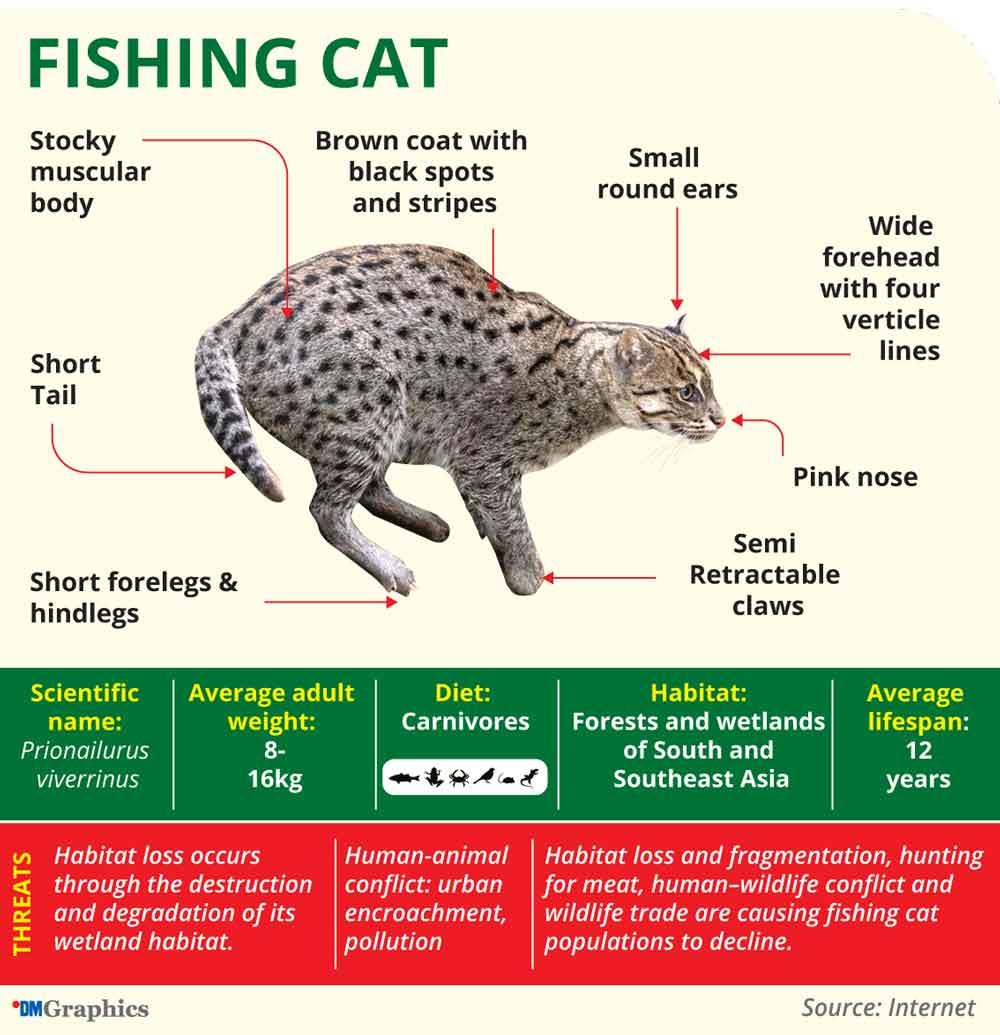
Sri Lanka presents its own version of this signal. Around Colombo and surrounding wetlands, long-term monitoring and recurring field observations have documented fishing cats persisting within fragmented urban landscapes, often using canals and marsh edges as movement corridors. Where wetland connections remain relatively intact, encounters tend to persist across years; where those connections narrow or disappear, sightings often decline.
Where Public Understanding Starts to Fray
Public conversations about wetlands often swing between two simplified views.
They are treated either as scenic green spaces best suited for parks and walkways, or as stagnant, inconvenient land awaiting development. Neither reflects how wetlands function.
Wetlands operate as infrastructure long before they become amenities. They absorb rainfall, delay flood peaks, recharge groundwater, support fish populations and regulate insects. When they are fragmented or incrementally filled, consequences often surface later, during drainage failures or sudden flooding.
The fishing cat is not the cause of these tensions. It is simply the most visible indicator that functional wetland systems still exist beneath the city’s surface.
Grounding This in Sri Lankan Reality
Field practitioners working around Colombo often note that fishing cat sightings occur unevenly. Encounters cluster near remaining wetland corridors and floodplains. Where those connections are severed, movement patterns change and animals appear in unexpected locations or disappear entirely.
This exposes a planning challenge that rarely enters public discussion. Ecological movement does not align neatly with administrative boundaries.
Recent extreme rainfall events, where water, land and infrastructure collided with real human consequences, have made it harder to treat wetland decisions as abstract or distant from daily life.
The Expert Tension Zone
Urban fishing cat sightings are often presented as evidence of successful adaptation. But adaptation and stress can coexist.
Are Colombo’s fishing cats part of a stable, connected breeding population, or are sightings masking habitat compression that forces animals into increasingly risky urban spaces?
When wildlife stories focus on individual animals rather than on systems, do they soften public understanding of structural risk?
When sightings are taken as evidence, are they signalling resilience or compression into smaller spaces, and how differently do ecology, hydrology and planning interpret that signal?
If wetlands are protected in principle but altered through incremental planning decisions in practice, where does accountability sit?
When flood resilience is discussed in technical terms, which decisions most influence outcomes – those made on planning documents or the small variations approved during construction?
These are not academic questions. They influence urban safety, wildlife policy and how future generations understand what was once here. These questions are raised not to assign fault, but to reflect the complexity practitioners encounter when ecological systems intersect with human planning.
Professionals across ecology, hydrology and planning often agree on goals but differ sharply on where risks emerge and when they become irreversible.
Why This Matters Beyond One Species
The fishing cat is not just a charismatic urban survivor. It reflects how Sri Lanka manages transition from natural systems to built environments while retaining the ecological functions that make cities resilient.
Colombo has received Ramsar Wetland City accreditation under the Ramsar Convention, recognising the presence of interconnected urban wetlands and their role in water management. Its marshes and canals are not decorative remnants. They form part of the city’s flood resilience and ecological continuity.
Similar tensions are emerging in rapidly expanding towns across the country. Decisions about drainage alignment, infilling thresholds and corridor continuity shape wildlife outcomes, public safety and how cities remember the landscapes they replace.
If wetlands matter to us only after they fail, through floods or infrastructure breakdowns, what does that suggest about how we value systems designed to work quietly?
This Story Is Still Being Written
What appears in public articles today often becomes the reference point for students, journalists and policymakers tomorrow.
Ensuring those reference points are accurate and responsibly framed depends on practitioners and researchers being willing to refine them early.
This article is part of a public-interest initiative, SriLankasEndangered.com, which works with scientists, educators, photographers and communities to improve public understanding of Sri Lanka’s ecosystems, one story at a time. The project publishes open, evolving features designed to invite expert input rather than close debate and operates independently of political parties and electoral agendas.
The Unity Icon
SriLankasEndangered.com uses a reflection symbol called the Unity Icon.
It begins with a triangle. The triangle represents a person. Each corner reflects something that shapes their contribution. Their knowledge. Their skills. Their experience. Sometimes even the personal reasons they care.
At the centre sits a small dot. It represents conscience. The quiet sense of responsibility that often guides decisions long before they are written into policy, research papers or public conversations.
In environmental work, these triangles often point in different directions. That diversity is valuable. It reflects how complex environmental challenges really are. But it can also mean effort becomes scattered across disciplines, institutions and communities that care deeply, but rarely intersect.
The Unity Icon does not suggest everyone must agree or work the same way. It reflects a quieter idea. When even one corner of each person’s work begins turning towards the same living systems, connections form naturally. Knowledge travels further. Solutions become more resilient. And responsibility feels shared rather than carried alone.
It is a reminder that environmental stability rarely depends on one voice. It grows when many forms of care begin pointing, even slightly, in the same direction.
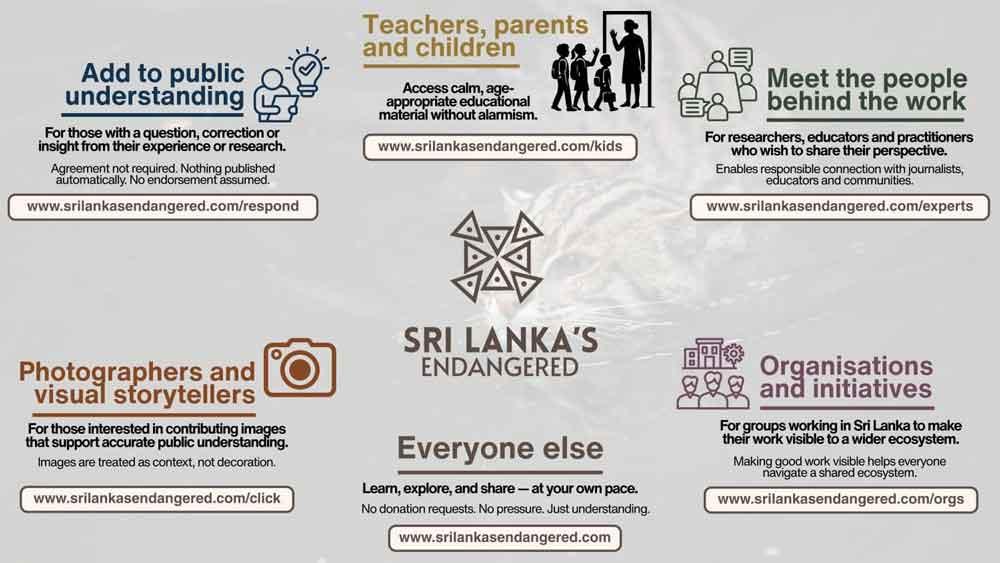
Add to public understanding
If this article raised a question, nuance, correction or perspective shaped by research, field work, planning or lived experience, you are welcome to respond here:www.srilankasendangered.com/respond
Contributions help refine how this issue is understood over time.
Meet the people behind the work
Researchers, practitioners, educators, planners and others working close to Sri Lanka’s environments who wish to share their journey, experience or perspective, and enable responsible connection with journalists, educators and communities are welcome here:www.srilankasendangered.com/experts
This space prioritises clarity and credibility.
Teachers, parents and children
For educators and families looking for fun, age-appropriate material that supports classroom discussion and home conversations, without alarmism or fear:www.srilankasendangered.com/kids
Designed for reading aloud, shared learning and curiosity-led discussion.
Photographers and visual storytellers
Photographers interested in contributing images that support accurate public understanding, with care for ecological context and timing, can explore ways to participate here:www.srilankasendangered.com/click
Images are treated as context, not decoration.
Organisations and initiatives
For organisations, researchers and initiatives working across Sri Lanka’s landscapes, waters and communities:www.srilankasendangered.com/orgs
A shared ecosystem is easier to navigate when good work is visible.
Everyone else
For readers who simply want to learn, explore and share at their own pace:www.srilankasendangered.com
No donation requests. No pressure. No doom. No guilt. Just understanding.
The fishing cat does not announce itself. It follows water that still remembers where it is meant to flow. Whether Colombo remembers too, or notices only when the water rises, remains an open question.
Anik Jayasekara is the current platform steward for www.SriLankasEndangered.com
07 Jun 2026 7 hours ago
07 Jun 2026 9 hours ago
07 Jun 2026 07 Jun 2026
07 Jun 2026 07 Jun 2026
07 Jun 2026 07 Jun 2026