19 Aug 2025 - {{hitsCtrl.values.hits}}
 Famine is defined as extreme and widespread hunger, often leading to death. Ancient Sri Lanka experienced at least one famine, recorded as ‘Baminithiyaseya’ in the Anuradhapura period, when monks ate tree bark and leaves, fearing the oral tradition of Buddhist scriptures would vanish if they perished.
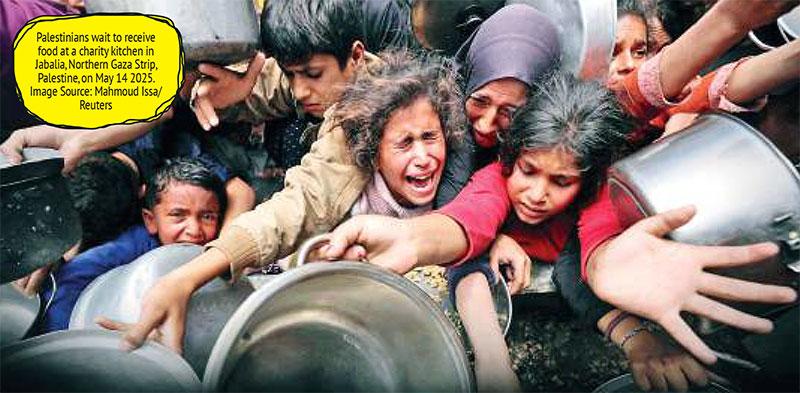
The 21st-century world, with its high-tech agriculture, should not experience famine. Incredibly, though, there are two famines now happening – in the Gaza Strip and in Sudan.
These are not famines caused by crop failures. Both fall into the category of man-made famines, in the horrific tradition of most of the 20th-century famines. Altogether, famines (man-made or otherwise) killed over 70 million people in the 20th century, more than both world wars put together. Late 19th-century and early 20th-century famines were so intense that they killed more than 100 people per 100,000 in the national population.
But, as we shall see, many famines were due to political decisions caused by intense nationalism, ethnic, religious or class hatred and extreme politics, and could have been avoided.
The greatest of 20th-century famines, which killed the largest number of people, occurred in China and the ex-USSR.
China’s great famine occurred after the communist victory over Chiang Kai-shek’s forces in 1949, when Mao Zedong declared his Great Leap Forward. But officials, eager to meet state quotas, began confiscating impoverished villagers’ harvests. Author Yang Jisheng (formerly of China’s state news agency) covered in harrowing detail the catastrophe (a taboo subject in China for many decades) in his book ‘Tombstone’ (2008).
As the author wrote cryptically, “I call this book Tombstone. It is a tombstone for my foster father who died of hunger in 1959, for the 36 million Chinese who also died of hunger, for the system that caused their death, for myself for writing this book”.
Even the death toll is not exactly known. It is estimated by various sources to be between thirty and forty-five million. The success story of today’s China is beyond the wildest imagination of those who suffered and perished due to shortsighted official policies between 1958 to 1961-62. This story is a grim reminder of how politics can wreck the lives of ordinary people, but the story of famines in the ex-USSR is equally grim.
Three major famines occurred in the Soviet Union: 1921-22, 1932-33, 1946-47, while the last Tsarist era famine was in 1891. The first Soviet-era famine began almost as soon as the Bolshevik government established its power after the civil war in 1918. Already, there were tensions because Soviet authorities began requisitioning food supplies for the Red Army from the peasants. Though the government hoped to please the agriculturalists with its New Economic Policy in 1921 (producers were free to sell their surplus produce after taxes), the entire Volga Basin was hit by a massive crop failure immediately after, forcing more than a million to migrate. More than twenty million people were affected.
This forced the Soviet government to re-establish ties with the West in order to secure food aid. An All-Russian Committee to Aid The Hungry was appointed, consisting of prominent intellectuals such as writer Maxim Gorky. Gorky’s appeals led to an agreement between the Soviet government and the American Relief Administration led by Herbert Hoover, providing food and medical aid to ten million Soviet citizens over the next two years. But an estimated five million people died from hunger, cholera and typhus due to weakened immune systems.
The second Soviet famine (1932-33) was more devastating, and remains controversial. An estimated seven to ten million people died, and the worst hit was Ukraine, then part of the USSR. A UN document signed by 25 countries in 2003 put the number of dead as many as ten million, while more recent scholarship estimates between 3.5 to five million deaths.
The Ukrainian famine called the Holodomor has been declared a genocide by Ukraine, the European Parliament and 35 of the 50 states of the US. In 2008, the Russian parliament condemned the Soviet state for sacrificing lives for the sake of economic and political goals.
Ukraine was among the largest grain producers in the USSR, and was subject to severe grain quotas in 1930. Due to a poor harvest, Ukrainians were subject to strict rationing from 1932. But it remains inconclusive to this day if the Holodomor was a deliberate ‘genocide’ (as it has been claimed) ordered by Stalin, who was bent on collectivisation of farming in the USSR and rapid industrialisation. What is beyond dispute is that peasant farmers (in Ukraine and elsewhere in the Soviet Union) were forced to give up their land and work in state farms. Those who resisted were deported.
That leaves us with the Bengal famine of 1943, which killed over three million people, affecting West Bengal and the area now called Bangladesh. The irony is that it wasn’t caused by any shortage of food. According to Indian economist Amartya Sen, the cause was an entitlement failure which affected the ability of certain groups of people to purchase food.
After Myanmar (Burma) and Singapore fell to Japanese armies in 1942, rice imports to India stopped, and a cyclone damaged crops. But the main reason for the famine was not this. British authorities began stockpiling food for the British army, and large amounts were sent to forces in the Middle East. Boats, carts and elephants were confiscated in Chittagong (in today’s Bangladesh) as a Japanese invasion was expected there. This was a blow to low-level commerce on which many poor Bengali livelihoods depended.
It took months before the colonial government grasped the gravity of the situation. In 1943, the Bengal government, together with the British army, distributed more than 110 million free meals, but this was hardly enough. In London, British Prime Minister Winston Churchill reacted vulgarly, saying that Indians were breeding like rabbits, in any case. He even asked why Mahatma Gandhi was still alive if there was a famine in India.
More recent studies by journalist Madhusree Mukerjee present evidence that the famine was made worse when Churchill’s wartime cabinet in London opted to export Indian rice to the empire’s theatres of war despite being warned that it would cause a famine in India.
British interests failed to prevent an even more devastating famine in Bengal in 1770, which caused an estimated ten million deaths, when the region was controlled by rival powers – the Mughal empire, and the British East India Company. But the above cases are not examples of deliberate starvation used as an official policy to exterminate a people (though some believe that to be the case in the Ukrainian famine). The first such case in the 20th century is the Armenian genocide (1915-16) when the Turkish military killed between 600,000-1.2 million Armenians through execution, ill-treatment and starvation.
Starvation of prisoners was an official German policy of the WWII Holocaust. While Jews were principally targeted, civilians and political prisoners from Nazi-occupied Europe and POWs from Eastern Europe were given meagre rations in Nazi concentration camps, resulting in many deaths. Images of malnourished civilians including children from the ‘ghettos’ created by Nazis for Jewish citizens of occupied cities are hauntingly similar to those from historically documented 20th century famines such as Ukraine and Bengal.
A similar process is happening in the Gaza Strip today. There is a daily deluge of images showing hungry adults and children begging for food at overwhelmed relief centres in the devastated zone. Pictures of skinny Palestinian babies and children from Gaza evoke the haunting historical images of starving Jewish children from World War II. Israel denies there is a famine in Gaza and denies accusations of genocide. But only famine-like conditions can produce such depleted bodies, and this can only be interpreted as a deliberate policy to either kill the remaining Palestinian population through starvation or drive them out by denying them food and water.
The other famine is in Sudan, caused by warring factions rather than drought. Yemen, too, is facing acute food shortages. But these are situations which can be avoided entirely but for human folly, and there is little sympathy for the victims.
08 Jun 2026 6 hours ago
08 Jun 2026 6 hours ago
08 Jun 2026 6 hours ago
08 Jun 2026 7 hours ago
08 Jun 2026 8 hours ago