25 Oct 2025 - {{hitsCtrl.values.hits}}
 “We wanted to see everything, but by the end of day three, we spent more time in the car than sightseeing,” said Thomas and Eva, travellers from Germany.
“Short stays combined with long drives turn what should be memorable trips into exhausting experiences,” said a tourism analyst.
“Sri Lanka is stunning, but we felt we were always on the move. It didn’t feel like a holiday, more like a race,” said Aisha, a visitor from the UAE.
“It took us the same time to drive from Colombo to Yala as it did to fly from Doha to Colombo. That was surprising,” said Rahul and Priya, travellers from Qatar.
By Ahamed Fazal Hameed
(BSc (Business Economics with Computing), MSc (Management), MA (Financial Economics)
Sri Lanka’s tourism sector is rebounding after past crises, with nearly two million visitors arriving in 2024. New hotels and resorts are expanding options nationwide. Yet short stays and overambitious itineraries risk turning holidays into exhausting journeys, leaving tourists with limited time to truly experience the island’s cultural and natural treasures.
Sri Lanka’s tourism sector is showing signs of recovery. After setbacks caused by the 2019 Easter attacks and the economic turbulence of 2022, visitor numbers are climbing. Nearly two million tourists arrived in 2024, and early 2025 figures indicate continued growth. New hotels, resorts, and boutique properties are opening nationwide, offering more options than ever.
Yet beneath this optimism lies a pressing question: Is Sri Lanka truly delivering a better experience for its visitors?
The Short Stay Paradox, Too Much to See, Too Little Time
The average international tourist spends only about eight nights in Sri Lanka. Yet promotional campaigns urge them to see everything -Colombo, Sigiriya, Kandy, Nuwara Eliya, Ella, Yala, Galle, Trincomalee, and Jaffna. “We wanted to see everything, but by the end of day three, we were spending more time in the car than actually sightseeing,” say Thomas & Eva, travellers from Germany
Long drives between key destinations, Colombo to Ella (6–7 hours) or Kandy to Yala/Trincomalee, turn a restful holiday into rushed, exhausting journeys.
Visitors often leave having “seen a lot” but truly experienced little, discouraging repeat visits, a critical factor for sustainable tourism.
Over-Promotion
Marketing that tries to cover every region equally often reduces the quality of the experience. Short stays combined with overextended itineraries lead to fatigue and disappointment.
“Sri Lanka is stunning, but we felt we were always on the move. It didn’t feel like a holiday, more like a race,”Aisha, another tourist from the UAE visitor said.
Hotels and tour operators also face challenges: Shorter stays limit guest engagement and reduce revenue from ancillary services. Chasing breadth over depth risks undermining visitor satisfaction.
Travel-Time Trap
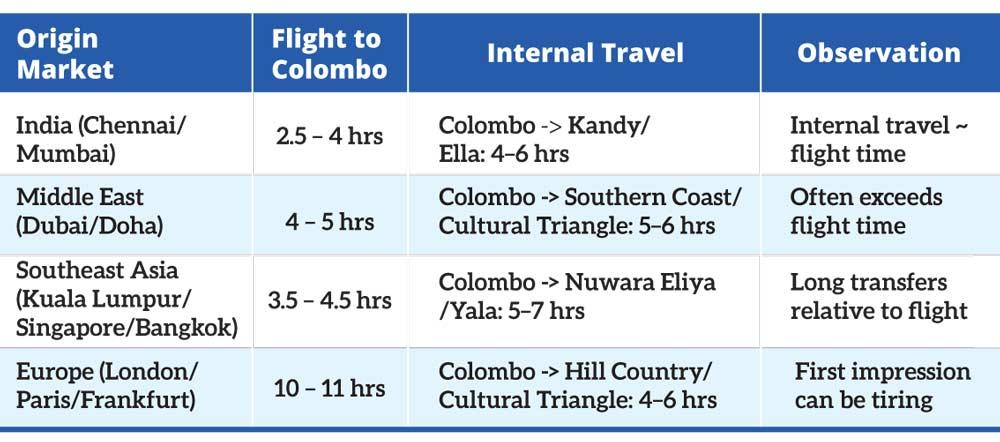
For major markets, India, Middle East, Southeast Asia, and Europe, international flights average 3–11 hours.
Yet domestic travel often takes as long, sometimes longer.
Travel times to Sri Lanka vary widely depending on the origin and the internal transfers required. Flights from India (Chennai or Mumbai) are short, lasting 2.5–4 hours. Flights from Southeast Asia (Singapore or Kuala Lumpur) take 3.5–4.5 hours. In both cases, transfers from Colombo to destinations like Kandy, Ella, or Yala take 4–7 hours—often as long as or longer than the flight itself.
Travellers from the Middle East (Dubai or Doha) have moderate flights of 4–5 hours. Internal transfers to the Southern Coast or the Cultural Triangle can take 5–6 hours, frequently exceeding the flight duration.
Long-haul travellers from Europe (London, Paris, Frankfurt) face flights of 10–11 hours. For them, internal transfers to major destinations usually take 4–6 hours, shorter than the flight. However, these ground transfers can feel tiring immediately after arrival.
“It took us the same time to drive from Colombo to Yala as it did to fly from Doha to Colombo. That was surprising,”say Rahul and Priya, travelers from Qatar
Implication
Attempting to cover too many regions results in rushed holidays and weaker experiences.
Long-term government-led initiatives aim to strengthen Sri Lanka’s tourism infrastructure by building faster, more reliable intercity highways, rail networks, and domestic flights. Investments in regional airports and ports will better connect key tourist hubs, while sustainable tourism policies will help protect cultural and environmental assets. In the short- and medium-term, however, economic constraints make large-scale projects challenging.
The government and industry stakeholders must collaborate on practical strategies that address immediate challenges, reduce travel fatigue, and ensure tourists have enjoyable experiences. These strategies include designing region-focused itineraries to minimise long transfers, emphasising immersive experiences in selected areas rather than rushing across the island, and fostering cooperation among hotels, transport providers, and local attractions to provide seamless visitor experiences.
Sri Lanka has the natural beauty, cultural richness, and hospitality to be one of the world’s most compelling travel destinations. But experiences must be designed around how tourists actually travel, not marketing ideals.
Until transport infrastructure improves, sustainable growth depends on curating experiences over quantity: limiting travel distances, focusing on fewer regions, and providing high-quality, immersive stays.
The government and stakeholders can follow a three-point action plan to improve tourism. First, optimise travel within the island by creating region-focused itineraries and seamless transfers.
Hotels, transport providers, and local attractions should work together to reduce travel fatigue. Second, enhance the guest experience by focusing on immersive activities in selected regions instead of “see it all” tours. Curate experiences that efficiently highlight cultural and natural attractions. Third, adopt collaborative short- and medium-term planning. The government and industry stakeholders should develop realistic, cost-effective strategies that improve infrastructure and policies to meet immediate tourism needs.
With realistic short- and medium-term strategies and collaborative action, Sri Lanka can ensure tourism growth is strong, sustainable, and leaves visitors with lasting, positive memories.
07 Jun 2026 8 hours ago
07 Jun 2026 07 Jun 2026
07 Jun 2026 07 Jun 2026
07 Jun 2026 07 Jun 2026
07 Jun 2026 07 Jun 2026