22 Aug 2017 - {{hitsCtrl.values.hits}}
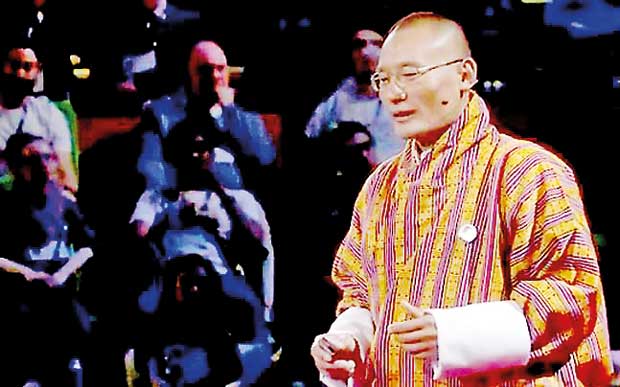
Prime Minister of Bhutan Tshering Tobgay
With the current climatic issues that wrap the world up in concern, suggestions and solutions to go green and be eco-friendly are sprouting everyday. Global warming, our gravest climatic combatant, shows no sign of slowing down. Carbon dioxide is one of the main green house gases that contribute to the environmental enemy, global warming. Amidst all this climatic confusion that has been spurred on, Bhutan has stepped up as a carbon neutral country, emerging as a climatic hero setting an example to the rest of the world.
Bhutan’s Prime Minister, Tshering Tobgay’s revolutionary TED talk caused the world to watch in awe at Bhutan’s exemplary eco-efforts, which inspired the world to follow in their footsteps and be more practical in going green and eco-friendly. TED talks- sloganed as ‘ideas worth spreading’ -are videos of speeches given by experts who have the power to influence people’s perceptions and opinions on various fields from entertainment to technology to design. The Bhutan Prime Minister’s TED talk lived up to every word of the slogan as an idea worth spreading. The talk also sets an example underscores a moral that we Sri Lankans should definitely consider looking up to. Tiny though it may be, Bhutan is a country which sets many examples and gives lessons to other countries. In that context it isn’t tiny at all.
Dressed in Bhutan’s national costume, Tobgay steered his way to the main topic by way of his Gho. “Our national dress is unique, but that is not the only thing that is unique about our country. Our promise to remain carbon neutral is also unique. And this is what I’d like to speak about today, our promise to remain carbon neutral,”he said.
"We call this holistic approach to development, Gross National Happiness or GNH. Back in the 1970’s, our fourth king famously pronounced that for Bhutan Gross National Happiness is more important than Gross National Product,” he recalled"
He started taking a peek at the background details of Bhutan and at the same time shunning away misconceptions based on his country which brought quite a few laughs from his audience. “Bhutan is a small country in the Himalayas. My country isn’t one big monastery populated with happy monks. The reality is that there are barely 700,000 of us sandwiched between two of the most populated countries on earth, China and India. The reality is that we are a small underdeveloped country doing our best to survive. But we are doing ok. We are surviving. In fact we are thriving,” Tobgay said.
He credited Bhutan’s successes to the kings who worked selflessly for the good of their people. What was truly exceptional was how Bhutan gave more priority to the Gross National Happiness(GNH) over Gross National Product (GNP) which isn’t the case in most developed countries, let alone developing countries.“The reason we are thriving is because we’ve been blessed with extraordinary kings.
Our enlightened monarchs have worked tirelessly to develop our country, balancing economic growth carefully with social development and environmental sustainability and cultural preservation, all within the framework of good governance. We call this holistic approach to development, Gross National Happiness or GNH. Back in the 1970’s, our fourth king famously pronounced that for Bhutan Gross National Happiness is more important than Gross National Product,” he recalled.
"So our country is under forest cover and all that forest is pristine. That’s why we are one of the few remaining global biodiversity hot spots in the world"
Despite an economy of GDP less than 2 billion dollars, Bhutan’s principles come through for the well-being of its people and stick unwaveringly to their policy of GNH before GNP which is something that should be considered by governing bodies in other countries as well. “Ever since, all development in Bhutan is driven by GNH, a pioneering vision that aims to improve the happiness and well-being of our people. But that’s easier said than done, especially when you are one of the smallest economies in the world.
Our entire GDP is less than 2 billion dollars. So our economy is small, but here is where it gets interesting. Education is completely free, all citizens are guaranteed free schooling, and those who work hard are given free college education. Health care is also completely free. Medical consultation,medical treatment and medicines, they are all provided for by the state. We manage this because we use our limited resources very carefully. This is also possible because we stay faithful to the core mission of GNH which is development with values,” he stressed.
His next few words prove an important lesson, especially to us, Sri Lankans. “Our economy is small and we must strengthen it. Economic growth is important, but that economic growth mustn’t come from undermining our unique culture or our pristine environment. Today our culture is flourishing. We continue to celebrate our art and architecture, food and festivals, monks and monasteries. And yes we celebrate our national dress too. So our culture is flourishing. But so is our environment,” said Tobgay.
"But neither Bhutan nor the world can afford to spend 15 years going backwards. This is why his majesty the king started ‘Bhutan for Life"
According to Bhutan’s Premier, 72% of Bhutan is under forest cover. “Our constitution demands that a minimum of 60% of Bhutan’s total land shall remain under forest cover for all time. The government shall ensure that in order to conserve the country’s natural resources and to prevent degradation of the ecosystem, a minimum of 60% of Bhutan’s total land shall be maintained under forest cover for all time,” the Premier said.
In a world where political leaders fight over power, Bhutan’s kings set an example to other leadership figures through their actions, which is through righteous governance. “Incidentally our king used this constitution to impose democracy on us. You see, we the people, didn’t want democracy. We didn’t ask for it, we didn’t demand for it and we certainly didn’t fight for it. Instead our king imposed democracy on us by insisting that he will include it in the constitution. But he went further. He included provisions in the constitution that empower the people to impeach their kings and included provisions here that require all our kings to retire at the age of 65,” he said.
In the name of development and advancement, foliage is being reduced to nothing, but concrete in many countries. But Bhutan stands strong as an exception. “So our country is under forest cover and all that forest is pristine. That’s why we are one of the few remaining global biodiversity hot spots in the world. And that’s why we are a carbon neutral country. In a world that is threatened with climate change we are a carbon neutral country. Turns out it’s a big deal. Out of the 200-odd countries in the world today, it looks like we are the only one that’s carbon neutral. Actually that’s not quite accurate. Bhutan isn’t carbon neutral, Bhutan is carbon negative,”the Premier added.
According to the Bhutan Premier, his country generates 2.2 million tons of carbon dioxide, but their forests sequester more than three times that amount. So Bhutan stands as a net carbon sink for more than 4 million tons of carbon dioxide each year. But that isn’t all of Bhutan’s efforts. They export most of the renewable electricity generated from the fast flowing rivers that stream the country. And the clean energy that is exported offsets about 6 million tons of carbon dioxide in Bhutan’s locality.
“By 2020 we’ll be exporting enough electricity to offset 17 million tons of carbon dioxide. And if we were to harness even half of our hydropower potential, that’s exactly what we are working at. The clean green energy that we export would offset something like 50 million tons of carbon dioxide a year. That is more CO2 than what the entire city of New York generates in One year. So inside our country we are a net of carbon sink. Outside we are offsetting carbon.
This is important as well. You see the world is getting warmer and climate change is a reality. Climatic change is affecting my country. Our glaciers are melting causing flash floods and landslides which in turn are causing disaster and widespread destruction in our country. We have 2700 of them to contend with,”he warned.
Tobgay further said that his country and his people have done nothing to contribute to global warming, but they are already bearing the brunt of its consequences. And it’s very difficult for Bhutan, being a small poor country, landlocked and mountainous. This statement familiarizes with how selfish the world can be and not pausing to think about how one’s actions will affect others. “But we aren’t going to sit on our hands doing nothing,” the Bhutan Prime Minister said.
“We will fight climatic change. That’s why we have promised to remain carbon neutral. We first made this promise in 2009 during COP 15 in Copenhagen, but nobody took notice. Governments were so busy arguing with and blaming one another for causing climatic change that when a small country raised our hands and announced ‘we promise to remain carbon neutral for all time’, nobody heard us. Nobody cared. Last December in Paris at COP 21 we reiterated our promise to remain carbon neutral for all time to come. This time we were heard. We were noticed and everybody cared.
What was different in Paris was that governments came round together to accept the realities of climatic change. They were willing to come together and act together and work together, all countries from the very small to the very large made a commitment to reduce the greenhouse gas emissions,”Tobgay said.
Tobgay stressed on how crucial it’s to stick to one’s commitments and shared ways in which Bhutan volunteers to reduce greenhouse gas emissions. “As far as Bhutan is concerned, we will keep our promise to remain carbon neutral. Here are some of the ways we are doing it. We are providing free electricity to our rural farmers.
The idea is that with free electricity they will no longer have to use firewood to cook their food. We are investing in sustainable transport and subsidizing the purchase of electric vehicles. Similarly we are subsidizing the cost of LED lights and our entire Government is trying to go paperless. We are cleaning up our entire country through ‘Clean Bhutan’- a national program. We are planting trees throughout our country through ‘Green Bhutan’ another national program. But it’s our protected areas that are at the core of our carbon neutral strategy. Our protected areas are our carbon sink. They are our lungs,” said a proud Tobgay.
A concept that could be adopted from Bhutan and truly be put into practice in Sri Lanka is the interconnection of national parks, reserves and sanctuaries with one another. Sri Lanka, a country with many protected nature sites that shelter diversities of fauna and flora, would surely benefit from this idea. “Today more than a half of our country is protected as national parks, nature reserves and wildlife sanctuaries.
But the beauty is that we’ve connected them all with one another through a network of biological corridors. Now what this means is that our animals are free to roam throughout our country,” he said. Every year Bhutan sets aside resources to prevent poaching, hunting, mining and pollution in their national parks and also uses resources to help communities who live in those parks.
"We are planting trees throughout our country through ‘Green Bhutan’ another national program. But it’s our protected areas that are at the core of our carbon neutral strategy. Our protected areas are our carbon sink. They are our lungs"
But leading better lives while continuing to live in harmony with Mother Nature is expensive, but the approach that Bhutan has taken in addressing this issue is quite impressive. “Over the next few years our small economy won’t have the resources to cover all the costs that are required to protect our environment. In fact when we run the numbers it looks like it’ll take us at least 15 years before we can fully finance all our conservation efforts.
But neither Bhutan nor the world can afford to spend 15 years going backwards. This is why his majesty the king started ‘Bhutan for Life’. Bhutan for life gives us the time we need. It’s essentially a funding mechanism to look after our parks. To protect our parks until our Government can take over on our own fully. The idea is to raise a transition fund from individual donors,corporations and institutions, but the deal is closed only after predetermined conditions are met and all funds committed.
So multiparty, single closing an idea we burrowed from Wall Street. This means that individual donors can commit without having to worry that they’ll be left supporting an underfunded plan. It’s something like a kick starter project only with a 15-year time horizon and millions of tons of carbon dioxide at stake. Once the deal is closed we use the transition fund to protect our parks giving our Government time to increase our own funding gradually until the end of the 15-year period. After that our Government guarantees full funding forever. We are almost there. We expect to close later this year,”the Premier said.
In conclusion, Tobgay expressed his wish to share his dream with the rest of the world. Selfless as it is, it’s a dream that every one of us can afford to share which could result in that dream becoming a reality. “What if we could mobilize our leadership and our resources, our influence and our passion to replicate the ‘Bhutan for Life’ idea to other countries, so that they too can conserve the protected areas for all time?
After all, there are many other countries that face the same issues that we face. They too have natural resources that can help win the world’s fight for sustainability. Only they may not have the ability to invest in them now. So what if we set up ‘Earth for Life’ a global fund to kick start the ‘Bhutan for life’ throughout the world? I invite you to help me to carry this dream beyond our borders to all those who care about our planet’s future. After all, we’re here to dream together, to work together, to fight climate change together to protect our planet together. Because the reality is, we are in it together,” underscored Tobgay.
01 Jul 2026 4 hours ago
30 Jun 2026 6 hours ago
30 Jun 2026 7 hours ago
30 Jun 2026 7 hours ago
30 Jun 2026 7 hours ago