08 Mar 2018 - {{hitsCtrl.values.hits}}
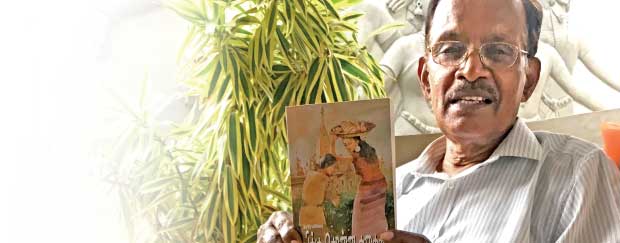
Celebrated poet S. Pathmanathan says that overcoming linguistic barriers will help bridge gap between the North and South
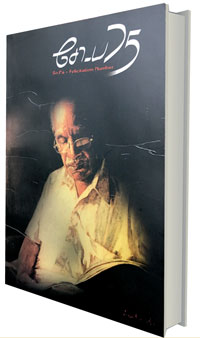
 “Literature should be for the people; and poets and writers should function as the voice of the people representing the vast majority,” says S. Pathmanathan, a poet and a translator from Jaffna. Pathmanathan, fondly referred to as ‘SoPa’, is a product of Jaffna Hindu College who had had an interest in literature since his younger days. During his career he had served as the Principal of the Palaly Training College from 1993 to 1996 and also travelled abroad to master the English language on several occasions. His collections of poetry include Vadakiruthal (1998), NinaivuChuvaduhal (2005) and Suvattecham (2009) while his translations have appeared in the Journal of South Asian Literature (1987), Penguin New Writing in Sri Lanka (1992), Lutesong and Lament (2001) and A Lankan Mosaic (2002). Having bagged two State Literary Awards, four Provincial Awards, the Governor’s Award and the Kalabhooshanam Award, SoPa strives to make a positive change in society through literature. While on a recent visit to Jaffna, the daily mirror caught up with this visionary poet. Amidst bell chimes from a nearby kovil, SoPa quite enthusiastically expressed his views about how the language barrier could bridge the North and the South while also elaborating the role of writers.
Excerpts:
Q Tell us about your experiences as a poet in Jaffna.
I was in Government service right throughout my life. For a brief period I was a clerk just to find a foothold. But then I thought this is not what I want to do. I loved to teach and therefore wanted to be a teacher. So when I had the opportunity, I became a teacher in 1964. Then I went for training in English teaching and it became my vocation there onwards. While being a teacher I also entered university, graduated and continued my career, starting from the early 1980s. After that I was appointed as a lecturer at the Palali Teachers’ College which was a prestigious teachers’ college in the North. Then for six years I served in the Eastern Province. It was compulsory to serve in the remote areas once we received training and I believe that it’s a very good system. Thereafter I was offered a scholarship in the UK. This was for Teacher Trainers, which was the terminology in the West.
In the meantime the war aggravated. The ‘83 riots’ took place and the Teachers’ College got displaced. People started moving up and down and it was chaos. Likewise many things happened between 1983 and 1995. It was the most gruesome and troublesome period in this part of the country. I continued in service till 1999 and retired thereafter. So whenever I’m motivated or inspired or feel like expressing myself, I write. There was enough material to write about; the war was reaching the land here and unprecedented things were happening. People were facing difficulties. They were being displaced not to mention the shelling and things which became the order of the day. I have been busy even after retiring in 1999. I didn’t want to idle. So I did most of my publications after retirement.
Q What are you inspired by in your literary career?
I have a fairly good grounding in Tamil literature. But my horizons were widened since I learned English literature. Therefore my inspirations were mainly Tamil classics. I have also devoted a part of my writing for translations since I thought there weren’t many translations done during that time. People don’t get through these linguistic barriers. Most of the problems in this country are due to the fact that there’s a big language barrier between the North and the South. When we were young it wasn’t so because English helped us to communicate with the Sinhalese. Apart from the language problem the two communities were moving further and further away.
Q What are the immediate actions that need to be taken to fix this language barrier?
There could be an exchange between the North and South. For example the Government would select 50 best students who have done their O/L Examination to be sent to Japan. In return 50 Japanese students will visit Sri Lanka. But more than such a programme, an exchange within the country would be more effective. This should be given priority. But in terms of sports we should be happy that one girl from Jaffna bagged two gold medals recently in an All Island sports event. Such events would positively contribute in bridging this gap between the North and the South.
Q You mentioned about Tamil classics and literature which we have seldom heard of. Tell us about some genres in Tamil works of literature.
Tamil literature is rich in ‘Bakthi’ literature which means devotion. By this we refer to the literature that came around the seventh to the 12th Century mainly in Tamil. We also had out own tradition. People 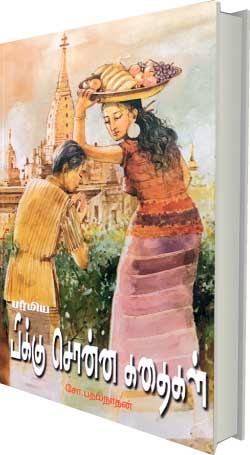 were religious because there are many temples and kovils.
Temple festivals are still a part of our lives. Temples were also not places of worship, but places where religious discourses were taking place. I was inspired by ‘Harikatha’ which means ‘katha of Hari’. This is Krishna’s story found in the Ramayana, Mahabaratha and other epics.
Those religious discourses weren’t speeches, but they were recited and sung to the accompaniment of music. They were so catchy and as a schoolboy I used to sit at these discourses and listen to them. That would be my first inspiration. The uncle who brought me up was a great fan of this programme and I eventually became used to it. Epics are a great storehouse of many stories.
Q The exchange of heritage and culture in Jaffna was challenged as a result of the war. Nine years after the war, don’t you think now is the right time for the North and South to get together?
During this war and a little bit afterwards, this rich culture which I grew up in has been subject to many changes. Certain things are already gone.
We grew up the traditional way, but there’s nothing I can show my grandchildren today. What one would call the typical Jaffna culture has drastically changed. People started to migrate either to avoid the war or because they were in search of greener pastures. But after the war they would come down only for a visit.
So there’s no genuine attempt made to preserve their culture. The Tamils who are now living abroad are the third generation. The first generation had an exposure to the Jaffna culture; the second generation had a mix of both.
But this third generation, who was born and bred there, may not have any idea about the culture here. Because of this war, an elaborate museum has never been in our possession.
Q How likely is it for a person from Jaffna to shift to Colombo on a job transfer or a similar opportunity as at now?
It’s still a challenge and there’s a traditional barrier as well. There is inwardness in us, so we don’t like to move out. People in Jaffna used to be all over Sri Lanka doing their businesses back in the day. But times have changed now. They have lost their freedom. I’m not blaming the Government, but they could do much more.
 Q What role can literature or literary exchanges play in the reconciliation process?
There was one exchange programme back in 2004 or 2005 when there was a brief ceasefire. A team of writers came here and we had a full day meeting with poetry recitals and other items. Then a team from Jaffna travelled to Colombo and conducted another programme. The two communities have been drifting apart and if the writers had played a positive role and made peace their priority without fanning the flames of the war, Sri Lanka would have been a great country. We have lost so much and everybody lost. Nobody wins a war.
Q What’s your message to the younger generation in terms of appreciating literature.
We have to break through these barriers. One big hurdle is the language barrier. I have been an English lecturer for 35-40 years. I don’t mind admitting that teaching English to the vast population has been a failure. Ideally I would say that as a Tamil it’s easier for me to learn Sinhalese than English. For an average Sinhalese it’s not difficult to learn Tamil as well because there’s so much in common in terms of syntax, word order, vocabulary etc. On top of that we share a common culture. Due to the suspicion and animosity of politicians, people look at Sinhala language as an instrument that is being used to oppress them. Sometimes Sinhalese people may also wonder why they need to learn a language of a minority. But my answer would be that if you learn an extra language you will also learn the culture as well, hence you horizons will broaden. In order to unite this country, we need to have a will and purpose in all our hearts.
23 Jun 2026 50 minute ago
23 Jun 2026 1 hours ago
23 Jun 2026 1 hours ago
23 Jun 2026 1 hours ago
23 Jun 2026 1 hours ago