Reply To:
Name - Reply Comment
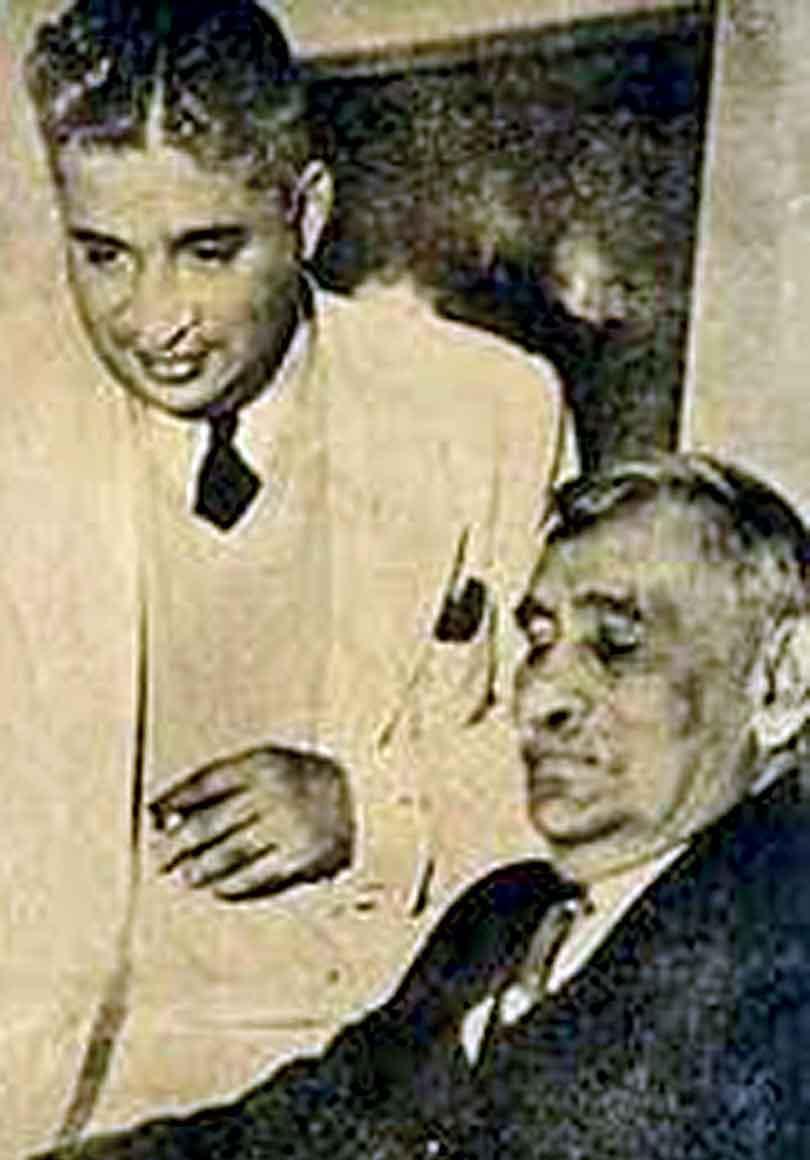
Dudley Senanayake with his father D. S. Senanayake
By Gamini Leeniyagolla
When Dudley Senanayake died in 1973, nearly 1.8 million people lined the streets of Colombo to say goodbye to their much loved leader. In a country of 12 million, that was one in seven people. It wasn’t a state-mobilised crowd or a political rally.
They were mostly farmers from the Dry Zone who worked on the lands he had irrigated, teachers who benefitted from his school expansion scheme, civil servants, traders, students — ordinary people who walked for hours just to stand in silence as his cortege passed.
They came because they had never seen him act like a ruler. He lived like one of them: refusing special queues, apologising for accidental bumps, paying for things himself, treating political opponents with basic human respect. For many, it was the first time they had grieved a leader they had never met personally, but whose decency they trusted. His funeral became less about
death and more about a public reaffirmation that integrity in politics was possible, and that the people had noticed it.
Dudley was born under an auspicious sign. His father, D.S. Senanayake, was at a temple ceremony in Bothale, Mirigama, when the news came. The temple astrologer predicted a great future for the child. History proved him right, though not in the way most expected. Dudley’s greatness lay not in how much power he held, but in how little he clung to it.
He left St. Thomas’ College, Mt. Lavinia, as its best all-round student — equally at home in classrooms, on the cricket field, the soccer pitch, and the athletic track. At Cambridge, he won a Blue in cricket and earned degrees in Natural Sciences and Law. He returned to practice law, and entered politics only because his father persuaded him to do so. Public life was not his ambition; it became his duty.
As Prime Minister four times, twice in the 1950s and twice in the 1960s, he put his signature on the irrigation schemes and agricultural programmes that fed the Dry Zone. But those who met him remember something more: his humanity.
The following information was shared by Dr. Karunasena Kodithuwakku and the late Rukman Senanayake during informal conversations and via numerous reports. When The Queen of England, Queen Elizabeth II, and the British Parliament decided to confer a Knighthood (the title ‘Sir’) on Dudley in the 1950’s and informed him accordingly, Dudley had declined the Honour graciously, declaring: “I prefer to be known as plain Dudley Senanayake like now, rather than as ‘Sir Dudley Senanayake.”
In Kandy during his third term, Dudley accidentally bumped into a senior government valuer in the corridor of Queen’s Hotel. Before the man could speak, Dudley apologised. Later that day at the YMBA foundation stone ceremony, officials joked that they expected a larger donation from him. He opened his chequebook, looked at it, and said, “Give me the cheque I gave. Rs. 250? That’s my brother’s signature. I don’t have even that much.”
He cut his hair at a salon in Colpetty. When the head barber tried to move him ahead of the queue, Dudley said: “No, no, I will wait for my turn.”
A senior politician from Kegalle came to see him urgently in 1965. The secretary told him to be at Woodlands before 7 a.m. When Dudley saw him, he invited him to breakfast. The man turned away, overwhelmed.
“I can’t believe how I am welcomed here,” he said. “At my former leader’s house, I’m not even allowed to sit on a low bench.” He was however careful to protect the dignity of the country that he represented. Prime Minister Dudley Senanayake received an invitation to the Royal Coronation of Queen Elizabeth II in 1953.
After accepting the invitation with due honour, Dudley went to England and was staying at a Hotel when a high official of the British Government paid him an unexpected visit. This was to appraise him of a change in plans.
”Hon, Prime Minister, I’m sorry to inform you that a difficulty has arisen regarding providing you with a separate horse carriage as informed earlier. Would you please share a carriage with Hon. (so and so) of Africa and grace the occasion”?
Dudley was very annoyed, and told the official: “Please inform your government that I expect a seperate horse carriage to be provided for me too, just like for all the other Leaders as promised. Otherwise, I would consider it an insult to my country and will return to my country immediately without attending the Royal event.”
It is reported that the British Government had promptly complied with Dudley’s request.
Even as Prime Minister, Dudley refused the trappings of office.
One day in 1965-70, he told his security not to follow him and drove his Triumph Coupe alone to Mirissa. He spent the day photographing the beach and drove back safely. The police kept watch from a distance. Another morning, he set off for Nuwara Eliya for golf, again asking security to stay back. Few hours later they found him at Ramboda Pass, sitting on a culvert smoking his pipe, the radiator of his car boiling over. He was relieved to see them and asked them to take him for his game—in their vehicle.
Traffic police once chased a speeding car only to find the PM at the wheel, pipe in hand. On Galle Road, he spotted an old friend at a bus stop, stopped the official car, and said, “Hey, what are you doing here? Jump in!” He took the man to Woodlands for tea and snacks, then drove him to Fort Railway Station himself. The friend was a Tamil gentleman who had captained Royal when Dudley captained St. Thomas’. Titles meant nothing to him.
His humor was the same—dry and self-deprecating. At an All Ceylon Agricultural Officers Association AGM, the president pleaded with him and Minister M.D. Banda to “breed and recruit” more officers for the five-year plan. Dudley replied: “You all know I am not capable of breeding humans. You’ll have to ask the Honourable Minister — he’s already produced seven children!”
The hall erupted in laughter.
The day after the 1970 election defeat, party members went to see him in hordes. Our family too, was amongst them. As we left, he came up to our mother and said softly: “I’m very sorry, Mrs. Banda.” Even in defeat, his first thought was for others, especially for people like M.D Banda who had never lost an election before.
Dudley Senanayake drew crowds not with slogans, but with sincerity. He never asked people to lower themselves to meet him. He met them where they were. In an age of political theatre, he was simply, stubbornly, decent. During the period 1965-1970, when Dudley Senanayake was Prime Minister, the Opposition led by Sirimavo Bandaranaike, made allegations against Robert Senanayake (Dudley’s brother) regarding certain Foreign Exchange issues in Parliament. Dudley got up and urged the Speaker to:
Appoint a Parliamentary select committee to investigate the allegations against his brother.
Appoint a Member of Parliament from the Opposition as its Chairman
Appoint the majority of the Select Committee members also from the Opposition.
According to the findings of the Select Committee and as reported to Parliament later, Robert Senanayake was completely exonerated. The entire leadership of the Opposition had then apologised profusely to Dudley.
An important point about this episode is the statement made by Dudley himself in Parliament prior to appointing the Select Committee: He had declared that if his brother was found guilty of having indulged in any malpractice by word or deed, he (Dudley) would forthwith resign from the Premiership. Such was the caliber of Hon. Dudley.
That is why Sri Lanka remembers him not as a politician, but as “the gentleman Prime Minister.”
On June 19, the day of his birthday, it is heartening to remember that such leaders once walked amongst us.
Gamini Leeniyagolla is the late minister M.D. Banda’s eldest son. The reluctant heir