30 Oct 2025 - {{hitsCtrl.values.hits}}
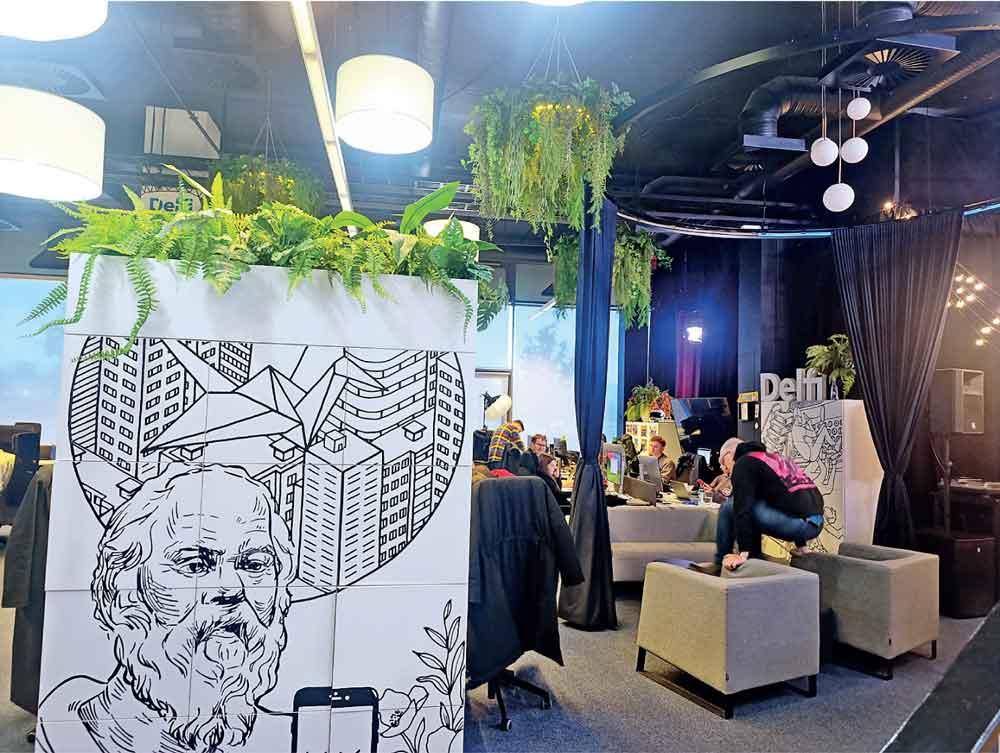
The picture shows DELFI, a cozy newsroom located in the heart of Vilnius equipped with studio facilities and editorial space where journalists work on mixed media to disseminate information to the public- Inside LRT - Lithuania’s public broadcaster
Disinformation is the order of the day for Lithuania, a Baltic State that has a long history of dealing with Russian aggression and has been on the frontlines in combatting Kremlin-backed disinformation and propaganda. According to geopolitical experts, the majority of the disinformation encountered in Lithuania is of Russian origin and is often intended for international audiences in order to undermine NATO, the EU, and the West in general while promoting Russian legitimacy and authority. But in order to counter this growing threat of disinformation, which is now being perceived as a security risk, collective interventions are required to debunk these narratives.

“We mostly fact-check misinformation and disinformation found on social networks and we collaborate closely with social media platforms. We find claims to be fact-checked, sometimes these claims are being sent by readers”
- Aistė Meidutė, Editor Melo Detektorius
As part of the Indo-Pacific Media Resilience study tour funded by the European Union and facilitated by Internews, this writer along with several other Sri Lankan journalists had the opportunity to visit Vilnius, the capital of Lithuania and observe how Lithuania’s public broadcaster, military and individual newsrooms have doubled their efforts to provide accurate information to the public.
A public broadcaster’s perspective
The Lithuanian public broadcaster Lithuanian Radio and Television (LRT) is at the forefront of providing media literacy and conducting educational campaigns for the public in an attempt to debunk disinformation and propaganda campaigns. According to Aleksandra Ketleriene, Deputy Editor of lrt.lt, LRT’s online news portal, disinformation and propaganda aren’t something new for Lithuania. While disinformation was largely an issue faced by Western Europe, it has now become an equal issue in Baltic States, Poland and Ukraine as well.
“We are very unfortunate because we have two neighbours, Russia and Belarus trying to undermine our country and trying to attack with disinformation campaigns since the Russian annexation of Crimea in 2014 and even earlier than that. The soft propaganda was going on all the time as observed by those with a Russian background. They are trying to persuade that Russia is doing well, but Baltic States are not doing so well. One of the main propaganda narratives is that we are a failed state. This is of course not true when you look at statistics. After the annexation of Crimea, disinformation campaigns became aggressive, but the good news is that we are constantly following them. We know that we are their target because they want to put their narratives among the public and a public broadcaster is their number one target because the public trusts us,” she said.

“We are very unfortunate because we have two neighbours, Russia and Belarus trying to undermine our country and trying to attack with disinformation campaigns since the Russian annexation of Crimea in 2014 and even earlier than that”
- Aleksandra Ketleriene, Deputy Editor of lrt.lt
The LRT website is available in five languages, to allow the public to analyse disinformation narratives. Journalists have now become watchdogs for disinformation and propaganda, protecting the audience from narratives and campaigns. Due to a dearth of journalists in promoting awareness about disinformation, LRT has designed several educational and media literacy programmes to assist the public to identify and debunk disinformation. Ketleriene further said that they are watching the Russian and Belarusian information space, trying to monitor what is resonating with their people because the narratives could sometimes originate from politicians as well.
On the other hand, LRT’s investigation team works in collaboration with other journalists in the region to analyse the trends, disinformation techniques that are used in Baltic States and Lithuania through leaked documents from Kremlin. The team analyses how the Kremlin uses social media and how it employs experts and professionals to spread out their message. One of its members explained how social media channels that previously spoke against NATO and EU, shifted into anti-vaccine, anti-pandemic narratives and to pro-Russian, anti-Ukraine channels. Through their investigations it was revealed that the administrators in each of these channels were interconnected and only the names of channels keep changing. For such investigations they collaborate with NGOs who provide them with technical support, developing various tools to monitor and analyse such campaigns.
The role of Lithuanian Armed Forces in debunking disinformation
Joining the country’s efforts to debunk disinformation narratives coming mainly from Russia and Belarus is the Lithuanian Armed Forces. The strategic communications department of the Lithuanian Armed Forces was established in 2011 with the primary intent of countering adversary propaganda which had been on air since 2008. Since Russian invasion of Ukraine in 2014, the military topic sparked interest among public in Lithuania and all Baltic States including Poland.
The Information and Environment Assessment branch looks into hostile information mainly from Russia and Belarus by analyzing mainstream media and official statements. Their main task is to go through a database of claims that have been compiled over the years while sharing their assessment of evolving disinformation techniques and trends with the media, so that people would have a better knowledge about the information environment.
Responding to a query on why the military was entrusted with this task, a spokesperson told the Daily Mirror that disinformation itself is a security risk and that the military is more trusted than the media.
DELFI’s largest fact-checking initiative - Melo Detektorius
In addition to debunking disinformation at a state level, individual newsrooms have made it their responsibility to join the efforts in checking facts and providing accurate information to the public. Melo Detektorius is one such initiative established in 2018 and is the second oldest fact-checking initiative in Lithuania. This initiative is carried out by the Baltic’s largest online news outlet – DELFI. This writer had the opportunity to visit DELFI, a cozy newsroom located in the heart of Vilnius equipped with studio facilities and editorial space where journalists work on mixed media to disseminate information to the public.
The fact-checking initiative had evolved from one of its first projects called Debunk, which mainly focused on debunking Kremlin’s disinformation and propaganda narratives. But Melo Detektorius Editor Aistė Meidutė had then realised that a separate fact-checking initiative was required. Having fact-checked over 3000 claims, Melo Detektorius operates with full editorial independence. “We mostly fact-check misinformation and disinformation found on social networks and we collaborate closely with social media platforms. We find claims to be fact-checked, sometimes these claims are being sent by readers. Each one of these claims then follow an investigation and a rating system. Ratings are based on five criteria – True, False, Partly False, Manipulation and Fabrication,” she explained.
Meidute said that the rating system makes it easier to explain a particular claim and its veracity to the public. Fact-checking is now an everyday job for journalists at Melo Detektorius, but their job comes with associated threats. She explained how journalists have to endure harassment and hate speech from bad actors. “Lithuania is a small country and we definitely know that those behind the screen could appear on the doorstep. So we have taken precautions to safeguard journalists who work with us,” she added.
Melo Detektorius has several online tools to analyse false claims and disinformation and they also work in collaboration with social media platforms. In addition to running a programme on disinformation which is being aired on DELFI TV, the team also invests a lot on pre-bunking fake news and disinformation to empower the general public to be critical of the content they see on social media platforms before its being shared widely.
Similarly to DELFI, Patikrinta 15 min (Checked by 15 min) is Lithuania’s first fact-checking project, active since August 2016 which rigorously verifies claims circulating public discourse to combat misinformation, focusing on debunking false information related to health, science and politics.
07 Jun 2026 07 Jun 2026
07 Jun 2026 07 Jun 2026
07 Jun 2026 07 Jun 2026
07 Jun 2026 07 Jun 2026
07 Jun 2026 07 Jun 2026