13 Nov 2017 - {{hitsCtrl.values.hits}}
"The Bolshevik Revolution was a lagged continuation of the French Revolution: it heralded the emergence of the working class as significant wielders of political power, consequent on its own capture of State power"
That which presently lies in the past, once lay in the future,foreshadowing possibility.
The search for legacy is not a Proustian effort to redeem the past but a forensic exploration of what to forget, in order to revitalise the future. The Bolshevik Revolution, which was heralded with such heady acclaim, lies in ruins today with the rubble of the Berlin Wall. The State, established by the Revolution - The Union of Soviet Socialist Republics (USSR) - and the system created by the Revolution- Soviet communism - no longer exist. What legacy of the Bolshevik Revolution, then?
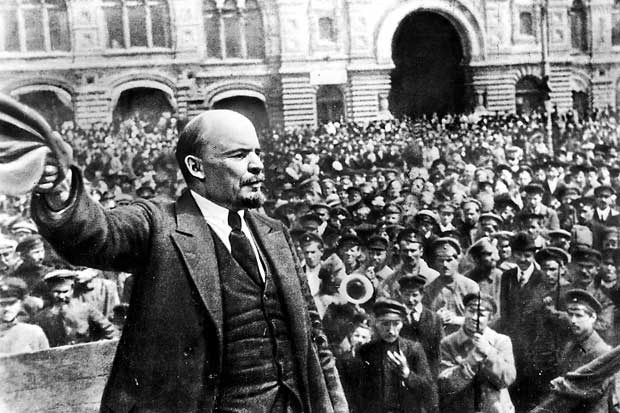
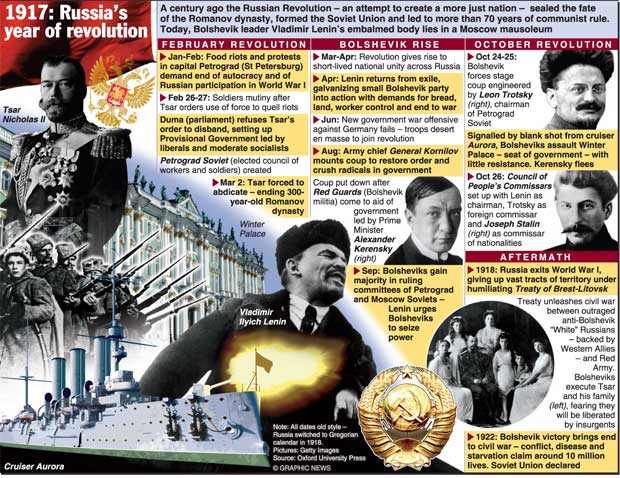
The Bolshevik Revolution- led by Lenin- overthrew the Czarist feudal regime. It was a pivotal event in world history which took place a hundred years ago, on 7th October 1917. It was a mutation on the French Revolution which was also an overthrow of the ancient regime of the Royalist Bourbons- another pivotal event of world history which took place on 14 July, 1789 in Paris. The French Revolution symbolized the capture of State power from the Feudals by the newly empowered bourgeoisie and the entrenchment of the capitalist class in State power. After the French Revolution, politics became a lucrative game played by different contending segments of the capitalist class. Scams are not exceptions in capitalist government but an integral part of its governance- a part of its duality- as rice and parippu are an essential part of Sri Lankan cuisine.
The Bolshevik Revolution was a lagged continuation of the French Revolution: it heralded the emergence of the working class as significant wielders of political power, consequent on its own capture of State power. Its concern was to make sure that workers now become entrenched as permanent players in the political power game. The Post-Bolshevik Revolution shifted political focus from being an inter-capitalist jostle, to becoming an intra- political battle of capital and worker, in Sri Lanka symbolised by the Communist Party being a member in one of her bourgeois Cabinets.
"It was argued that since women hold up half the sky, they should be given equality with men. The Soviet Union became the beacon for women’s rights and gender equality"
The Bolshevik Revolution was ideologically based on the Marxian model of history, best explained in the Communist Manifesto (1848), co-authored by Marx and Engels. Marxian ideology was a component part of the Whig interpretation of history- Hegel and Nietzche being among its distinguished adherents. In this interpretation, human progress lay in a constant and persistent upward movement towards the light. Its Marxian variant was that it was only social class and economic constraints which could sponsor such action, “the history of all hitherto existing societies is the history of class struggles”. In
elaborating on this propelling mechanism, Marx upended the Hegelian dialectic of thesis, anti-thesis and synthesis. Action starts with the thesis, which generates an anti-thesis and, eventually, the best of both elements merge into a synthesis. An example of this movement was where feudals (the thesis) would generate its anti thesis- the capitalistic bourgeoisie- who, in its turn, would capture State power.
The evolving movement continues on the same beat but on an elevated track. Capital (now entrenched as the thesis) would create workers (anti-thesis). Empowered capital had its French Revolution, it is not the responsibility of empowered workers to have their Bolshevik Revolution. A combination of the best of these two, would push towards a more humane work relationship and a greater productivity of capital, a win-win situation both for capital and workers. Revolutions will be generated from below and continue their democratic fervency, till they end by reaching the nirvana of communism.
Fifty years had passed since the Communist Manifesto appeared. Like today, post-1850s had lost faith in the political system, lost faith in their leaders, was not sure of its own values or even recognise who they are. There was an abyss- an emptiness- beneath the illusory sense of stability best captured by Dosteovsky in his books “Crime and Punishment” and “Notes from the Underground”.
Despite Europe being influx during this post-1850s turbulent period, with bitter strikes and industrial unrest, there was not seen a definitive revolution organised from below, though small, regular insurgent sightings did periodically appear, like Banquo’s ghost. It was at this time the Lenin, radicalised by reality, reshaped classical Marxism. In his, “What is to be done?” (1902), he opined that there was no automaticity in revolutions occurring, as Marx had forecast. Lenin argued that revolutions do not descend from heaven, but have to be made to happen when conditions were ripe. It was to be carried out by a professional, revolutionary Communist Party, this Party totally dedicated to The Cause.
The Communist Party must take a vanguard role in educating and making workers aware about their exploitation. Workers must be made to realise the unfair apportionment of the fruits of their labour- by owners of the means of production, distribution and exchange-to excessively reward capital, that is themselves. In this Leninist interpretation, Revolution was not a Marxian democratic event driven from below but an autocratic event, imposed from above.
"The Bolshevik Revolution- led by Lenin- overthrew the Czarist feudal regime. It was a pivotal event in world history which took place a hundred years ago, on 7th October 1917"
In the early 1900s, the most mature working class primed for revolutionary action was in Germany, as Germany was economically, technologically and culturally, the most advanced nation of the time. She also had a tried and tested leader in Rosa Luxembourg, to lead the capture of power. But German revolutionary grasp did not extend to German revolutionary reach. It was not in Germany but in Russia that the Revolution took place. Russia was the most backward of the European countries, economically, technologically and culturally, but contrary to Marxian Dialecticism, it was in this backward country where the revolution first took place. It was like Neanderthals detonating the first atom bomb. How come? Lenin tried to explain this contradiction. Europe was a weakly interlinked economic chain. It was also an assymetric linkage.
The Bolshevik revolution took place at the end of World War1, and like vultures, Europe’s victorious powers demanded more than their kilogram of pork, similar to demands made on defeated Germany. Trotsky, the foreign minister, had to concede lamely most of the demands, in the Brest-Litovsk treaty. Within the Soviet Union itself, there were insurgencies, White Russians, Cossacks etc. While attempting to build the new society in a bankrupt State, the new rulers had to simultaneously negotiate the end of this cruel and bloody civil war.
As appropriate to a movement that hegemonises humanitarian concerns over capital, the paradigmatic change made by the Bolshevik Revolution was mostly with respect to upgrading the abysmal condition of the Russian human stock at all levels and providing it with long overdue humanitarian solace. Capitalism concentrated on providing and extending legal rights: socialism concentrated on providing and extending humanitarian and social rights. The different treatments of poverty highlight the difference. For capitalism, poverty was an externality to be solved by individuals through hard work: for socialism, poverty was the most pollutant of pollutions, to be solved by collective effort.
In 1920, the Soviet Union was the first country in the world, despite its bankrupt status, to introduce free health care for all its citizens, regardless of their background. This comprehensive health package included medications and operations. This innovation enabled the Soviet Union to claim the moral high ground over capitalist countries placing her at odds with the USA, where even today, the USA does not provide this fundamental right of health care, the limited subsidies provided by Obamacare being under regular threat of substantial restrictions. To the USA, providing health care is not a moral obligation of the State, but an investment to earn profits.
It is interesting that the next country in the world to provide comprehensive free health care, is Sri Lanka (then Ceylon). It is not known whether George E de Silva, the father of the Sri Lankan scheme, studied the Soviet system, but full marks have to be given to him. It is mistakenly claimed that it was in Britain, after World War 11, that the first comprehensive National Health Scheme (NHS), was introduced.
"All education upto the University was provided free. It is not known whether these reforms were inspired by Bolshevik policies on education. Illiteracy was wiped out and Sri Lanka"
Education was another universal humanitarian initiative undertaken by the financially strained Bolshevik government. It has a widely proclaimed- and acclaimed- public policy of the Bolshevik government that good quality education was a right of all children and young people. Czarist Russia was one of the worst feudal countries in the world. Education was provided on payment by Imperial Russia, mostly to the aristocracy and a minuscule slice of the emerging bourgeoisie.
Within a few years of the Revolution, the government- the first initiative in the world- provided free, compulsory, primary and secondary education. In addition, education in universities and technical institutes were made free. The results were startling. In 1900, under the Czars, literacy was less than 30%, under the Bolsheviks, in 1930, it shot up to 75%, and in 1950 it reached the 98% mark which is the maximum possible, since there is a hardy, residual cohort of senior citizens who were averse to education. Like in Health policy, Sri Lanka (then Ceylon), under CWW Kannangara, followed similar humanitarian policies of the Soviet Union. All education upto the University was provided free. It is not known whether these reforms were inspired by Bolshevik policies on education. Here, again, the results were startling. Illiteracy was wiped out and Sri Lanka, with her upgraded human resources, is set on the path to becoming an upper middle income country.
Women, in Imperial Russia, had no rights. They were the most exploited segment of the populace, after serfdom was abolished. After the Bolshevik revolution this changed. It was argued that since women hold up half the sky, they should be given equality with men. The Soviet Union became the beacon for women’s rights and gender equality.
Women were recruited to the labour force in droves and were given equal wages for equal work. For the first time, women worked in factories, in production lines and offices. They operated agricultural machinery, joined fishing crews and the police and defence forces. 8th of March was recognised as Women’s Day, which subsequently became International Women’s Day. Family planning was encouraged, the USSR was the first country in the world to provide paid maternity leave and abortions were provided on demand. The Soviet Union recognised that a woman has sovereignty over her own body. The eastern rite which was the official Christian religion and the sturdiest exploiting supporter of Imperial czars, was dis-established and atheism encouraged.
"Its Marxian variant was that it was only social class and economic constraints which could sponsor such action, “the history of all hitherto existing societies is the history of class struggles”
The greatest achievement of the Soviet Union was her rapid industrialisation, at a clip unheard of earlier. On an earlier occasion, Peter the Great ventured to do so, but there were no great successes though Russia incurred tremendous human costs. Great economic ventures result in great achievements but the downside human costs are harrowing. The great American drive to go West was through genocide- the wiping out of scores of ‘’Red’’ Indian nations. Britain created ‘’famines’’, where, literally tens of millions of forefathers of those living in current India died of starvation, because food was exported elsewhere in British India. Industrialisation in the Soviet Union was carried out with an iron hand, by Stalin (The Man of Steel). He found “Russia to be a wooden spoon and left her with the atom bomb”.
The massive industrialisation saved the USSR from annihilation by the Nazi Wehrmacht during World War 11. The Russian Grand Army, under the Czars, collapsed in ruins in World War1, because it did not have the industrial infrastructure to sustain the Grand Army’s resistance and meet the need for its arms and war material. Not so the USSR Army during World War11. With the year’s surcease gained by the master stroke of Russian diplomacy, the Ribbentrop-Molotov peace agreement, Stalin was able to push all USSR’s heavy industry to East Russia, out of the reach of Germany’s Wehrmacht (the Army) and the Luftwaffe (Air Force). Although the Soviet Union suffered a death toll of 22 million in World War11, if Stalin had not developed Soviet Union’s heavy industry- at a heavy humanitarian price- the victory of Nazi Germany over the Soviet Union, would have led to the decimation of the total Russian population of 240 million. Hitler had no sympathy for the Untermensch, sub-humans like the Russian Slavs, as the Jews would knew well, of whom 6 million were gassed.Development is not a tea party. It has its extremely harsh side. The Bolshevik Revolution had its pluses and minuses, the pluses far exceeding the minuses. Its reforms, especially on the humanitarian side, inspired people around the world and set precedents for countries to emulate. The Bolshevik Revolution is a legacy to celebrate.
30 Jun 2026 14 minute ago
30 Jun 2026 28 minute ago
30 Jun 2026 31 minute ago
30 Jun 2026 39 minute ago
30 Jun 2026 43 minute ago