15 Jan 2026 - {{hitsCtrl.values.hits}}
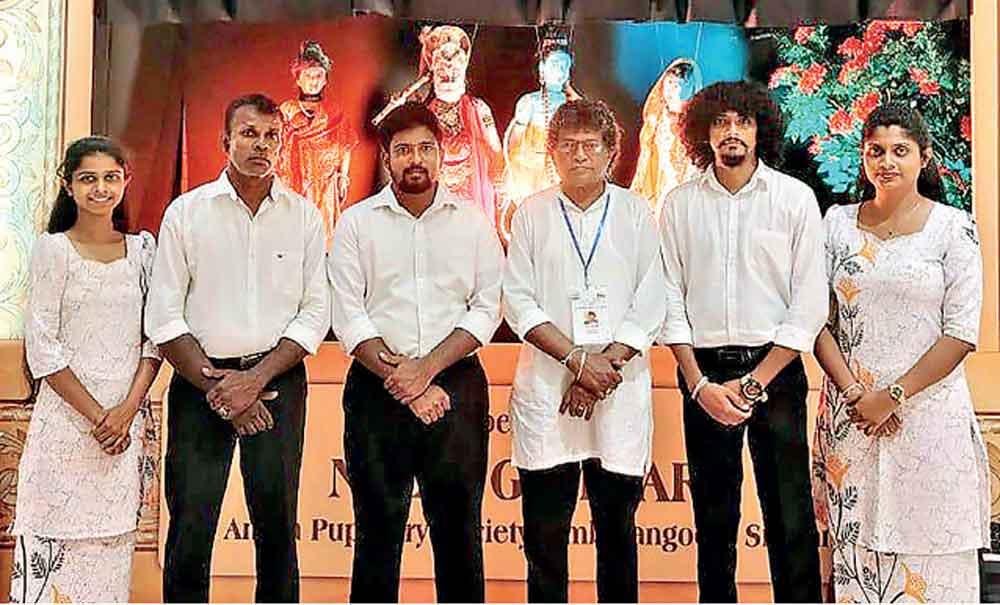
G. Premeen, his son Indika Gamini, his son Sanush Vihansa Gamini
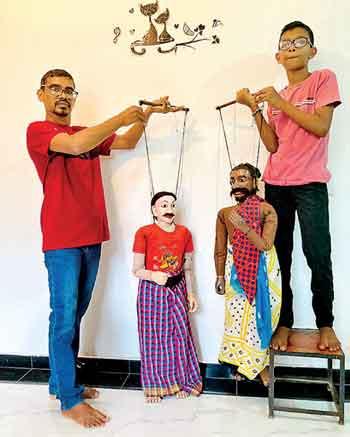 |
| The seat of puppetry as folk art is the Balapitiya-Ambalangoda area in the Galle district. The picture shows a puppet used for entertainment |
By Janakantha Liyanage
Puppetry, popularly known as “Rukada” in Sri Lanka, has been a branch of theatre that dates back to the reign of ancient kings. Rukada has survived as a folk art to the present times thanks to the incessant toil of a school of artistes from Ambalangoda and Balapitiya in the district of Galle.
Terminologically the Sinhala name “Rukada” has been described as figures representing partly live human beings made of wood. Other half of life is given by the puppeteer.
A puppet play is a concerted effort of a team of singers, play wrights and musicians. All such performances are in reality theatrical. Puppetry in Sri Lanka, just as the other spheres of culture, art and craft has been influenced by India, China, Malaysia, Japan and Germany
The seat of puppetry as folk art is the Balapitiya-Ambalangoda area in the Galle district. The name of Gamchari Podisirina Gurunnanse of Kandegoda in Balapitiya has gone down in the annals of history as pioneer of puppetry in Sri Lanka. Baiya Gurunanse, Sadoris Rupasinghe, D.S. Dharmasiri, G. Dahiyella. G. Nalinton, Chalis Silva, G.M. Sesagala, Charlis Rupasinghe, James Ransinghe, Nimal Gamchari, Sirisena Suriarachchi and W.Wickremasinghe were energetic personalities who plunged into new ideas to fall in line with dancing and theatre. At present, organised teams of puppeteers of their descendants live in Balapitiya area.
The survival of this folk art could be attributed to the untiring efforts of Gamchari Podisirina Gurunnanse. If not for him the art of puppetry would have faded into oblivion.
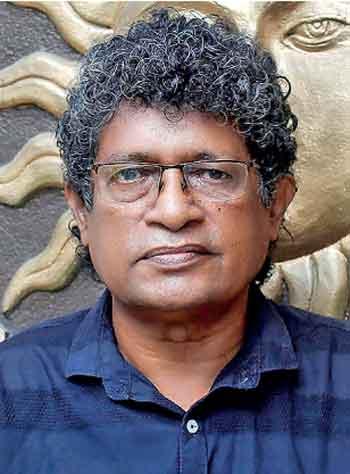 |
| Villager Nalin (Head of the Anura Puppet Group) |
Puppetry in Sri Lanka survives today due to the efforts of his grandsons Gamchari Martin, Gamchari Premin and Gamchari Gamini. They maintain that in 1995 then Minister of Cultural Affairs Lakshman Jayakody established a Puppetry Art Sub-Committee to uplift puppetry, but it became defunct soon. They pointed out that puppetry is a segment of dancing and theatre is a subject in the school curricular. However puppetry isn’t taught in schools for want of teachers. They affirm that given the opportunity they could provide a formal training to school teachers.
They requested the relevant authorities of the government to protect puppetry as a folk art, which has been interwoven with the Sri Lankan culture.
07 Jun 2026 4 hours ago
07 Jun 2026 5 hours ago
07 Jun 2026 8 hours ago
07 Jun 2026 9 hours ago
07 Jun 2026 9 hours ago