11 Apr 2025 - {{hitsCtrl.values.hits}}
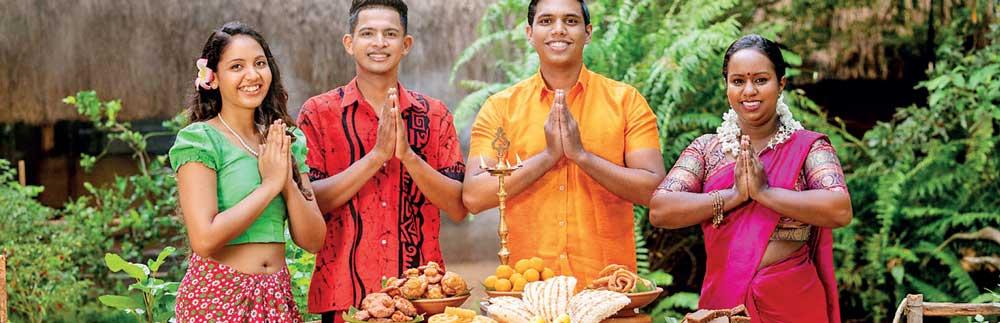
Traditional attire and the meticulously arranged table of festive delicacies illustrate the cultural essence of Avurudu celebrations
 The sound of the familiar koha (or the ‘asian koel’), chanting the rhythmic tune, which millions of Sri Lankans wake up to, is a sign that ‘Avurudu’ (New Year) is near.
The Sinhala and Tamil New Year is not just a celebration of the dawn of a new year, but also that of unity, cultural enrichment and a sense of family unity. This is all demonstrated, for example, in the ‘boiling of milk’ ritual, where milk is boiled in a new clay pot and the time when the whole family sits down to have the auspicious meal.
Each ritual, from the boiling of the milk to the auspicious meal to what you wear, is decided by astrologers who determine the precise astrological time and dress codes for various rituals. The dawn of the New Year is signified by the sun’s movement from the Meena Rashiya (House of Pisces) to the Mesha Rashiya (House of Aries).
Cleansing
The initial ritual Sri Lankans observe is the bathing of oneself, by applying a herbal mixture; this is so that one can purify oneself and be fully prepared before embracing the neutral period of the new year. This ritual takes place usually on April 12.
Nonagathaya (neutral time)
Before embracing the New Year, there is a time when we are in between the old year and the New Year. This period usually begins on April 13 and goes on for around 12 hours and 48 minutes. At this time, people are encouraged to prepare themselves spiritually for the New Year, so they do this by rejecting material pursuits and engaging in day-to-day activities such as cleaning, cooking or reading.
As the ‘Nonagathaya’ comes to an end, we proceed with the lighting of the hearth, or simply boiling milk on a brand new clay pot. As the pot boils and the milk overflows, the one overseeing the pot usually calls on the whole family to gather to observe the overflowing of the milk, which is to signify prosperity and abundance for the New Year.
The kiribath (milk rice) is prepared to be had at the table with other accompaniments (like any curries or sambols to go with the kiribath), and the most exciting part of all meal prep is laying out the New Year sweets. Usually, the layout consists of Kokis (the orange crispy snack), Kavum (Oil Cake), Mung Kavum (made with sweetened mung green gram), Athirasa (a flat sweet-cake), Aasmi (a deep-fried snack) and many other delicacies.
Ganu Denu (Exchanging wishes)
It is customary to offer betel leaves to parents, and in return, they may offer blessings or money (Kai-vishesham in Sri Lankan Tamil) for the New Year. This ritual symbolises respect and gratitude, which is customary in Sri Lankan culture, yet the values of respecting your elders are reminded here. The act of exchanging usually takes place before the first meal.
Right after the main activities, family members go from house to house in the neighbourhood, exchanging wishes and even parcels of delicacies. In return, other households exchange their treats with the visitors. This fosters neighbourliness and brings a sense of community to the celebrations.
In the past, the ‘Avurudu Utsawa’ (New Year festival) was common in many village communities. The town’s folks gather around, organising festivities, activities and events coinciding with the astrological times. This, in effect, fosters a sense of community amongst village folks. And the one aspect that makes such community events so popular is the popular New Year games. Some popular games include the: “Kotta Pora” (pillow fighting), “Aliyata Aha Thabima” (marking the elephant’s eye), “Avurudu Kumara Kumariya”, “Kamba Adeema” (tug of war), Thirikkal races and many other joyful activities.
In the current day, while the feeling of the ‘Avurudu Uthsawa’, the community aspect of the New Year might not be the same. Schools, universities and other corporates, fuel the festival’s spirit by organising such events to help bring about togetherness and socialising amongst students. They are most likely busy with studies and assignments and employees are generally busy with work, hence for workers and students alike, it is an opportunity to have a lighter moment with each other for once during the busy year. Leading hotels and resorts also organise large community-style ‘Avurudu Uthsawa’ where guests can engage in the same activities, similar in spirit to the traditional festivals held in villages. Nonetheless, most people, especially in Urban Sri Lanka, keep their celebrations to themselves and then visit neighbours or relatives. Some families go out of Colombo to celebrate the New Year with relatives who live far away, where the New Year’s spirit might be a few notches higher.
16 Jul 2026 15 minute ago
16 Jul 2026 48 minute ago
16 Jul 2026 1 hours ago
15 Jul 2026 7 hours ago
15 Jul 2026 7 hours ago