21 Aug 2025 - {{hitsCtrl.values.hits}}
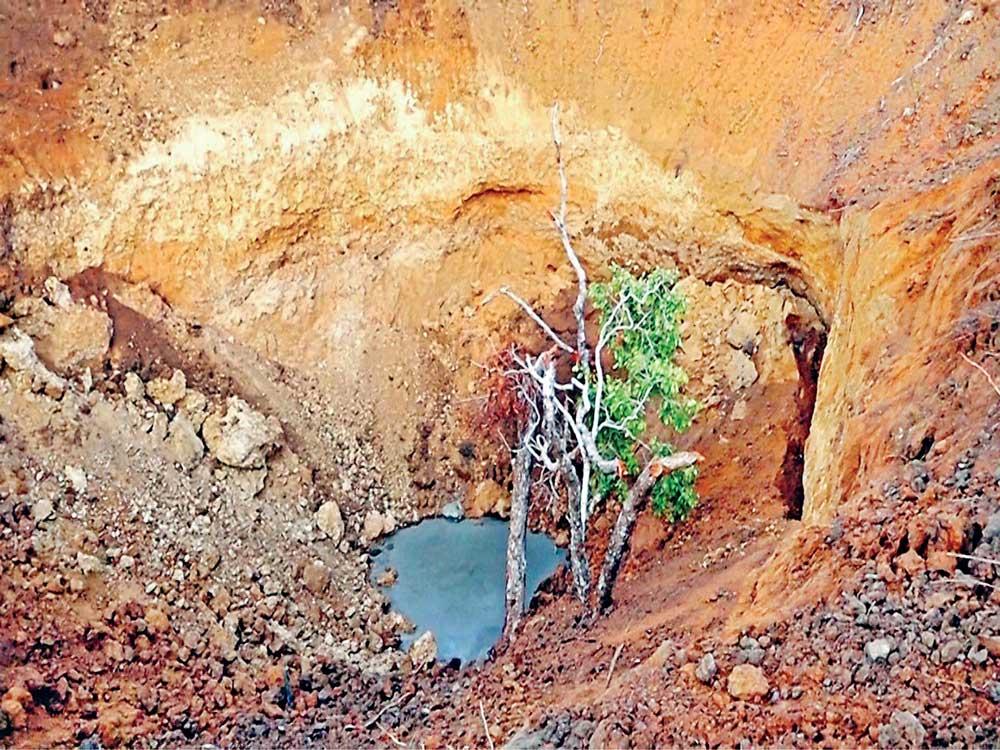 Though the tunnel was designed with the assurance that it would cause minimal ecological disruption, this picture shows that subsidence could not be prevented
 By Prageeth Sampath Karunathilaka and Sudharika Gurusinghe
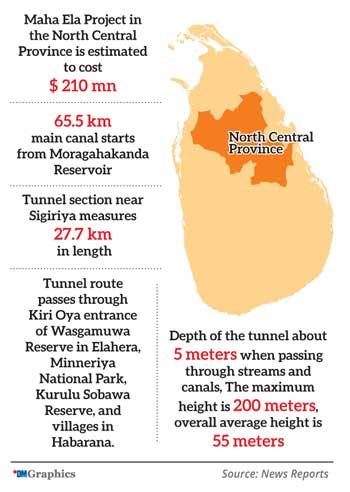
It is common for countries to launch development projects while they achieve economic growth. Such projects bring both benefits and drawbacks. Although various development work has been undertaken in Sri Lanka to minimise these drawbacks, some have still had adverse effects on the population. Maha Ela Project in the North Central Province is one such initiative. Implemented under the Ministry of Irrigation, it is estimated to cost 210 million US$.
This project is implemented as part of the Mahaweli Water Security Investment Programme and comes under the purview of the Ministry of Irrigation. It involves a 65.5 km main canal starting from Moragahakanda Reservoir, consisting of both open and underground sections.
The tunnel section of this project, which is being constructed near Sigiriya, measures 27.7 kilometres in length. The canal stretches for 27.5 km from Moragahakanda Reservoir to a location called Koduruwa, where it continues through two tunnels. The reason for directing this canal through a tunnel was to ease the process of carrying excess water from the Mahaweli river basin to the adjacent river basins. The water catchment areas of the two basins are separated by a mountain, with water on one side flowing into Mahaweli River and water on the other side flowing into another river.
The tunnel takes route through a highly sensitive area, including the Kiri Oya entrance of Wasgamuwa Reserve in Elahera, Minneriya National Park, Kurulu Sobawa Reserve and several villages in Habarana. To address environmental and social concerns, the tunnel has been designed to cause minimal ecological disruption. The depth of the tunnel is about 5 metres when passing through streams and canals, with a maximum height of 200 metres. The overall average height is considered to be 55 metres. The 200-metre-high sections are located in mountainous areas. The tunnel excavation has been carried out parallel to the elevation of the mountain.
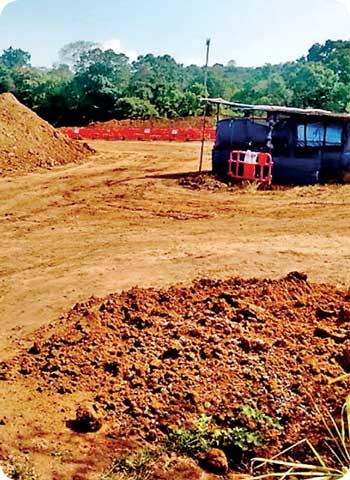 |
| Places which have experienced subsidence being filled in by the authorities - Officials maintain that many projects in Sri Lanka, including this tunnel, are not designed to resist earthquakes |
Reappearing of old waterways
The tunnel is constructed 4.5 kilometres from Sigiriya. However, recently, this tunnel area experienced subsidence near Sigiriya. As a result, old waterways that once supplied water to Sigiriya reappeared. Nearby residents claimed that the site is now being filled with concrete without proper consideration of these waterways. A project official stated that the Department of Archaeology has not confirmed whether the old waterway revealed during the subsidence was a water system that carried water to Sigiriya.
There was no ground subsidence during the canal excavation. The submerged area consists of sandy soil and is surrounded by paddy fields. If a proper soil test had been conducted at the start of this project, officials might have been aware of the excavation carried out in sandy soil. The project officer, however, maintained that the sandy area was identified early, and appropriate technical methods were adopted. The tunnel at the submerged site passes through sandy and decomposed rock layers at a depth of 15 metres. Nearby, there is a canal flowing close to Sigiriya and Minneriya reserve. There are many farmers cultivating big onions who use water from this canal. These farmers are now facing serious problems because the tunnel has subsided, stopping the flow of water in Kosgaha Canal, which they rely on for their cultivation.
Project officials explain that the subsidence happened due to sand deposits accumulated over hundreds of years along the path of the canal. A tank called Mailaththewa, built across this canal, supports about 45 acres of paddy cultivation. The soil beneath these fields is sandy. Officials believe the tunnel sank due to this sandy soil. If a proper inspection of this soil had been carried out, this subsidence would not have occurred.
According to the officers, soil testing was conducted by drilling about 300 boreholes, followed by soil stabilization before excavation. Project officials pointed out that although various technical methods were used to examine the soil here, no subsidence was detected. No matter how many inspections were carried out, the subsidence could not be prevented. He also added that subsidence was minimal and did not cause major damage. According to him, even with modern technology, such accidents cannot be predicted.
Similar subsidence incidents have occurred before in Kiri Oya and another location. However, the official said the failure of technical methods to detect the subsidence near Sigiriya is a serious concern. Furthermore, the official pointed out that changes in the geological layers beneath the surface can alter the nature of the soil. When these layers move, the soil can loosen and collapse. Such events are usually caused by previous strong pressure between the ground layers. One potential subsidence site has also been identified in the centre of Habarana city, which was passed with great difficulty during construction.
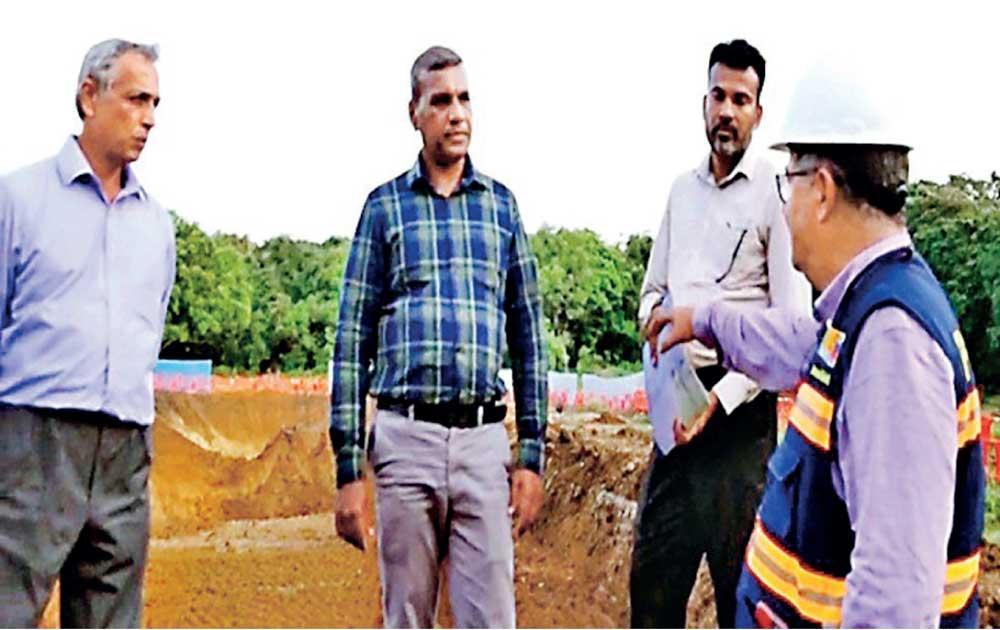
Deputy Minister of Lands Sunil Ranasinghe (second from left) inspecting the areas which have experienced subsidence
Seegiriya 5- Officials point out that areas near Sigiriya (Shown in the picture), Habarana and Anuradhapura are exposed to severe danger in the event there is either subsidence, an earthquake or landslide due to the repercussions of this project
Sri Lanka is now located in a new seismic zone, as noted by Professors Wilbert Kehelpannala and Athula Senaratne, and reported in the media multiple times. Newspapers and other media outlets have reported on this matter. Minor earthquakes have occurred near Sigiriya and Anuradhapura in the past. The project officer added that since this tunnel lies in a high-risk area it will be severely affected in the event there are earthquakes.
Playing around in a seismic zone
A new seismic zone runs from west to east across Sri Lanka. In the 1980s, Kandy felt the tremor of a 5.2 magnitude earthquake in the sea area, which happened 425 kilometres away. Similar earthquakes in mountainous areas could cause severe damage. In the past, there was a seismic zone extending from Trincomalee southward, with many minor earthquakes recorded around Anuradhapura. Authorities have warned that a major earthquake could even damage the embankment of Lunugamvehera reservoir. Against this background, an investigation done by this newspaper revealed that the tunnel is being built without a seismic report, despite unstable soil layers. According to the project officer, no technical assurance has been given on soil stability at the tunnel site. There is no guarantee that areas near Sigiriya, Habarana, and Anuradhapura will not experience subsidence if an earthquake or landslide occurs, and any damage would be severe.
The official also noted that although the tunnel is being constructed with concrete possessing a strong cover, there is no guarantee it can withstand earthquakes. Even though excavation is carried out using modern machinery, such equipment impact ground stability, increasing the risk of landslides or subsidence in the area.
The official said that many projects in Sri Lanka, including this tunnel, are not designed to resist earthquakes. He pointed out that this tunnel project has also not been constructed to withstand earthquakes. The tunnel has been built to withstand normal conditions. It is also clear that the tunnel, which passes through 13 Divisional Secretariat divisions, is in a high-risk area. The official said that these plans had been designed based on the assumption that Sri Lanka was not located in a seismic zone. Designing it to be earthquake-resistant would have significantly increased costs. The official admitted that many government buildings are not earthquake-proof.
While many developed countries have met earthquake-resistant standards during tunnel construction, Sri Lanka has yet to implement such measures. The government tends to ignore these concerns when initiating projects. Although this tunnel is built by a government institution, those involved merely follow orders.
Critics point out that the government itself should inform the public that an earthquake would not pose a danger. The lack of implementation of such plans in Sri Lanka has now become a serious issue. Irrigation projects are not designed to withstand earthquakes.
Accordingly, the lives of people living in 13 Divisional Secretariat divisions are at risk. The ground around Sigiriya is unstable, and it would not be surprising if that area subsided in an earthquake. The lives of people living in Naula, Elahera, Bakamuna, Habarana, Mihintale, Thirappane, Rambewa, Medawachchiya, and Kekirawa are at risk.
The plan is to transfer water from Moragahakanda and Kalu Ganga projects to the North Central region through tunnels and canals. The Irrigation Department has previously confirmed that the water from Moragahakanda is insufficient for agricultural activities in Polonnaruwa itself. Although this project was commenced with a $475 million loan, there are issues with the water supply system.
Another goal is to fill the canal with excess water when Kandy and Mahaweli regions receive rainfall. Due to sediment buildup in Mahaweli reservoirs, the expected water levels are not being reached. Additionally, changes in Sri Lanka’s rainfall present serious challenges to securing the anticipated water supply. In the past, changes in the rainfall patterns in Sri Lanka have also been observed. Therefore, obtaining the expected water supply poses a significant challenge for this project. If successful, the project could meet its objectives and deliver benefits. However, if this risky project is carried out, there will be no one to hold accountable in the event of an accident.
Attempts made to obtain information from the Department of Archaeology were unsuccessful as no representatives were available for comment.
Project Director Seneviratne Banda commented: “The project’s design guarantees that structure would be earthquake-resistant. If you have doubts, you can verify this with the Colombo head office. I speak with knowledge. A water management plan has been prepared to supply the project with the required water. This is a complex matter. The plans have been developed based on data available since 1930. Sigiriya is 4.4 kilometres away, so even if subsidence occurs here, Sigiriya will not suffer any damage. This project is not a failure. Subsidence can occur in the ground, and the soil may not be strong. The plans were made with this in mind. Areas where subsidence occurred were identified as having weak soil. In the centre of Habarana, one such area extended to about a kilometre. Reservoirs like Laxapana, Victoria, Randenigala, and Polgolla were constructed without seismic design, but there are tunnels. If an earthquake were to occur, what would happen? So far, they have sustained no damage. I acknowledge Sri Lanka is now part of a new seismic zone. I have studied this. I confidently state that this project is designed to withstand such earthquakes. I provide this assurance on behalf of the government.”
Commenting on the situation during a visit to the sunken area near Sigiriya, Deputy Minister of Lands, Sunil Ranasinghe, said: “There has been subsidence in the tunnel that carries water from Maha Ela in the North Central province. I inspected the site and observed subsidence in two locations. The tunnel stretches about 28 kilometres. This area used to be a paddy field. Restoration work is currently underway and it does not obstruct the tunnel’s construction or affect local farmers. Such weak spots have been identified near Sigiriya, and engineers warn that subsidence could occur there as well. This project is estimated to cost nearly 150 billion rupees, with an additional 150 billion needed. Reports have emerged of various irregularities and inefficiencies in the project. We are investigating these issues promptly and taking steps to address them.”
08 Jun 2026 17 minute ago
08 Jun 2026 20 minute ago
08 Jun 2026 27 minute ago
08 Jun 2026 35 minute ago
08 Jun 2026 2 hours ago