13 Jun 2025 - {{hitsCtrl.values.hits}}
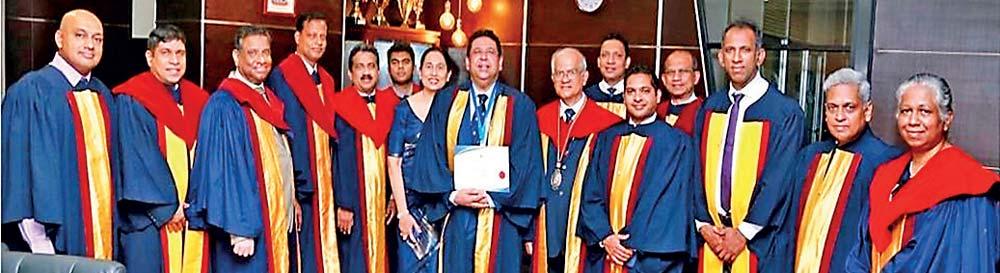
The Orator with the Council of the SLCOG
 Dr. Sanath Akmeemana, President of the Sri Lanka College of Obstetricians and Gynaecologists, awards the oration medal to Dr. Gamini Galappatthy, Senior Consultant Cardiologist, National Hospital of Sri Lanka, who delivered the prestigious Professor D.E. Gunatilleke memorial oration at the Samson Rajapaksha auditorium of the SLCOG House on May 25, 2025. The oration was titled ‘Heart Disease and Pregnancy – The Crossroads Well Signposted Will Prevent Disasters’.
Prof. D.E. Gunatilleke Oration
Prof. D.E. Gunatilleke was a renowned consultant obstetrician and gynaecologist and former President of SLCOG 1979-1981, has made invaluable contributions to obstetrics and gynaecology in Sri Lanka—his legacy continues to inspire generations. He was born in 1924 and entered Colombo Medical College in 1944, passing MBBS with a brilliant academic record in 1949. He continued to shine both academically and clinically, obtaining his membership of the Royal College of Obstetricians and Gynaecologists, London, as the best student from the British Commonwealth. A pioneer in introducing laparoscopic gynaecological surgery, he died in 1983, having served the country for nearly four decades. This prestigious annual oration in memory of late Prof D.E. Gunatilleke honours his values of meticulous clinical practice, kindness and integrity and was attended by many members of his family.
This year’s Prof. D.E. Gunatilleke Memorial Oration, titled “Heart Disease and Pregnancy – the Crossroads Well Signposted Will Prevent Disasters”, was brilliantly delivered by my classmate from the Royal College, Dr. Gamini Galappatthy, Senior Consultant Cardiologist at the National Hospital of Sri Lanka.
A Personal Connection to the Oration
Attending this distinguished oration carried deep personal meaning to me, not only because of my lifelong friendship with Gamini since our early years at Royal College, but also due to my late father, Dr. D.V.H. Silva, who was a fellow member of the Royal College of Obstetricians and Gynaecologists (UK) and its Sri Lankan affiliate, SLCOG. Among the audience were many of my late father’s colleagues and former students, adding a sense of both legacy and professional camaraderie to the occasion.
Listening to Dr. Gamini Galappatthy’s oration, I recognised the critical need to elevate awareness of maternal cardiac care, prompting me to contribute through a paper article—exploring the paradigm shift he advocates in obstetric patient care to prevent crises at pivotal junctures.
The ‘crossroads’: learning to navigate safely
The crossroads are real—every pregnant woman with heart disease stands at one. Gamini’s use of the metaphor of a dangerous crossroads between pregnancy and heart disease was appropriate and illustrative. Travelling down either road, one encounters many inherent dangers, but coming to the junction unprepared could end in disaster! A maternal death is a tragic and largely preventable disaster at the crossroads, the majority due to heart disease in Sri Lanka. In addition to snatching a woman’s life in the prime, the socio-economic impact of a maternal death is far-reaching. With the right signposts, collaboration, and a shift to proactive safety thinking, the obstetric teams can ensure these women navigate the crossroads safely.
Gamini provided novel insights into the ‘Safety-I’ and ‘Safety-II’ frameworks as applicable to maternal cardiac care—emphasising the importance of learning as done at present, from mistakes, risk identification and error prevention (Safety-I) while also highlighting the need for a broader approach of additionally studying successful practices and successful outcomes (Safety-II) to enhance success in patient care. His emphasis is on multidisciplinary collaboration, early risk assessments, and optimised treatment protocols as the cornerstones of proactive maternal healthcare.
The concepts of Safety I and Safety II, which Gamini highlighted, were first proposed by Professor Erik Hollnagel from Denmark in a 2013 paper. These are currently being recognised by the World Health Organization (WHO), the National Institute for Clinical Excellence (NICE) UK and the Royal College of Obstetricians and Gynaecologists (RCOG) in the UK.
The novel Safety II approach proposed by Gamini in his oration for the field of obstetrics and gynaecology in Sri Lanka, especially in the context of heart disease management in pregnancy, was well received by the esteemed audience at the oration, consisting of consultant obstetricians, physicians, cardiologists and medical administrators.
The oration was spread out as below, proposing a paradigm shift in thinking to enhance maternal cardiac care in Sri Lanka by applying the Safety-I and Safety-II Frameworks.
Maternal cardiac care in Sri Lanka is of particular importance, as preventable cardiovascular complications during pregnancy remain a leading cause of maternal mortality. To enhance patient outcomes, healthcare providers must shift from the retrospective focus of Safety-I, centred on failures, risk identification, and error prevention, to the proactive principles of Safety-II, which emphasise successful practices, positive outcomes, and the implementation of guideline recommendations. Shifting to the Safety-II framework could enhance patient safety by minimising risks while optimising best practices.
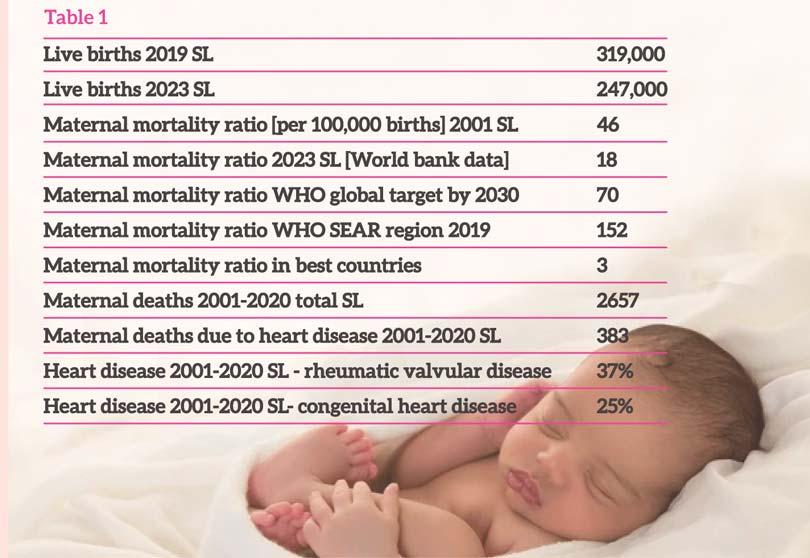
Gamini shared maternal mortality statistics and heart disease in pregnancy statistics for Sri Lanka and described outcomes and trends over the past several decades to the present day, and compared SL statistics with global and regional benchmarks. (See Table 1). He also emphasised key aspects of the WHO maternal heart disease risk stratification and European Society of Cardiology guidelines on managing heart diseases in pregnancy.
The Safety-I and novel Safety-II concept Gamini described is as follows:
Safety-I: Learning from failures
Sri Lanka’s maternal healthcare system, recognised as one of the best globally, still faces several challenges, including a relatively high maternal mortality ratio compared to the best in the world, largely due to late diagnoses of heart conditions and limited access to specialised cardiac care.
Safety-I principles aim to address these risks by conducting WHO-initiated Maternal Death Surveillance Response [MDSR] meetings at the national level after a maternal death to arrive at the cause of maternal deaths. Such data are analysed by the Ministry of Health to derive a set of globally accepted and comparable statistical parameters such as the maternal mortality ratio and causes of maternal mortality.
In Sri Lanka, from 2001 to 2020, a leading cause of maternal mortality was heart disease. Of these, rheumatic valvular heart disease, mainly mitral valve stenosis, was the leading cause. It is estimated that 60% of these
deaths are preventable by early diagnosis.
Learning from failures, these statistics allow healthcare providers to identify and eliminate future hazards before they escalate and put in place measures to reduce future preventable complications such as:-
Safety-II: Learning from Successes
To improve patient outcomes, healthcare providers must transition from the current Safety-I framework to the Safety-II approach, which enhances patient outcomes by building upon Safety-I and incorporating proactive measures. It is estimated from a recent analysis in the USA that 1% to 4% of pregnant women have heart disease. In Sri Lanka, this would account for around 2500 pregnant mothers annually with heart disease, a large majority of whom undergo successful pregnancies and are delivered through the crossroads safely by their obstetrics teams.
Learning from the successful outcomes includes:
By shifting focus from avoiding mistakes to replicating successful practices, Sri Lanka can create a resilient maternal cardiac care system that improves survival rates and overall healthcare effectiveness.
In short, Dr. Gamini Galappatthy said that, “A globally recognised paradigm shift from the present Safety-I to a Safety-II approach, which builds upon Safety-I by integrating additional proactive measures to enhance patient outcomes, would ensure that Sri Lanka’s maternal cardiac care system is both reactive to failures and proactive in promoting success. By integrating ‘signposts’ such as early risk identification, evidence-based successful strategies and a multi-disciplinary approach, disasters at the Heart Disease and Pregnancy ‘crossroads’ can be prevented and the crossroads navigated safely”.
The Writer holds an MBA, is the son of the late Dr. D.V.H. Silva FRCOG (UK), a distinguished Obstetrician and Gynaecologist, is a seasoned finance leasing expert and former transformational CEO of Abans Finance PLC. Currently pursuing a master’s in financial economics, he has been a classmate of Dr. Gamini Galappatthy—the esteemed orator—from their primary years at Royal College Colombo.
14 Jun 2026 7 hours ago
14 Jun 2026 9 hours ago
14 Jun 2026 9 hours ago
14 Jun 2026 14 Jun 2026
14 Jun 2026 14 Jun 2026