22 Oct 2025 - {{hitsCtrl.values.hits}}
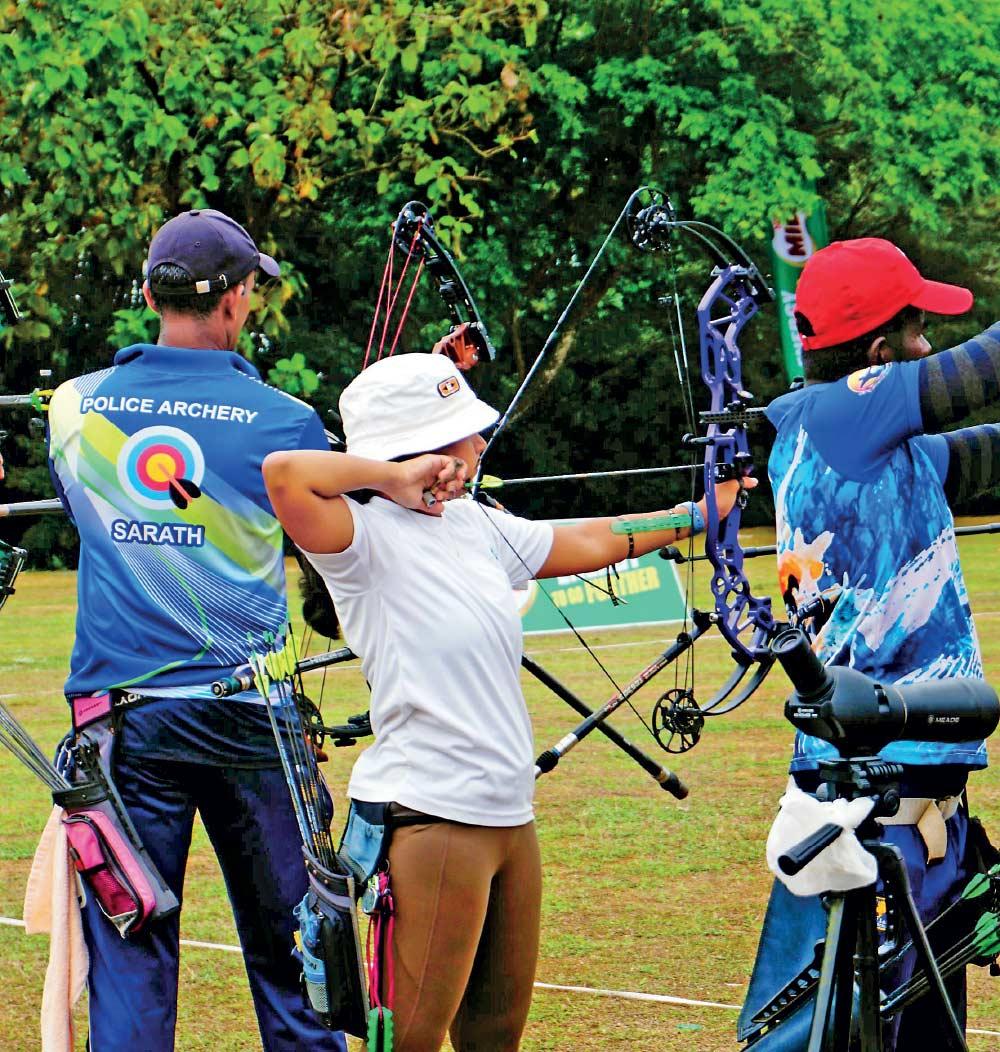
Rehana Tayabally. 22nd National Archery Championships 2025. Maitland Archery Academy
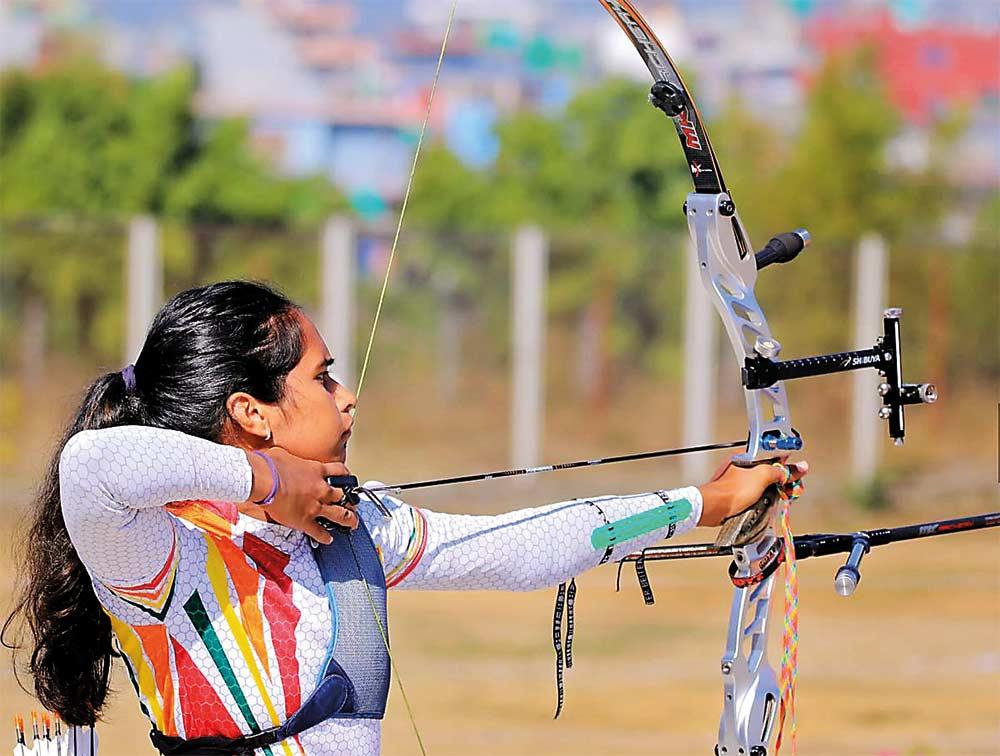
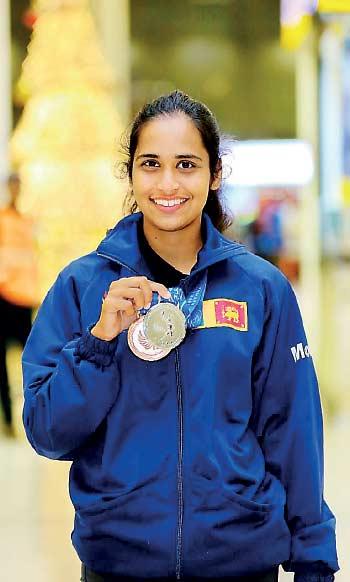
Rehana Tayabally. South Asian Games 2019
By Tahaan Jayewardene
|
Rehana Tayabally. South Asian Games 2019
|
Twenty-seven-year-old Rehana Tayabally, the archer who struck gold, has won more than just the gold medal at the National Championships this year.
The real gold is clear to anyone who’s seen her shoot. An air of calm and cool confidence is how I would describe seeing Tayabally shoot her arrow. The ‘gold’ is the invaluable strength and control of mind, that only an archer such as Tayabally, can demonstrate.
Tayabally, won the gold medal at the 22nd National Archery Championships this September. This involved shooting her arrows with a compound bow at 50 meters, aiming at the target face (of only 122 cm).
Her journey in archery, marks several significant local accomplishments; her making the national team from 2015 to 2019, and becoming the senior and junior national Champion in 2017. Her international accomplishments include winning the silver medal at the indoor youth cup in Thailand (2017), and the bronze medal at the 2018 South Asian Archery championships (team event), and the silver and bronze medals at the South Asian games in 2019.
Journey
Tayabally first started archery when she was just 12 years old, having been influenced by her father, former archer Leyaket Tayabally, founder and head coach of Maitland Archery Academy (MAA).
She competed in her first tournament at 13. It wasn’t love at first try. She said that in the beginning she found the sport boring and wanted to run around instead of standing in one place to shoot arrows. Just like any kid would want to do at that age, she added.
At 15, it was a friend who convinced her to come back for practice whilst having nothing to do during school holidays. This time, she began to enjoy the sport, spending every day of her holidays practicing. She noticed she was getting good at it and began to enjoy both the sport and having good company around her.
Mind over Matter
“It was just very unexpected. I guess it meant that hard work eventually pays off,” she said referring to her win at the National Championships.
She adds, that coming up to the tournament it was difficult having to juggle work and training, also mentioning that she had a shoulder injury.
“I guess if you believe in yourself, you can always achieve it.”
She underscores the importance of mental strength saying that despite also being sick with the flue the week before the championships, “on the day of the tournament if you remain mentally strong you can still do it.”
Tayabally mentioned the two-time Olympic gold medalist, winner of the 2016 Olympic games, Hye Jin Chang, from Korea. She points out that the Olympian is a small lady, and for archery you don’t need to be big and muscular. Mental strength is what’s essential. Elaborating on her own experience, she said, “if you go with the correct Mindset to your competition, I think that’s all that matters.”
“The way you’re thinking, your positive thinking, definitely plays a big role,” she said. Using her own win as an example, she says that even while not being at her physically strongest before the tournament, she still managed to win.
Self-control and Awareness
Tayabally demonstrates great self-control and awareness. The mental and behavioural strategies she uses, for improving her mental state, demonstrate this. When she feels nervous, she looks to nature (the sky or trees), which helps calm her. She mentions how she sometimes listens to music and zones out, not wanting to participate or hear conversations about missed shots. This helps her focus and think positive. “Before every shot you think okay this is going to be a good shot,” and thinks of the process beforehand; how you’re going to shoot before doing it.
She adds that she always tries to shoot before the opponent, thereby reducing the pressure she feels. She usually wants to shoot fast, as soon as the timer starts, different from other archers who may prefer the pressure of waiting till the last 50 seconds (which she’s seen happen at a few international tournaments.)
Finally, she mentions that other than figuring out your own strategy, it’s a lot about muscle memory and training yourself in doing it repeatedly. “I think it’s 80% technique [and] 20% aim,” she said.
She brings up the Korean team, saying they are the best at archery and shoot around 600 arrows a day, and shoot over 7 hours. Their whole life is archery, she said, and their team works hard on mental training (teaching their athletes to face their own fears).
Biggest challenges
Tayabally spoke about some of the biggest challenges she has faced as an athlete. From not being chosen for international tournaments (despite being one of the top three ranking athletes), to not having a national coach and proper training facilities, and the struggle of being a female in sports. Unlike other countries whose national teams train together, she mentions how the Sri Lankan team don’t have national team practices and don’t train as a team. She elaborates that there is a lack of training facilities, including not having a common practice space nor a national coach, due to funding constraints.
She added that national teams in other countries have a training schedule and equipment, and facilities provided by their governments.
She mentioned the distinct benefits of training with a team, not only for the team events for tournaments but also the benefits of practicing under pressure. This is important for any athlete, as simulating real competitive conditions during practice is invaluable. She mentioned teams from India and Bangladesh get support from their governments. Bangladesh for example, despite starting archery after Sri Lanka, have done well, even sending an archer to represent their country at the Olympics.
Tayabally also talked about the constraints of doing archery professionally, saying a lot of civilians don’t do the sport because they can’t earn a living out of it. She said, “anyone who does it, who’s a civilian, just does it out of passion.” She adds that people usually do it as a sport in schools, and everyone else who does the sport are from the forces.
Supporting Archery
Tayabally talked about how the sport of archery, and new archers can be better supported. She mentioned the sport’s need for funding, saying that archery is an expensive sport.
She also said, “we definitely need a national coach [and] we definitely need a place to practice.”
She mentions however, that the sport is picking up traction in Sri Lanka, and a lot of schools are starting it.
She adds that a lot of famous schools have archery. She suggests having inter-school competitions and giving athletes more exposure to the international arena. “Because Sri Lanka does have good potential.”
“We’ve had some good athletes but don’t have the funding or the best equipment to get this recognition in the international arena.”
Sri Lanka’s potential in archery, she explained, how unlike rugby players for example, isn’t constrained by an ideal physique. Sri Lankans, with our comparatively smaller physique, can do well in this sport. She also adds that it’s one of the oldest sports, and even the Veddas did archery. With more government intervention (more funding and more focus), she said that Sri Lankans can do well in this sport.
Sharing an example of how impactful government intervention can be, she talked about the 2019 South Asian games in Nepal, where the government gave support,providing an international coach and a place to practice.
After just six months of practicing together as a team before the tournament many athletes improved drastically. “We were able to win many medals at the South Asian Games because of that.”
Practicing together and shooting against each other, thereby learning to handle that competitive pressure, helped the athletes improve. "Because archery is a sport where you have to compete against yourself, and then you have to also compete against someone else.”
Archer’s Arrow
The bow and arrow are both symbol and weapon. The reality: the arrow is not the weapon. The mind is. A good archer has tuned their minds to listen to silence. A silence they create; a calm pool of water undisturbed no matter the storms raging above. A calm earned through shear will power, discipline, control, and focus. Such that the true reflection of a good shot, is not the shot itself, but that of the mind that’s become the weapon of precision and focus.
07 Jun 2026 7 hours ago
07 Jun 2026 8 hours ago
07 Jun 2026 07 Jun 2026
07 Jun 2026 07 Jun 2026
07 Jun 2026 07 Jun 2026