28 Aug 2025 - {{hitsCtrl.values.hits}}
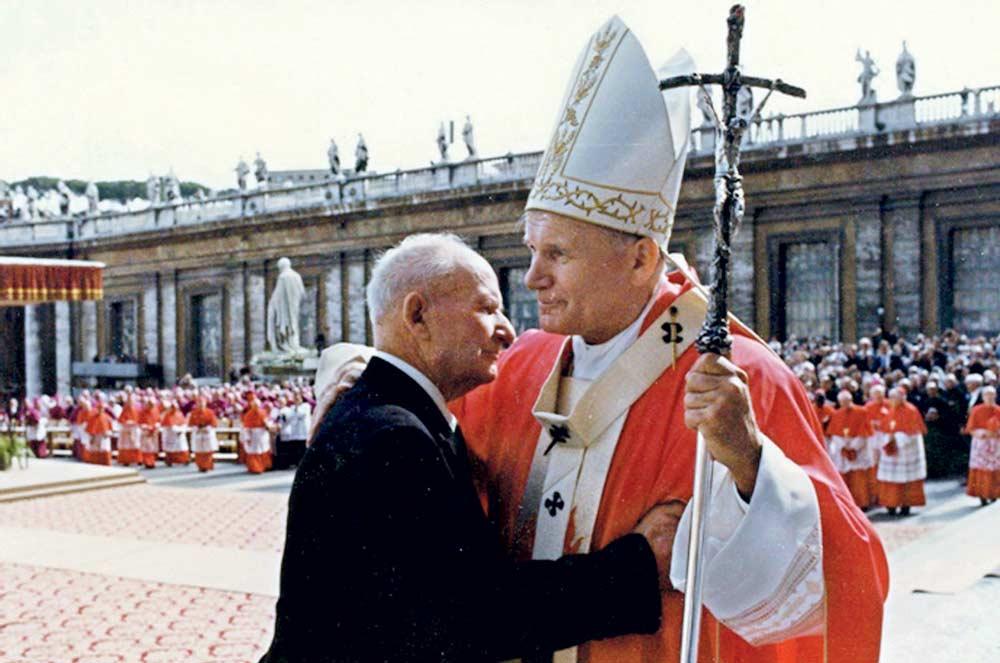
Franciszek Gajowniczek with Pope John Paul II at the canonisation ceremony of St.Maximilian Kolbe on October 100, 1982
 St. Maximilian Maria Kolbe was born on January 8, 1894, in Zduńska Wola, situated in the then Russian-occupied part of Poland
Father Maximilian volunteered to die at Auschwitz in place of another prisoner, ultimately perishing by starvation and injection. He passed away on August 14, 1941
St. Maximilian Kolbe was a standout student at the Franciscan Minor Seminary in Lwow, excelling particularly in mathematics and science
Maximilian’s father, Julius, joined Piłsudski’s Polish Legions, was captured by Soviet Russians, and executed at just 43
|
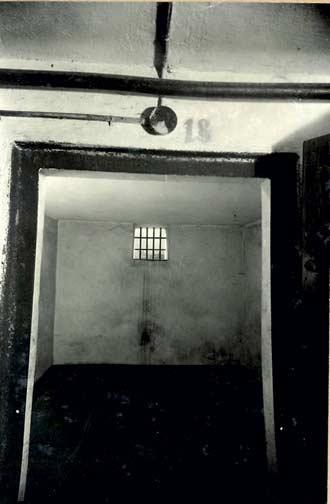
Death Bunker at Auschwitz (Photo courtesy: The Archives of MI Niepokalanów (Archiwum MI Niepokalanów), Teresin, Poland) |
|
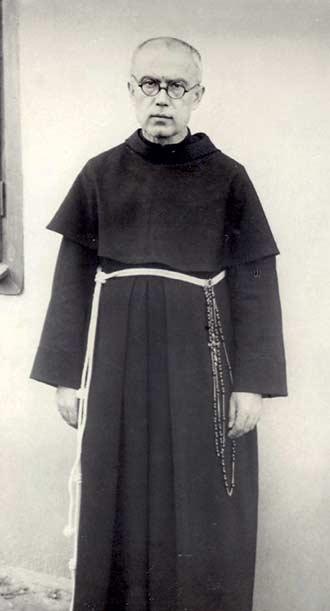
St. Maxilian Kolbe |
By Prabath De Silva
The 84th anniversary of the death of St. Maximilian Maria Kolbe—a Polish Franciscan priest who, during the Second World War, volunteered to die in place of a fellow prisoner, Franciszek Gajowniczek (a father of two, condemned to starve to death in the infamous “Death Bunker” at the Nazi concentration and extermination camp of Auschwitz), in order to save that prisoner’s life—fell on August 14, 2025. St. Maximilian Kolbe was no stranger to Sri Lanka. During his missionary journeys to and from Japan, China and India, he visited the Island (then known as Ceylon) in 1930, 1932 and 1933.
In July 1941, the Nazis discovered that a prisoner had escaped from the Auschwitz concentration and extermination camp. On such occasions, the Nazis enforced a brutal retaliatory policy they believed would serve as a deterrent: for every escapee, ten men randomly chosen from the remaining prisoners would be starved to death. Following this cruel and inhuman policy, the SS officer, Karl Fritsch, selected ten men from among the prisoners who were standing in ranks for this unjust collective punishment. One of those chosen was a Polish prisoner, Franciszek Gajowniczek, who pleaded in anguish, ‘My wife and children’. Father Maximilian Maria Kolbe was a 47-year-old Polish Franciscan priest who had been taken prisoner by the Nazis. He was not among the ten chosen for the cruel and vengeful punishment. Father Maximilian heard the desperate plea of his fellow prisoner, Franciszek Gajowniczek. Moved by compassion, he walked up to the Nazi officer. When asked, “Who are you?” Father Maximilian replied, ‘I am a Catholic priest. I want to die for that man; he has a wife and children’. The Nazi officer complied with Father Maximilian’s request and chose him in place of Franciszek Gajowniczek. Along with nine other prisoners condemned to death by starvation, Father Maximilian was led to a cell in the ‘Death Bunker’. A person who had served as an assistant janitor at Auschwitz at that time later testified that in his prison cell, Father Maximilian led the prisoners in prayer. Each time the guards came to check, they saw him standing or kneeling in the middle of the cell. He and the other nine prisoners were starved and deprived of water for two weeks, and all but Fr. Maximilian and three others died. The guards, eager to empty the bunker as quickly as possible, administered lethal injections of carbolic acid to Father Maximilian and the three remaining prisoners, ending their lives.
Father Maximilian passed away on August 14, 1941. His mortal remains were cremated the following day, August 15, the Feast of the Assumption of Mary. Gajowniczek, whose life was spared through Father Maximilian’s supremely heroic and sacrificial act of love, remained imprisoned at Auschwitz until he was transferred from there to the Sachsenhausen concentration camp on October 25, 1944. He remained a prisoner there until the camp was liberated by the Allied forces following Germany’s surrender on May 7, 1945. Six months later, when he reunited with his wife Helena, who had survived the war, he learnt that their two sons had been killed in a Soviet bombardment of Rawa Mazowiecka in January 1945 before his release. Gajowniczek dedicated the rest of his life to sharing the story of Father Maximilian’s supreme act of love and sacrifice – how one man laid down his life so that another man might live. Father Maximilian’s sacrifice was a living example, an epic realisation of what Christ said: ‘Greater love has no one than this, than to lay down one’s life for his friends’ [John 15:13]. It was also a profound imitation of what Christ himself did.
On October 17, 1971, Pope Paul VI beatified Father Maximilian Kolbe. Eleven years later, on October 10, 1982, Pope John Paul II canonised him, proclaiming that he was a ‘martyr of charity’. Franciszek Gajowniczek was present in Rome to witness both the beatification and canonisation ceremonies. St. Maximilian Kolbe is one of the 20th-century Christian martyrs commemorated in statues erected above the Great West Door of Westminster Abbey, a cathedral of the Church of England.
When one looks at the life of St. Maximilian Kolbe, it becomes clear that his supreme act of laying down his life to save another man was not a spontaneous, isolated or impulsive gesture. It was unequivocally the cumulative outcome of a deeply rooted and well-formed spiritual life he lived from early on.
Early Years
Raymond Kolbe, who took the religious name Maksymilian (transliterated as Maximilian in English)upon entering the novitiate in 1910, and later the additional name Maria at his ordination as a Franciscan priest in the Order of Friars Minor Conventual (OFM Conv.) in 1914, was born on January 8, 1894, in the Polish town of Zduńska Wola then situated in the Russian-occupied part of Poland. At that time, Poland was partitioned and divided between the Russian, Prussian and Austro-Hungarian empires.
His parents, Julius Kolbe and Maria Kolbe (née Dabrowska), were weavers by trade; his mother later worked as a midwife. They were devout Catholic Christians. Of their five sons, two died in infancy. The three surviving sons—Francis, Maximilian and Joseph—began their early informal education at home, and were later sent to the Franciscan Fathers in Lwow for formal education in the hope that they would become priests. Julius and Maria Kolbe inculcated in their three sons a profound love for and faith in God. They also planted in them a streak of patriotism, a love for their Fatherland, Poland. Julius and Maria chose the cloistered life later in their lives. Julius entered a Franciscan friary, and Maria joined a Felician Sisters’ convent as an extern.
Apparition of Mary
St. Maximilian Kolbe, at times, was as mischievous as any child could be. On one day in 1903, when he was only nine years old, his mother, exasperated by his pranks, asked him ‘What is going to become of you?’ Little Maximilian, who took this question to heart, began to spend time before the family altar praying. His mother, observing her son spending long hours in solitude, praying and weeping at the family altar in solitude, became concerned about what was troubling him. When she asked him what disturbed him, Maximilian told her:
“When you said to me, ‘What will become of you?’ I prayed very hard to Our Lady to tell me what would become of me. And later in the church, I prayed again. Then the Virgin Mother appeared to me, holding in her hands two crowns, one white, one red. She looked at me with love and she asked me asked me if I would like to have them. The white [one] meant that I would remain pure, and the red that I would be a martyr. I answered “yes, I want them”. Then the Virgin looked at me tenderly and disappeared”.
[Treece, Patricia, ‘A Man for Others: Maximilian Kolbe: Saint of Auschwitz in the Words of Others who knew Him’, Harper & Row, New York, 1982]
This experience undoubtedly left an indelible imprint on St. Maximilian Kolbe’s spiritual journey.
Education, Rome, Ordination and ‘Militia Immaculata of the Immaculata’
St. Maximilian Kolbe was a bright pupil at the Franciscan Minor Seminary in Lwow, where he displayed notable excellence in mathematics and science. In 1912, he was sent to Rome for higher studies at the Pontifical Gregorian University, where he received a doctorate in philosophy in 1915. While in Rome, on April 28, 1918, he was ordained as a priest in the Order of Friars Minor Conventual (OFM Conv.). He pursued further studies at the Pontifical University of St. Bonaventure, where he was awarded a doctorate in theology in 1919.
When World War I broke out, St. Maximilian Kolbe was still studying in Rome. At that time, Józef Piłsudski’s Polish Legions were engaged in battle against the Russians for the independence of Poland. His father, Julius Kolbe, who had by then left the cloistered life at the Franciscan friary, joined Józef Piłsudski’s forces to fight for his country’s freedom. Julius Kolbe, who was only 43 years old, was captured and executed by the Russians. His death was a traumatic event for young St. Maximilian Kolbe.
The year 1917 marked a crucial turning point for the Church and for the world. In Europe, the rise of materialism and the Russian revolution, which brought Lenin and atheistic communism to power, resulted in an open “war” against religion and the Church. Meanwhile, in Italy, the unresolved “Roman Question”, which arose from the military occupation of the Papal States by the Kingdom of Italy in 1870, had created a political climate and social opinion hostile towards the Catholic Church and the Papal authority. Some intellectuals, political parties, groups (notably Italian Freemasons) and activists in Italy openly launched vigorous campaigns against the Church and the Papal authority. The response of the young student and Franciscan friar, St. Maximilian Kolbe, to this global and moral challenge was the founding of the Militia of the Immaculata.
On October 16, 1917, St. Maximilian Kolbe, together with six fellow Franciscan friars, founded the Militia of the Immaculata (The Army of the Immaculate Blessed Virgin Mary), a non-violent spiritual army waging a battle of love for the conversion of sinners and opponents of the Catholic Church, using as weapons the preaching of the Gospel of Jesus Christ, prayer (particularly prayers invoking the intercession of the Blessed Immaculate Mother Mary), evangelisation through modern media (magazines, newspapers, books, radio), missionary and pastoral outreach, personal sanctification, Eucharistic devotion and charitable apologetics. Members of the Militia of the Immaculata are called The Knights of the Immaculata.
St. Maximilian Kolbe, from an early age, adopted five ideals in life: a military career in defence of his beleaguered and divided homeland, ordination as a Franciscan priest, championing the causes of the Catholic faith, holiness, and martyrdom. As events unfolded in his life, all these ideals except the military career in a secular army to fight for the freedom of his country came to fruition. His military inclination, however, found expression in a non-violent spiritual form through the Militia of the Immaculata.
Towards the final stages of his studies in Rome, he contracted tuberculosis, an infection that afflicted him throughout the rest of his life from time to time. Despite the physical suffering, poor health and weakness caused by bouts of this infection, St. Maximilian Kolbe unwaveringly laboured for and served the causes to which he was profoundly committed and dedicated.
Return to Poland, Niepokalanow, Apostle of Media, and Missionary Endeavours in Japan and India
 After completing his studies in Rome, St. Maximilian Kolbe returned to Poland in 1919 and began serving as a teacher at the Franciscan Seminary in Kraków, a position he held till 1922, while actively promoting the work of the Militia of the Immaculata. In 1922, he launched the popular Catholic periodical Rycerz Niepokalanej (The Knight of the Immaculata). In 1927, he founded a new Franciscan monastery called ‘Niepokalanów’ (The City of Mary Immaculate) near Warsaw, which grew into a large and influential religious centre for Catholic media operating both a publishing house and a radio station, Radio Niepokalanów. Niepokalanów eventually attracted a community of about 700 friars and workers. He and his fellow friars, while practising strict religious poverty, made use of the most modern equipment, printing machines, and administrative strategies in their media work at Niepokalanów. The periodical Rycerz Niepokalanej (The Knight of the Immaculate) achieved a spectacular monthly circulation of one million. The daily newspaper Mały Dziennik (the Small Diary), launched by the monastery at Niepokalanów, later reached a significant circulation of 137,000 on weekdays, and nearly double that, 225,000, on weekends.
This is the first in a series of articles written about St. Maximilian Kolbe—The Saint and Hero at Auschwitz in view of his 84th death anniversary.
08 Jun 2026 6 hours ago
08 Jun 2026 6 hours ago
08 Jun 2026 6 hours ago
08 Jun 2026 7 hours ago
08 Jun 2026 8 hours ago