23 Mar 2026 - {{hitsCtrl.values.hits}}
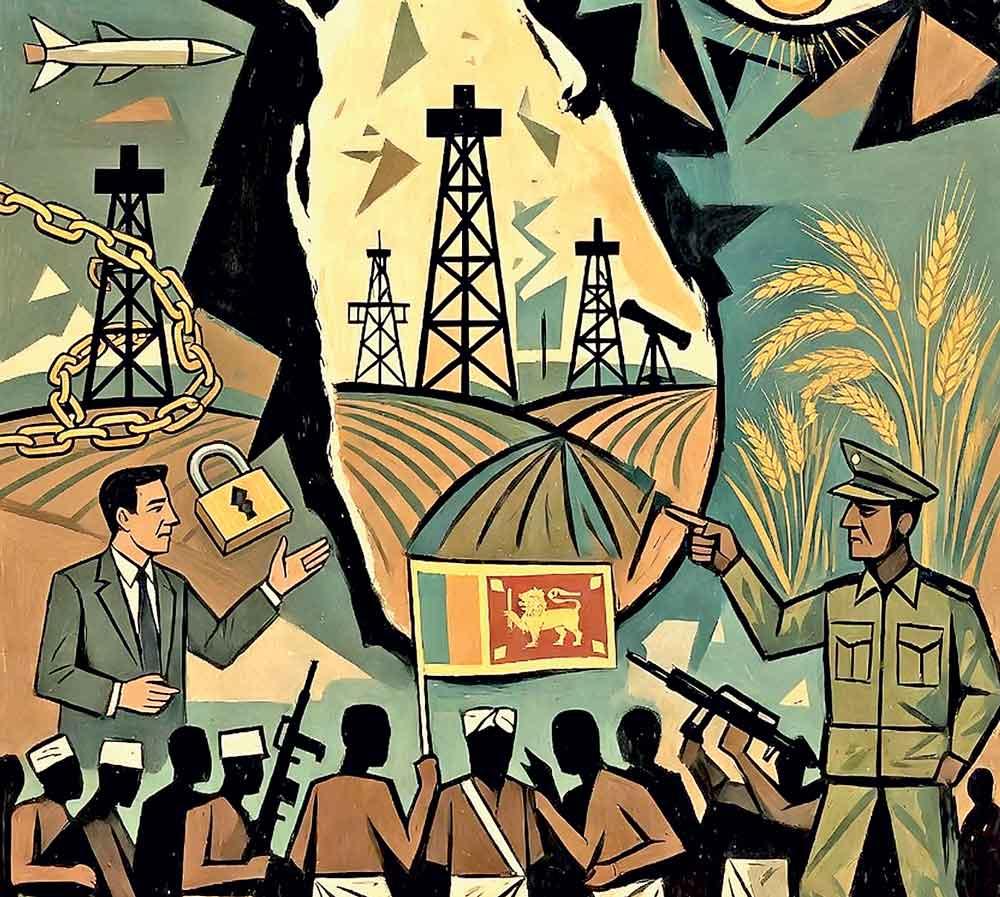
 “Sri Lanka’s strategic location is its greatest asset, yet today it is a target painted on the back of a fragile economy.”
“From the Strait of Hormuz to the Colombo Port, the world’s vital trade arteries are constricting under the pressure of a protracted war.”
|
U.S. Envoy Sergio Gor |
As the Middle East inferno jumps its tracks, Sri Lanka finds itself uncomfortably close to the heat. With U.S. Envoy Sergio Gor touching down in a region reeling from torpedoed warships and $100-a-barrel oil, the island nation faces a brutal reckoning. President Dissanayake’s recent refusal to host armed American warplanes signals a desperate grab for “strategic autonomy,” yet with fertilizer prices soaring and the Exclusive Economic Zone becoming a literal firing range, neutrality is proving a luxury a fragile economy can scarcely afford. The era of passive positioning is over.
In the midst of the Middle East war moving up a gear with a profound impact on the global economy, U.S. Special Envoy for South and Central Asia Sergio Gor is visiting Sri Lanka and Maldives from March 19 to 24 for high-level engagements focused on what the U.S. embassy said ‘advancing cooperation in the Indian Ocean region’.
He is the highest U.S. official to visit Sri Lanka in recent months. He has arrived in the country in a context where the Middle East war that started after the U.S.-Israeli attack on Iran shows no sign of ending so far. More than three weeks have passed since the military action that started on February 28. Iran has retaliated targeting U.S. interests in the region. The war is now protracted, and the world is now reeling under its impact. The war’s immediate effect on Sri Lanka which is tottering with a fragile economy is severe.
The U.S. official also came here in a context where the war spilled over to Sri Lanka’s backyard after a U.S. submarine torpedoed an Iranian warship in Sri Lanka’s Exclusive Economic Zone (EEZ). Probably, both the parties to the war are concerned about Sri Lanka’s position which can be detrimental to their security interests at this moment.
Ahead of the visit, the White House announced in a statement that while in Sri Lanka, Special Envoy Gor will meet with senior leaders to reaffirm the importance of the U.S.-Sri Lanka relationship and strengthen cooperation in key sectors. Special Envoy Gor’s meetings will further support U.S. efforts to safeguard vital sea lanes and secure ports, reinforce mutually beneficial trade and commercial ties, and advance a free, open, and prosperoU.S. Indo-Pacific for the benefit of both our peoples.
In Maldives, Special Envoy Gor will meet with senior government officials to reaffirm the United States’ commitment to the bilateral relationship, advance security cooperation, and explore opportunities to support Maldives’ efforts to promote its critical infrastructure and expand its economy, as well as to commemorate 60 years of diplomatic ties. The United States values its enduring partnerships with Sri Lanka and Maldives and our shared commitment to regional security and stability, the White House.
Special Envoy Gor also joined Sri Lanka Navy Chief of Staff Rear Admiral Damian Fernando aboard SLNS GAJABAHU, a former United States Coast Guard cutter now in SriLanka_Navy service, symbolizing the strength of our longstanding maritime partnership. The fourth former U.S. Coast Guard cutter – ex-DECISIVE—now undertaking its Pacific journey to Sri Lanka, will further expand our maritime security partnership and regional cooperation, the U.S. embassy said.
The U.S. has security interests in the bustling Indian Ocean region. Vital container, hydrocarbon and bulk shipping transits this body of water, which connects hotspots like the South China Sea and the Middle East. Unlike in most oceans, the U.S. does not have territory in the Indian Ocean.
Sri Lanka’s strategic location at the intersection of the Indian Ocean has made it a major focus in Indo-Pacific geopolitical literature. Sri Lanka and the Maldives have outsized importance for the U.S. as a result of its strategic positioning in the region, U.S. Assistant Secretary for South and Central Asia Paul Kapur, a key official of the Trump administration, said earlier. It means the country has a dual identity – relatively a small state but a major maritime operator.
U.S. security, commercial interests insect at Sri Lanka
As far as the ongoing war is concerned, the U.S. obviously has concerns about the region to make sure that it is not used against its security and commercial interests.
Sri Lanka’s strategic importance for U.S. military and economic interests became obvious with better and bigger clarity with the latest visit by the top official and what President Anura Kumara Dissanayake said in Parliament.
The President said that his government declined permission for two U.S. combat aircraft to land at the Mattala International Airport from March 4 to 8.
“They wanted to bring two warplanes armed with eight anti-ship missiles from a base in Djibouti,” he said.
The President’s remarks were meant for the local consumption - people to be jubilant by his neutrality regarding the Middle East war despite requests from a world power to take a partisan stand. However, open declaration of such a request can trigger diplomatic ramifications since igts is not meant to be announced in public.
The U.S. official also visited the Colombo Port, a major transhipment hub that straddles the Indian Ocean sea lanes in the region. These are vital trade arteries that should be protected for smooth transnational trading.
“It is clear how this critical hub connects South Asia to global markets- and why maritime security matters here. That is why the U.S. -Sri Lanka partnership is helping advance secure, transparent trade, support ongoing efforts to improve port efficiency, and protect the integrity of supply chains that have a direct impact on the bottom line for U.S. manufacturers and consumers,” he said in a post on X after visiting the Colombo Port.
These remarks mean that the U.S. expects the sea lines to be kept safe to make sure that they are not used by Iranian vessels against its interests at the time of war.
Sri Lanka needs war to end more than anything
Peace is far more important for Sri Lanka which is trying to revive its economy after the 2022 economic crisis. The need for the Indian Ocean to be a zone of peace resonates today more than ever after the Iranian warship was torpedoed in its Exclusive Economic Zone.
Though Sri Lanka speaks of a neutral foreign policy, it is always challenging for the country to exercise it. Its strategic location is the best advantage it has. Still, it lacks strength at the moment to stand firm. Or else, the country’s political leadership should stand firm on the ground.
Be that as it may, it is always important for Sri Lanka to develop strategic autonomy- the ability to make its own decisions without depending on other powers. The country, particularly after the economic crisis, has lost strength considerably in this sphere. The government should work on building it so that it can leverage its strategic positioning for its own benefits. Local capacity building is fundamental here.
The major powers – the U.S., China, Japan and India – have strategic interests here for sure. Now, it has become clear that the U.S., a country with no territorial presence in the Indian Ocean, has both commercial and security interests in the region. The U.S. looks for the ability to flow its forces in this theater. It seeks partnerships with countries such as Sri Lanka naturally.
World is not same after war, Sri Lanka no exception
The world is not going to be the same after the war is over. The war did not end in the way expected by Israel and the U.S.. All the parties to the war targeted the civilian infrastructure.
The fighting – which has included Iranian drone and missile attacks on Gulf States and Israeli attacks on Hezbollah targets in Lebanon after the group launched assaults – has disrupted global oil and gas production and supply.
The conflict has triggered the largest supply disruption in the history of the global oil market, with shipping through the Strait of Hormuz, which normally carries around 20 percent of global oil consumption, reduced to a trickle. Around 20 million barrels per day of crude oil and oil products typically transit the Strait. The loss of these flows has tightened markets significantly, pushing crude oil prices above $100 per barrel and driving even sharper increases in refined products such as diesel, jet fuel and liquefied petroleum gas (LPG), according to the International Energy Agency (IEA).
The world is now reeling under the impact of the world fuel prices. Sri Lanka, for the first time after the pandemic, put up fuel prices twice by huge margins in conformity with spikes in the global market.
Even the U.S. is making a desperate push to secure every available barrel of oil amid a worsening energy crisis — even if it means lifting sanctions on the very country that they’re fighting against. But three weeks into war with Iran, the administration is running out of options to contain the skyrocketing price of oil and gas, CNN reported.
Need for renewable energy gathers momentum
After the war, the world will ramp up efforts to push for more and more renewable energy generation. The need to switch to e-mobility is felt today more than ever.
Since the U.S.-Israeli strikes on Iran began on February 28, Iran has launched a wave of ballistic missiles targeting Israel, U.S. military bases, oil depots and other infrastructure across the Gulf region. Nearly 100 countries have increased fuel prices.
It will now have a cascading effect on the local economies. In Sri Lanka too, energy prices will now result in the rise of grocery bills of people. During the last three weeks of the war, what is clear is the fact that Iran cannot strike down American-Israeli airpower over its skies. Likewise, the U.S. and Israel find it difficult to rein in Iran from blocking the Strait of Hormuz which is the narrow waterway vital to the flow of oil, gas and other commodities. Iranian attacks on energy-production facilities also continue.
Food crisis : what is in store for Sri Lanka?
In addition to the gradual rise of food items, the current fuel crisis will trigger a fertilizer crsis. Fertilizer prices have already shot up globally
High fertilizer prices will impact global food production. Sri Lanka, as the President said, has enough stocks for the current season. However, the government has to step in to secure stocks for the Maha season which is the man cultivation period.
Fertilizer prices have already jumped sharply, with the International Food Policy Research Institute (IFPRI) reporting that Middle East urea prices rose by more than $90 per metric ton in one week in early March – a 19% increase – and are now about 40% higher than before the war.
If agricultural productivity drops, it will trigger a food shortage for the population. Lack of food means malnutrition. One -fourth of Sri Lanka’s population now live below the poverty line.
The Middle East is not a source for oil to run cars. It is an important source of other forms of energy, like natural gas used for electricity generation and LPG for cooking and a destination for migrant workers from countries like Sri Lanka.
The war has immediate concerns for Sri Lanka. It has to act quickly to mitigate the impact of rising cost of living while taking long term policy measures for its strategic autonomy in the midst of increasing geopolitical rivalry playing out at its doorstep. It should also build national economic resilience.
08 Jun 2026 08 Jun 2026
08 Jun 2026 08 Jun 2026
08 Jun 2026 08 Jun 2026
08 Jun 2026 08 Jun 2026
08 Jun 2026 08 Jun 2026