28 Apr 2026 - {{hitsCtrl.values.hits}}
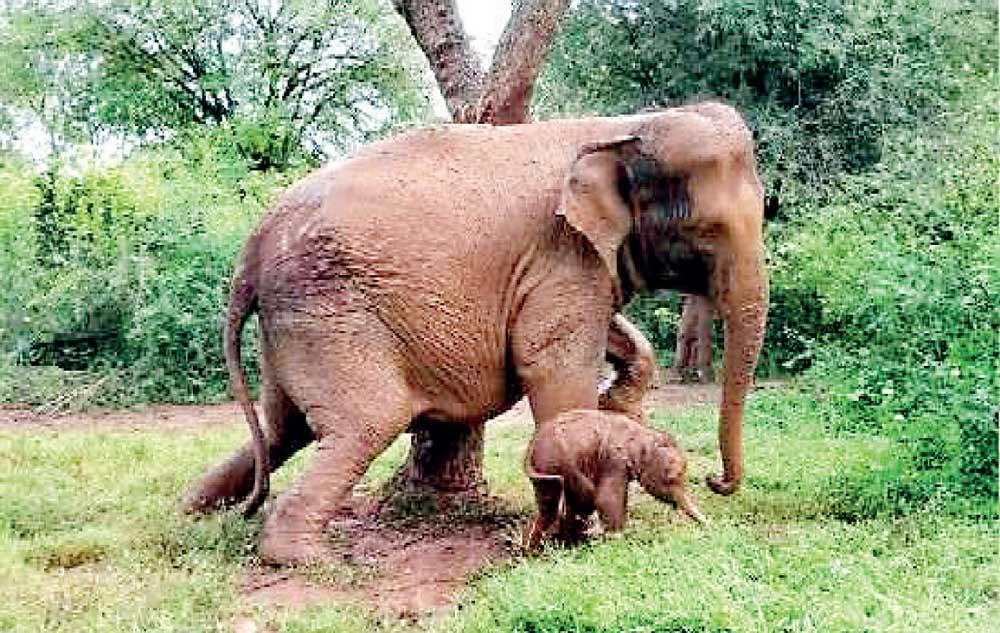
Sujeewa with her calf
Conservationists and activists continue to raise concern over the recent untimely death of the female elephant, ‘Sujeewa’ and urge the Government to conduct a thorough investigation into this suspicious death and to take proper legal action against those responsible
 It was reported on April 24, that Sujeewa, a female elephant, who was forcibly removed from her maternal herd as a calf and subjected to immense cruelty by elephant traffickers, has died while in the custody of the Department of Wildlife Conservation (DWC). Having been ill for several months, Sujeewa has met an untimely death that raises serious questions not only about Sri Lanka’s wildlife conservation practices and the administration of justice for crimes against wildlife, but also about the conscience of society as a whole.
Therefore, the Ministry of Environment, through the Criminal Investigation Department, must conduct a thorough investigation into her untimely death that occurred while she was held in DWC custody as part of an ongoing case related to rampant wildlife trafficking in Sri Lanka.
Sujeewa was first taken into DWC custody in February 2016, in connection with a case involving the illegal capture and trade of wild elephants from Sri Lanka’s forests. She was kept under the DWC’s supervision at a holding centre in Udawalawe. During this time, she reached puberty and gave birth to a calf. In 2021, the then government issued a shameful gazette notification titled “Regulations No. 01 of 2021 cited as ‘Fauna and Flora (Protection, Well-Being, and Regularisation of Registration of Tamed Elephants)’ published under Section 22A of the Fauna and Flora Protection Ordinance (Gazette Extraordinary No. 2241/41 dated 19.08.2021). Through this regulation, the government took steps to release elephants allegedly illegally captured from the wild — and held in DWC custody — back to the accused. Consequently, 14 baby elephants were released, and Sujeewa was also destined to suffer the same fate, along with her calf, which sparked widespread public debate at that time.
This government action provoked a huge public outcry as an inhumane endorsement of elephant trafficking. Environmental activists launched various struggles and sought judicial intervention. When the relevant case (No. B 23073/01/15) was heard at the Colombo Magistrate’s Court on 24 September 2021, the attorney appearing for the Attorney General informed the court that “the Magistrate’s Court is not bound by the observations of the Court of Appeal that directed the elephant and her calf should not be released.” The same request was made by the lawyer representing the party claiming to be Sujeewa’s owner. This clearly illustrates the true seriousness of the trafficking issue. However, Senior Counsel Ravindranath Dabare, appearing for the Centre for Environmental Justice, challenged this request, pointing out that the Magistrate’s Court is bound by the observations and directives of the Court of Appeal. He therefore requested and recommended that “the elephant and the calf be kept in the same place where they are currently being held.” Accordingly, the young mother and her infant daughter continued to be detained in DWC custody.
The serious question that now arises is how this healthy elephant died under suspicious circumstances.
In a context where a significant number of baby elephants brought to the Udawalawe Elephant Transit Home die prematurely, Sujeewa overcame those challenges and was healthy enough to reach adulthood, successfully conceive, and deliver a healthy baby. If the DWC cannot maintain even such a healthy adult animal, and if such animals die for some reason after just a few years, there must be a reasonable explanation. On the other hand, this death may also serve to justify the suspects’ request to retain possession of the case materials.
Moreover, this is not the first time such an incident has occurred. A baby elephant named ‘Seevali,’ taken into DWC custody in Gannoruwa, Kandy in connection with a similar elephant smuggling case, also died suspiciously after some time. Currently, another elephant called ‘Sandula’ in a similar situation is reportedly suffering from a serious illness. Therefore, we urge the Government to take immediate steps to conduct a transparent and thorough investigation, and to take legal action against those responsible if any illegal activity is revealed.
Furthermore, priority should be given to these elephant smuggling cases even now, and the parties responsible for this inhumane act should be severely punished without further delay.
For the first time, data were documented the extent of illegal capture and trade of wild elephants in Sri Lanka between January 2008 and December 2018. Data were collected from case records maintained by the Sri Lankan court system where suspects of illegal elephant trade were prosecuted, in addition to information from archives and interviews with various stakeholders. We documented 55 cases of illegally traded elephants. This is likely an underestimate, due to mortality during capture operations and the challenges of collecting data on this highly organised illicit trade. Significantly more elephants were found to have been seized in 2014-2015 than in all other periods combined. This study revealed evidence on illegal capture of wild elephants from wildlife protected areas and state forests, corruption among wildlife officers, involvement of politicians and other high-ranking personnel, and a lack of law enforcement. Based on this study, a research paper was published in 2020 and made a series of recommendations aimed at implementing policies to reduce trafficking of Asian elephants in Sri Lanka and improve conservation management of the species.
As a short-term action, the relevant authorities should expedite the judicial process against suspects and penalise offenders in a fair and just manner, regardless of the suspect’s social status, political affiliation, or role in society. Any measures taken should be made public in order to deter those tempted by this illegal act in the future. In the intermediate-term activities, funds, expertise, and time need to be made available to assist the Elephant Transit Home in Udawalawe and the Pinnawala Elephant Orphanage, where smuggled elephants are kept under care, in conducting assessments to determine whether these elephants are fit to be released back into the wild. Also as an intermediate-term action, the enactment of a national policy on captive elephants is needed introducing a scientific and transparent process for the registration and renewal of licences to hold captive elephants. This should limit the use of captive elephants for cultural, religious, and tourism purposes.
Sri Lanka should adopt the standardised captive elephant registration protocols and best practices proposed by the Seventeenth Conference of Parties of CITES in 2016 and the second Asian Elephant Range States’ meeting in 2017. These guidelines include DNA registration, monitoring protocols for captive populations, management guidelines, disease management, training and capacity building of staff and mahouts, and the need of a specific national policy to manage the captive elephant population to avoid illicit live elephant trade.
If the authorities pay urgent attention to these recommendations now, even though Sujeewa is no more, at least justice will be served for her companions.
14 Jun 2026 1 hours ago
14 Jun 2026 3 hours ago
14 Jun 2026 4 hours ago
14 Jun 2026 6 hours ago
14 Jun 2026 8 hours ago