07 Feb 2025 - {{hitsCtrl.values.hits}}
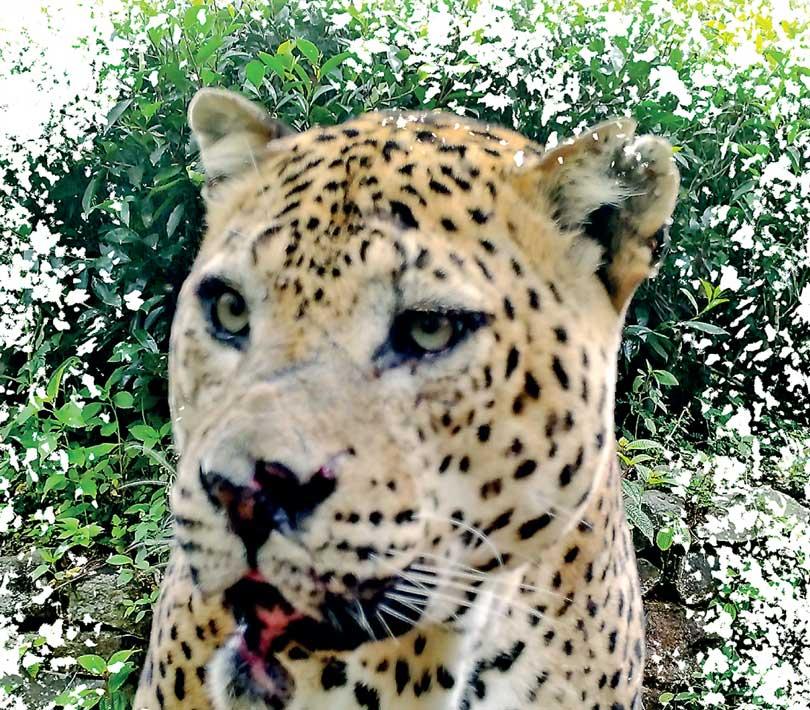
Ozzie
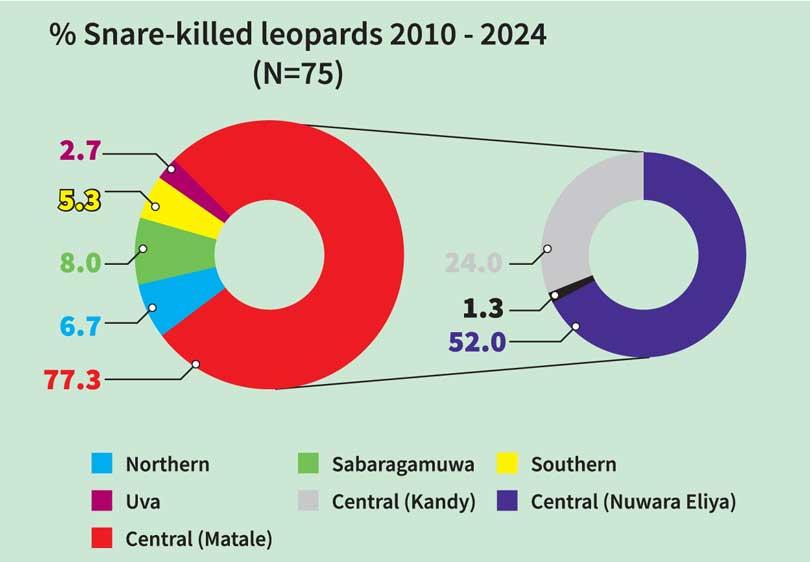
|
These three leopards were part of an island-wide population of only ~550 – 1050 mature individuals as estimated for the IUCN’s Global Red List of Threatened Species (Kittle & Watson 2020) With a relatively low population like that, every leopard counts, and losing them in such dire circumstances is even more tragic The possibility of rescue and treatment is higher if the leopard does not agitate, an action exacerbated by human presence |
Like all animals that die in snares, these leopards would have suffered horribly in their final hours as the wire nooses bit deeper into their flesh, crushing vital organs and cutting off blood flow.
 This time it really did feel like the end of an era. And what an inglorious end it was, a gruesome mockery of a powerful, stunningly beautiful leopard that had trodden the tea roads and forest paths of the southern Central Highlands for a decade or more. First picked up on our remote cameras in August of 2016 as a solidly built young adult male just entering his prime, we nicknamed him ‘Ozzie’. Now he – or rather what remained of his body - lay in the long grasses, bloated and obscene, like some discarded oversized toy. Only he hadn’t just been discarded, he had been mutilated - decapitated and missing all four paws, with only angry, blackish-red wounds and glistening white bone to indicate where his butchers had hacked.
On the day that his body was discovered – December 18th 2024 – I was going through the most recent images from the long-term monitoring cameras that we are running in the area. There he was, on November 11th, on the far side of the valley from where he was first photo-captured over 8 years previously. He was now instantly recognizable, both due to our having almost 200 remote camera images of him and because, due to some unseen altercation in early 2023, his lower lip now hung down from his jaw by a thin flap of skin. Not surprisingly, he had been in attendance of a resident female – courting behaviour that we had seen many times before across several estates and with various females.
Almost certainly the father of numerous offspring, ‘Ozzie’s’ genetic legacy will no doubt endure long beyond his tragically shortened physical life.
Sadly, this was the third leopard of a study population of ~ 25 leopards at any given time, that we have been monitoring across a relatively restricted region of the Central Highlands (~200 km2) to be killed by a snare in 2024. The first, in April, was a 4-year-old female, “OK”, who we had tracked since her birth. She was the daughter of “OC”, who is the only other leopard remaining in the study region that we have monitored for as long as ‘Ozzie’. “OK” had her first litter in early 2023 and her remaining female cub was still with her when she was killed. Around 16 months old when “OK” died, this cub is now approaching 2 years old and remains in her mother’s old range.
The second snare mortality, in the end of August, was a young adult male just starting out – much like “Ozzie” had been 8 years earlier. Like “OK”, “O’Duncan” had been born in a similar natal area- also in all likelihood to “OC”, but a litter earlier - in early 2021. It is entirely possible that he was sired by “Ozzie”. Due to the Covid-19 pandemic and the subsequent economic crisis in 2022, we had not been able to effectively keep tabs on “O’Duncan”. We were surprised therefore, to find him in 2024 as a young adult occupying a range – and courting with the resident female - ~9 km further along the ridgeline upon which he was born.
These three leopards were part of an island-wide population of only ~550 – 1050 mature individuals as estimated for the IUCN’s Global Red List of Threatened Species (Kittle & Watson 2020) – roughly one adult leopard for every ~26,000 people. With a relatively low population like that, every leopard counts, and losing them in such dire circumstances is even more tragic. Like all animals that die in snares, these leopards would have suffered horribly in their final hours as the wire nooses bit deeper into their flesh, crushing vital organs and cutting off blood flow. Their increasingly frantic, panic-stricken and ultimately futile struggles only act to further tighten the deadly embrace of the wires until finally, likely in agony, they breathed their last. We must ensure that this agony is not heightened by crowding around the snared leopard, attempting to catch that video clip or snap that image for posting on various forms of media. For the possibility of rescue and treatment is higher if the leopard does not agitate, an action exacerbated by human presence.
Why Snares?
Snaring is illegal in Sri Lanka, but it is also widespread as the requisite materials to construct the snares are cheap and easily available – wire, tri-shaw brake cables, old fencing – and the process is fairly anonymous. In the Central Highlands of Sri Lanka, where humans dominate the plantation landscape, leopards have adapted their behaviour to avoid people by reducing even more their already limited daytime activity and waiting until nightfall to move about and hunt. It is clear from our remote camera data that leopards here lie low during the day and in doing so are likely to dramatically reduce any potential interactions with people. As plantation communities have historically retreated back to their houses as night descends, this temporal partitioning has worked well through the years. This is one reason why there have long been so very few negative interactions between leopards and humans in this region, where both share the same space.
Snares, however, transcend this behavioural adaptation by lying in wait day and night, ensuring that leopards cannot avoid and evade them.
Many snares are set around vegetable cultivations in the Central Highlands, with the intention of protecting crops from wild boar that tend to dig them up. Despite the Flora and Fauna Protection Ordinance (1937) categorizing wild boar as a “pest species” and allowing for farmers to protect their crops, laying of snares is still illegal (FFPO Section 30 and 30(1)). Snares are completely indiscriminate, so even these “crop protection” snares do not spare leopards as evidenced by the black leopard killed on Laxapana estate in close proximity to a vegetable cultivation a few years ago. However, our previous research in the tea plantation area found that snared leopards are more likely to be found in proximity to forested areas, not villages, which suggests that many snares are also being set for bush meat and not just crop protection (Situnayake 2017).
This second reason for snares – the procurement of bush meat – needs to be handled differently. It is necessary to determine the underlying demand – do communities need supplemental protein? Is consumption just due to preference? Is there a commercial aspect? Some regions do have protein deficiencies due to poverty and/or poor nutritional understanding. In the buffer communities of Tanzania’s Serengeti National Park, where we have worked previously, the bush meat trade flourishes to an extent far surpassing what we see in Sri Lanka, and protein deficiency was identified as a driving cause. This issue was addressed with attempts to promote widespread poultry farming and egg production. Already in Sri Lanka there exists a program – the Samaritan’s “Egg Bank” - aimed at providing eggs 3 times a week to schoolchildren, including some schools within our study area. Perhaps this program needs to be expanded. In some areas there is a preference by some – therefore a created market – for ‘wild game meat’, and its procurement might underlie the use of snares. The commercial aspect is essentially a broadening of this same preference from a low-level, local market to a wider market demanding increased quantities. It is not uncommon in Sri Lanka to have well-off, urban individuals – including self-proclaimed “Wildlife/Nature Lovers” – to indulge in wild boar. It is important for these individuals to recognize that by doing so they become part of the problem and bemoaning the death of a leopard caught in a snare while consuming wild caught meat from time to time, smacks of the basest hypocrisy.
In ecology, a key tenet is that all things are essentially connected, and here the connection is straightforward: By eating wild meat in Sri Lanka - which does not have a legal hunting culture - you are increasing the use of illegal means to procure that meat. This might be the increased use of firearms in many lowland, dry zone forests, but in the Central Highlands it largely means increased snaring. In alignment with the old proverb about cake, it is very hard to have your wildlife (in the forest) and eat it too!
Possible Solutions
The knock-on effects of snaring can be profound, with potentially direct impacts on the already threatened leopard population as well as indirect impacts through the reduction in available wild prey for leopards. Our current research shows that ~85% of a leopard’s diet in the unprotected Central Highlands is comprised of wild prey, but if this natural prey base is reduced, leopards may be forced to increase their reliance on domestic species (e.g. dogs, cattle, goats) which directly leads to human-leopard conflicts.
Cultivators who set snares to protect their crops are typically not doing so because they enjoy killing wildlife in cruel and indiscriminate ways. Crop-raiding wildlife is a real issue and increased efforts need to be made to find more humane ways to mitigate it. One way to begin is with improved waste disposal as often animals are drawn to settled areas by the prospect of easy access to food waste. From there it is a small jump to raiding the growing crops. Eliminating the initial allure by disposing of waste more effectively can therefore have a beneficial effect.
Of course many animals come directly for the growing crops, so some estate owners with whom we are working in the Peradeniya area, are planting fruit trees at dedicated locations for wildlife, with the hope that this will reduce raids on their commercial crops. This is in line with the ancient kurulu-kele concept whereby farmers or home garden owners would set aside a section of “bird forest” which they would literally leave for the birds – again with the idea that their other crops would be spared. Another option to deter potential raiding wildlife is to construct better fences to protect crops. Electric fences are the most effective, but they are costly to erect and maintain, as are flashing lights and electronic buzzers – although recently a Sri Lankan schoolboy invented a more cost-effective monkey prevention contraption that needs to be tested. White plastic sheeting has been found to deter wild boar in some areas, but this is also not particularly cheap and brings up the problem of plastic waste disposal when the sheets inevitably get degraded. Some farmers have found success in India and the North of Sri Lanka with old sari material, with the rippling effect of the bright colours deterring some species. This is a relatively cheap option and it is the innovation of such cheap and effective options that must be fostered.
To address the snaring issue the Department of Wildlife Conservation (DWC) and conservation organizations – including our own (the Wilderness & Wildlife Conservation Trust - WWCT), the Wildlife and Nature Protection Society (WNPS), the Small Cat Advocacy and Research group (SCAR), Leopocon – conduct various activities including school educational programs, community and national awareness campaigns. WWCT has conducted dozens of awareness programs in the Hatton/Maskeliya/Norwood region over the past years – to school groups, tea pluckers in the field, community organizations and estate management. In conjunction with Regional Plantation Companies and the DWC, we now conduct regular snare patrols in this same region and have removed dozens of snares from the estate landscape. Yet we still lost 3 of our monitored leopards! This is extremely disheartening, but does it mean we are failing? It’s difficult to know what would have happened in the absence of our efforts, but it is clear that we have to try and do better. The DWC recently announced that there were no leopard deaths recorded in 2024 in the Talawakelle region which they attributed to their awareness programs and snare checks which had detected >300 snares. This is certainly commendable and the lesson learnt is increased snare patrolling, to hopefully address this at a broader level, especially in areas of high use by leopards.
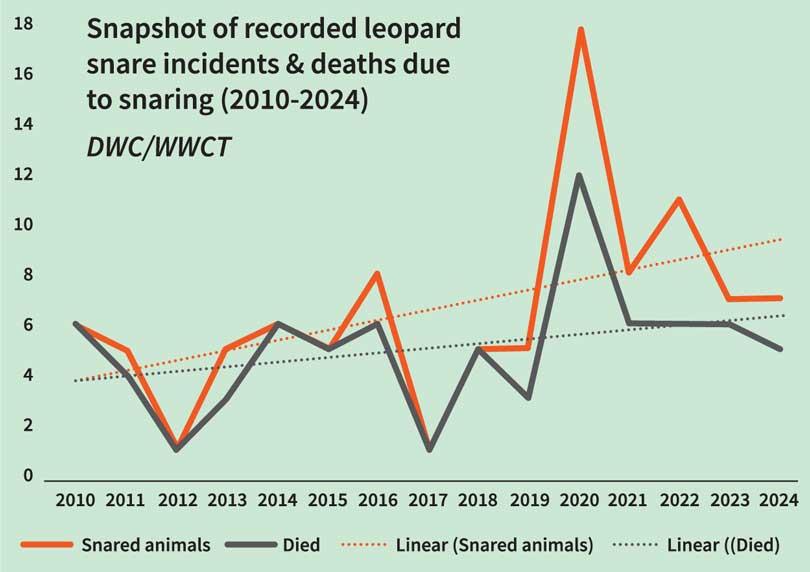
Overall there is a slight reduction in snare incidents and leopard deaths due to snares with the exception of the spike in the Covid years. That all our awareness work and snare patrols across the Highland landscape is possibly working, is but a small glimmer of hope. However, the issue of human caused mortality to leopards across Sri Lanka is an issue that needs constant attention, if indeed this form of mortality is to be kept in check.
Another solution is to improve and increase the dedicated pathways and corridors we detect that have leopard use; improved forest cover and link patch forests, thereby reducing the possibility of snares and leopards coming into contact.
Few people could rejoice in the sight of a wild animal bloated in death, with a strong wire cinched tight around its’ throat, waist or leg, the trampled vegetation and terrified rictus etched on its face, stark testament to its final tortured hours. For this reason alone – irrespective of the potential population-level impacts and broader implications that this might have – it is necessary to work together to try and eliminate the use of snares. This means trying harder to support local communities – which ultimately face the daily prospect of co-existence with wildlife – to devise alternative crop protection methods and to ensure that daily nutritional requirements are satisfied in a way that is not detrimental to surrounding wildlife. This means supporting the DWC and other organizations that work hard to raise awareness about the value of wildlife and the perils of illegal snaring, and that undertake on-the-ground snare detection and removal programs. It means NOT purchasing game meat for consumption, and educating and encouraging friends and family to do likewise – after all it is both unethical and illegal. It means being aware and spreading the knowledge that fines of up to 100,000 LKR and jail terms up to 5 years can result from snaring, and helping to ensure its implementation when needed.
Join us in which-ever way you can, to be a part of the solution to remove snares from our landscapes and to ensure that another leopard does not die in vain.
(The two writers represent the Wilderness & Wildlife Conservation Trust (WWCT) WWCT.org)
14 Jun 2026 6 hours ago
14 Jun 2026 8 hours ago
14 Jun 2026 9 hours ago
14 Jun 2026 14 Jun 2026
14 Jun 2026 14 Jun 2026