31 Oct 2017 - {{hitsCtrl.values.hits}}
 Construction is one of the most dangerous industries in the world. The ramifications of construction accidents are growing with a trend toward more complex projects, especially in developing countries like Sri Lanka. With industry booms and its gross product constantly increasing the number of accidents, death toll has remained stubbornly high.
Absolute mortality in the construction industry remains unacceptably high and those accidents can cause heavy losses of life and property which support the importance of construction safety management. The measurement and assessment of safety performance are therefore urgent and vital to improve safety management and to prevent accidents.
Local construction companies have a poor degree of risk awareness and do not deem health and safety as important. The objective of this research is therefore to understand the value of the health and safety policy as well as accidents that could be prevented by ensuring a good reporting system by analyzing mechanisms of injuries. According to the Labour Department of Sri Lanka, 500,000 man days are lost annually due to occupational health hazards.
Against this backdrop, my research reveals that many construction companies are unaware of safety policies and do not have safety officials. I randomly selected 30 construction companies and successfully returned 22. I had distributed 350 questionnaires and returned 305. The responses were comprised of 13.60% and 40.90% from micro and small construction companies respectively. On the other hand, the responses from medium and large scale companies were 22.27% and 18.18% respectively.
Possession of Health and Safety Policy
The possession of the health and safety policy is a legal requirement. It ensures the health and safety of employees as well as others affected by the organization’s activities. The questionnaire explores the health and safety policy in construction companies and determines the general content of existing policies in these organizations. 68.18% of companies that participated in the questionnaire indicated they did not have a written health and safety policy, while only 3.81% had such a one.
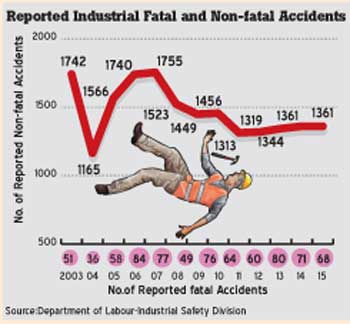
From data available at the Labour Department, nearly 2,500 to 3,000 fatal and non-fatal accident reports are annually reported to industrial safety. Out of them, 40 to 60 are fatal and some 30% occur due to construction methodologies.
A survey conducted in the Accident and Orthopoaedic Service of the National Hospital of Sri Lanka (NHSL) in 2015 treated 102,321 victims of accidents. It shows 12% of the injuries are due to occupational health hazards. Out of the fatal accidents, 50% are from the construction industry. As such, the data given above are in contrast to the real situation.
According to recent statistics of the Labour Department, during 2012-10-01 to 2013-09-30, the number of accidents reported by employers stood at 392. During the same period, the Accident and Orthopoaedic Service of NHSL treated 11,047 victims (10.5%) of the total number of patients, and 105,217 were due to occupational injuries. The 2013 Performance Report of the Labour Department mentions that only 3.5% of employees have reported accidents. It is clear that there is no proper channel of information about accidents to the relevant authorities.
To reduce this burden, it is important to fathom the size and scope of the problem. This can be determined by the collection and analysis of safety-related data. However, there are no clearly-defined regional or institutional-based focal points for health information management. Some have developed information systems to cater to their needs, but we found that there was no proper means of data collection in the work zones. Therefore, we should introduce or establish an institution or ministry to gather data of accidents occurring in construction sites.
In Sri Lanka, the safety of workers in construction sites is woefully neglected. Many construction workers and owners of construction sites are unaware of the needy to deploy health and safety officials to the sites and even if they had such officers, they were not aware of safety protocols.
Relevant authorities and officials should understand the needs of the health and safety policy. My recommendations of the finding were that strong risk assessment, management and proper auditing procedures should be followed. Everything regarding the health and safety condition of workers should be listed and checked. Safety rules, reporting of injuries and illnesses, notifications, enforcement of the safety policy and first aid should be included in the list. The government should set up an independent State body to record incidents including accidents and illnesses in construction sites. It should monitor the mechanism of injury to look into ways of averting such accidents in the future after finding out how they took place. In Sri Lanka, having safety policies are not practical. Sri Lanka should have a safety policy more suited to the country and it should be enforced strictly.
30 Jun 2026 25 minute ago
30 Jun 2026 39 minute ago
30 Jun 2026 42 minute ago
30 Jun 2026 50 minute ago
30 Jun 2026 54 minute ago