02 Sep 2017 - {{hitsCtrl.values.hits}}
 “Labbaika! Allahumma Labbaika, La Sharikalaka! Innal Hamda Wan Ne’mata Lak Wal Mulk La Sharieka Lak” (I stand up for Thy service, O Allah I stand up! There is no partner with Thee! I stand up! Verily Thine is the praise, the blessing and the kingdom! There is no partner with Thee).
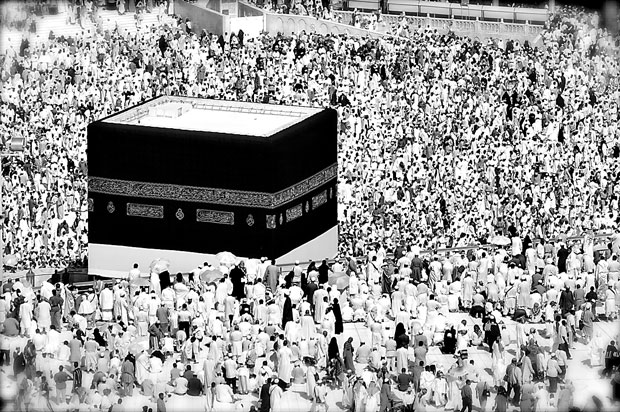
This is how the pilgrims glorify the creator, Allah Subhana Watala, when approaching the holy Ka’baa for the first time in their life. At this, Almighty Allah remarks to the angels: “Look at my servants, they have come towards me disheveled and scattered while their bodies and clothes are covered with the dust of long journeys. Oh My Angels, I take you to witness that I have forgiven their sins.”
The angels will say: “O Allah, among them there is that evil man ... At this, Allah will reply: “I have forgiven them all.” How fortunate the Hajjis are to get huge rewards for their good deeds from the benevolent Creator, Allah Almighty.
Pilgrims undertake pilgrimage to Mecca to perform Hajj barely two months after purifying oneself from the worldly desires and unhealthy habits by fulfilling the obligatory fasting as Allah Almighty has commanded in the Holy Quran: “Pilgrimage to the House of Allah is a duty man owes to Allah - upon those who can afford the journey.” When Hajjis set out in the path of Allah, they are reminded that they prepare themselves for peaceful exit from the world.
To perform Hajj, Hajjis leave behind their property, intimate friends, relations, kith and kin and also their much cherished motherland for a brief period. Pilgrims realise there will come a time to leave everything mentioned above forever. An everlasting preparation one makes in this world before death is by doing good deeds in complete adherence to the laws of Allah, as clearly narrated in the Holy Quran and in the ways shown by the Holy Prophet (peace be upon him).
After reaching the Holy city, it is most heartening to see the plain desert of Mecca, in the midst, the Holy Ka’baa where pilgrims make Tawaf (circuits) seven times reciting “O Allah! I beg of thee forgiveness and peace in the world and the next. O, Lord, give us good in this world and good in the hereafter and save us from the torment of the fire.”
The noteworthy feature in Hajj is pilgrims all wearing the same, simple and plain white unsewn clothing and living in the same manner. The white cloth the Hajjis wear is unique in the sense that it does not differentiate between kings and laymen, the powerful and the weak and all wearing white and stand equal.
The distinctions of rank and colour, wealth and nationality disappear. The whole humanity that converges in thousands assumes one aspect and one attitude before the Master. The true love of Allah here becomes the reality and the Hajjis are imbued with immense love of the Supreme Being. Hajj leaves a deep and everlasting impact upon one who performs it.
Most of the religious rites pilgrims perform were that of Prophet Ibrahim, his wife Hajarah and their son Ismail (peace be upon them all). It creates on the faithful a tremendous impression how a family at the time of trial and turbulence to be united sincerely and faithfully in obeying the Lord of the Universe, “Rabbil Alameen.”
To honour the Prophet Ibrahim (pbuh) and his family till the dooms day, Almighty Allah has commanded the Hajjis to exercise their virtuous acts like running seven times between the hillocks known as Al-Safa and Al-Marwa.
Hajarah (peace be upon her) was running in search of water in the barren desert to quench the thirst of her baby Ismail. She was astonished to see a spring bubbling from where her baby had been kicking his heels and today every pilgrim from this miraculous well of Zam Zam drink, bathe, launder their Ihram clothes, and further the holy water is stored in millions of gallons to be fetched home.
Prophet Muhammad (pbuh) has reported to have said Zam Zam is a cure for all diseases. This famous well of Zam Zam, rebuilt sometime ago with several pipelines sprouting out, provided water for the millions of Hajjis from the time of Prophet Ibrahim (pbuh) to the last five thousand years without receding, thus proving Almighty Allah’s supreme power over his creations.
Hajjis soon after leaving Mecca, their anxious moment was to go to Medina, the city of the Prophet Muhammad (pbuh).
According to Anas (May Allah be pleased with him), the Prophet said, “O Allah, bestow in Medina twice the blessings you bestow on Mecca.” Once the Hajjis reached the entrance of Medina, the green dome of the Prophet’s Masjid comes into sight where the auspicious body of Prophet Muhammad (pbuh) with his erstwhile colleagues Abu Bakr Siddique and Umar Farook Ralliallahunhum was laid to rest.
Hazrath Ibnu Umar (May Allah be pleased with him) narrates that the Prophet said, “The Holy Grave is like one has visited me while I am alive (Mishkat).” Hajjis spend more than eight days in the prophet’s town and are opportune to visit various historic sites and pray for those souls whose sacrifices 1,433 years ago made us to mould our lives according to the teachings of Islam.
While Muslims in Sri Lanka and rest of the world celebrate the Hajj festival as usual, in Mecca, Sri Lankan Hajjis will be busy along with Hajjis worldwide fulfilling Hajj rites in places like Mina, Arafat and Muzdalifa.
On the ninth day of Zul-Haj at Arafat, pilgrims make supplication (dua), recite the Holy Quran, engage in Zikr, deliver sermons and earnestly seek the blessings of Allah and his forgiveness, and staying at Arafath from Luhar to Mahrib is the core of the Haj. Like last year this time too, Sri Lankan pilgrims will devote more time for supplication to bestow much needed peace and happiness to our motherland in the House of Allah, Ka’baa.
It is most heartening and appropriate to recall Prophet Muhammad’s (pbuh) first and last Hajj was performed on Hijri 10. His hajj was known as “Hajjathul Wida” or farewell Hajj.
One hundred and twenty four thousand companions of Prophet Muhammad (pbuh) joined the Hajj. On the 9th day of Arafat, the verse announcing the completion of the religion of Islam was revealed to Prophet Muhammad (pbuh). “This day I perfected your religion for you, completed my favour upon you, and have chosen for you Islam as your religion” (5-4).
At the Mount Arafat, Prophet Muhammad (pbuh) made the farewell sermon. Companions who were present at that sermon began to carry the message - the light of Islam to every nook and corner of the world. We learn from the above that it is a duty of every Hajji who depart from Arafat to take some share in practicing and propagating the teachings of Islam in their environments which alone can bring peace and salvation to the entire world.
01 Jul 2026 2 hours ago
30 Jun 2026 5 hours ago
30 Jun 2026 5 hours ago
30 Jun 2026 5 hours ago
30 Jun 2026 5 hours ago