25 Jun 2025 - {{hitsCtrl.values.hits}}

 States such as Sri Lanka, Kenya, and Maldives cannot afford to be ideologically rigid in this new global order. Their very survival hinges on adopting strategic modularity, engaging across multiple institutional environments to secure issue-specific advantages rather than committing to rigid, single-axis alignments
Traditional paradigms of international relations—realism, liberalism, and constructivism—now struggle to explain the hybrid, multi-layered behavior of states. They falter before the non-linear reality of global politics, where nations engage in institutional multiplexing, navigating overlapping and sometimes conflicting global clubs to secure diverse advantages
Our central insight is that diplomacy today is inherently modular, layered, and transactional. Nations like India, simultaneously engaging in QUAD, BRICS, SCO, and G20, exemplify this strategic multiplicity by pursuing differentiated payoffs, blending reputational benefits, tangible gains, and diplomatic flexibility across various forums
By Jeevani Senevirathne
As geopolitical tensions escalate and the post-World War II order fragments, traditional theories of international relations struggle to explain the multifaceted behavior of nations. We are witnessing a fundamental shift where states, both large and small, engage in a sophisticated calculus of collectivism. The Dual Utility of Collectivism (DUC), a groundbreaking framework that illuminates how countries strategically optimize gains and autonomy within a complex, contradictory global system.
As Netanyahu’s-War in the Middle-East drags the world into brink of nuclear-war, the post–World War II order disintegrates and the global commons become increasingly contested.
Amidst these geo-political dynamics, international relations theory stands at a crossroads. Traditional paradigms: realism, liberalism, constructivism and the English school struggle to explain the hybrid, multi-layered behavior of both great and small powers navigating an era of fluid alliances, issue-based diplomacy, and simultaneous crises.
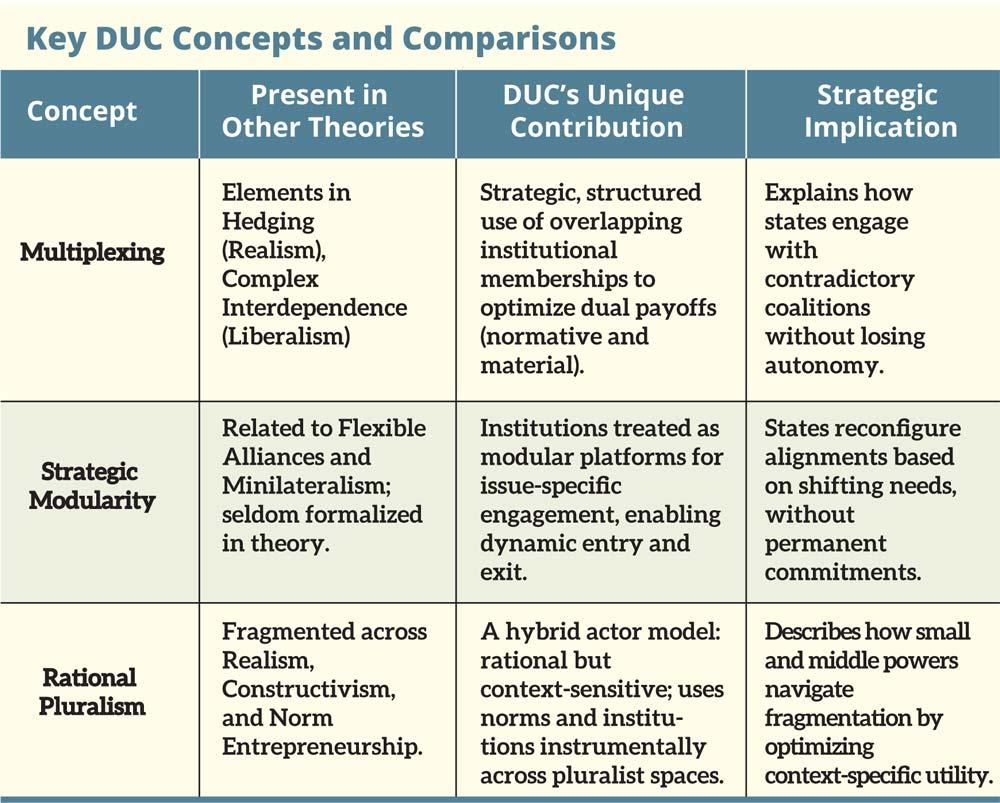
DUC introduces three interlinked concepts: Multiplexing, Strategic Modularity, and Rational Pluralism. Multiplexing refers to structured, overlapping institutional memberships for differentiated payoffs.
Strategic Modularity treats institutions as platforms that can be entered or exited based on shifting national interests. Rational Pluralism posits that states behave as context-sensitive actors who strategically engage both norms and material incentives. At its core, DUC models state behavior as U = N (Normative Payoff) + M (Material Payoff) + A (Autonomy Value). Strategic calculations During the COVID-19 pandemic, many states engaged COVAX for reputational benefit (N), secured bilateral vaccine deals for tangible gain (M), and maintained diplomatic flexibility (A).
This triadic rationale recurs across institutional engagement. India is simultaneously in QUAD, BRICS, SCO, and G20; France navigates the EU, NATO, and UN. Such strategic multiplicity reflects DUC’s central insight: diplomacy today is modular, layered, and transactional.
Major powers also demonstrate DUC logic. The U.S. balances economic nationalism with climate multilateralism. China engages through the Belt and Road (Means) while promoting sovereignty narratives via SCO and BRICS (Way). India exemplifies autonomy through hybrid alignment strategies. Even institutions like NATO (security) and the G20 (economic) now operate as dual-purpose platforms for reputation and influence. Why traditional theories fall short Realism is overly power-centric, liberalism overestimates institutional harmony, and constructivism lacks strategic forecasting utility. None fully account for the multiplex agency of today’s states—where norm compliance coexists with economic bargaining and geopolitical ambiguity.
They all falter before the non-linear reality of global politics where a small state can align with Western climate initiatives, hedge with Chinese infrastructure investments, and simultaneously remain neutral in Middle Eastern conflicts.
What these models fail to capture is the strategic flexibility that states exercise by engaging in what I call institutional multiplexing membership in overlapping, sometimes conflicting, global clubs(strategic-constructs), each offering a different mix of reputation, resources, and room to maneuver.
Consider the United States: It imposes tariffs under nationalist economic policies but simultaneously reaffirms its climate commitments through the Inflation Reduction Act and COP27 pledges.
Or China: a proponent of sovereignty through the BRI and SCO, while also claiming environmental stewardship under the Kunming Biodiversity Framework.
Even middle powers like India engage with the QUAD and BRICS simultaneously one eye on containing China, another on redefining Southern leadership. Humanitarian crises, like those in Yemen and Gaza, further reflect this complexity. Global responses are inconsistent fragmented by geopolitical interests, transactional diplomacy, and selective morality.
Dual Utility theory helps explain why middle powers like Türkiye or Qatar engage multilaterally in these zones: not only to project humanitarian responsibility (normative gain) but to cultivate regional influence and economic ties (material gain).
Shelter Theory argues that small states seek protection by embedding in asymmetric alliances. While normatively useful, it under-theorizes strategic adaptability. DUC views institutions not as endpoints but as flexible instruments of strategic utility—joined, exited or repurposed based on evolving calculations. In contrast to Shelter Theory, DUC integrates scenario modeling and game-theoretic autonomy forecasting.
Global imperatives
Climate change, maritime law, and the digital commons are redrawing the global agenda. These are not just “soft” issues they now directly affect sovereignty, economy, and security.
States that ratify UNCLOS gain standing in maritime disputes and access to deep-sea resources. Commitments under the Paris Agreement affect trade, aid eligibility, and infrastructure funding. Participation in forums like the G20 or Global South Dialogues creates reputational capital that translates into investment and diplomatic leverage.
Even authoritarian states now frame their diplomacy in normative terms. Iran and Russia claim to defend “multipolarity” against Western dominance.
The West itself invokes “rules-based order” to justify economic sanctions and military alliances.
Toward a new strategic doctrine for small states
States like Sri Lanka, Kenya, Maldives, and Vietnam cannot afford to be ideologically rigid. Their survival depends on what I call strategic modularity: engaging in multiple institutional environments to secure issue specific advantages.
A small state facing an oil shock due to Iran–Israel escalation must weigh:
Each option involves different mixes of normative and material incentives. The Dual Utility model, grounded in game theory, helps states simulate these choices before committing. Global south imperative For confused nations like Sri Lanka, Bangladesh, Pakistan and the Maldives, the stakes are even higher. Their weak and often extractive political and economic institutions marred by elitism, nepotism, corruption, and fiscal mismanagement, make it harder to negotiate with global giants which reduce their autonomy and bargaining power in international forums. Clearly they lack institutional and political inclusivity and agility. Sri Lanka’s 2022 economic meltdown, Bangladesh’s crackdown on dissent, and the Maldives’ geopolitical oscillations are symptoms of this deeper structural fragility. DUC accounts for how such states could navigate between Chinese aid, IMF reforms, and regional alliances to optimize outcomes despite internal fragility.
We live not in a bipolar or even multipolar world, but in a multi-layered institutional maze. The old questions West or East, align or abstain have been replaced by complex calculations of institutional benefit.
What we need is not more binary theorizing, but models that reflect how states actually behave: as rational pluralists in a competitive, contradictory system.
The Dual Utility of Collectivism offers such a model. Game theory can help simulate it. Meanwhile, it is not a rejection of realism or liberalism but an update a necessary framework for understanding how states big and small now navigate and interact in order to optimize normative and material gains and strategic autonomy in an international order under stress and uncertainty.
DUC accommodates the fluid, overlapping and contradictory realities of the current global order. Its pragmatic emphasis on utility, modular engagement, and agency under constraint makes it especially relevant for both large powers and the Global South.
The IR textbooks haven’t caught up yet. But the world has. What we are witnessing is a fundamental shift: collectivism is no longer a camp it’s a calculus.
About the Author: JSK Senevirathne is a Senior Lecturer at the Department of Business Administration, Faculty of Management Studies & Commerce, University of Sri Jayewardenepura.
08 Jun 2026 7 hours ago
08 Jun 2026 7 hours ago
08 Jun 2026 7 hours ago
08 Jun 2026 7 hours ago
08 Jun 2026 9 hours ago