07 Mar 2018 - {{hitsCtrl.values.hits}}
 In Kadapathaka Chaya, Vasantha Obeyesekere reaches out as far as he can without losing ground. When he went beyond in the film that followed it, Maruthaya, he not only lost ground, he lost us. In terms of the techniques and themes he used and resorted to – and there weren’t many of them – he both triumphs and fails in here. Like his previous films, with the exception of Diyamanthi, Kadapathaka Chaya is based on a real story, which involves the murder of a businessman by a relative, at the hospital he had been admitted to, who alleged that he had abused her. By the time we get to the sequence of the murder, we know what will happen. Obeyesekere’s most discernible motif was his desire to hint at a sense of foreboding. We know something terrible will happen, but we don’t know what exactly; the litmus test for a Vasantha Obeyesekere movie is thus not the climax, but the preparation to that climax.
We know something terrible will happen, but we don’t know what exactly; the litmus test for a Vasantha Obeyesekere movie is thus not the climax
In his early films – which I have seen, with the exception of Ves Gaththo – Obeyesekere didn’t toy around with the juxtaposition of the past and the present and the future the way he did after Palagetiyo. Palagetiyo, in that sense, was a closing chapter to a phase in his career that was marked out by an overwhelmingly naturalistic tone. In other words, there was no attempt at sensationalising or trying in any way to evoke a sense of melodrama out of the stories he adapted. He changed, in that respect, in Dadayama, for two reasons: because the background material (the murder of Adlene Vitharana) could not be adapted to the screen without doing away with that naturalism, and because he had reached a point where he needed to open out. Technically and formally, Dadayama hence enthralls us with its almost blinding use of sharp colours, in sharply defined contours: the talon-like nails that Swarna Mallawarachchi uses to scratch Ravindra Randeniya in the final sequence, for instance. A British filmmaker, having seen the film, is reported to have said that it seemed to him to have come from a conventional Hollywood thriller. He was correct, though not entirely so, because when placed against the Sinhala cinema, there’s nothing exactly conventional
about Dadayama.
A brief recapitulation of Kadapathaka Chaya’s plot might help us here. Nanda, played by Swarna Mallawarachchi, is still attending school when her brother-in-law Danaratne, played by Vijaya Kumaratunga in his last great performance, rapes her. To hide the scandal, he and his wife (Sunethra Sarachchandra) take her out of school and move her to an aunt’s home, where she is discovered by her teenage paramour, Piyatilake (Sanath Gunathilake). Both Danaratne and his wife decide that it’s best to marry her off, and they get her married to Piyatilake, who proves to be an incompetent though well-meaning and peaceable husband. When he’s expelled from the Army for having taken excessive leave from duty, he’s saved by Danaratne, who proposes that he run a business. The business proves to be a mess and disaster; Piyatilake can’t help but extend the line of credit to his customers. One thing leads to another, he discovers his wife’s affair with Danaratne, and after a confrontation with Danaratne, is injured. Nanda, swearing vengeance, visits him at a hospital and murders him by throwing acid on his face.
The best summing up of Kadapathaka Chaya I can make is, Vasantha Obeyesekere treads on territory he has not tread before
Right until the scene of that murder, Kadapathaka Chaya moves rather inexorably, aware of its own terrible, gruesome trajectory. Unlike Dadayama, where you weren’t aware of who the victim was and what the villain had done to her, until sometime, or for that matter whether the villain was actually a “bad guy” (Ravindra Randeniya’s facile charm, as always, makes us doubt his motives throughout), the villains and the victims in this film are sharply and clearly defined. The characters are no longer concealing their intentions, because the director provides various cues – noticeably by the use of a voiceover from the present to provide a point of contrast to a sequence placed in the past – to make us aware of what those intentions are. If you had even a modicum of sympathy for Priyankara Jayanath from Dadayama, for instance, you don’t feel even that for Danaratne, because he’s overbearingly unlikeable. And that’s what makes the first half of Kadapathaka Chaya click: the fact that we know who these people are. We hence need someone to identify with. When that someone (Nanda) loses her gentleness and springs up on her tormentor with vengeance, we feel ominous about her too. Obeyesekere gives us armfuls of air to clutch at. Predictably, naturally, we clutch and fall.
It has been said by some of his critics that Vasantha Obeyesekere tends to go overboard in certain sequences which require slight explication. This defect, which is less a defect than a quality to be met with in most auteurs, hardly crops up in Palagetiyo (in fact it never really crops up at all); it’s never really apparent even in 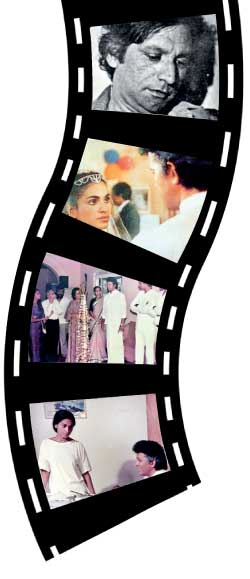 Dadayama, though the few scenes which show us the conflict between Priyankara’s obligation to the woman he raped and made pregnant and later made love to and again made pregnant on the one hand, and his societal aspirations in the form of his impending engagement to the upper-class woman he meets right after his first encounter with the girl he abandons, are lengthened, as though we didn’t get his point the first time. In Kadapathaka Chaya this comes out most strikingly in the first 45 minutes, during which the past and the present cut to each other by the juxtaposition of the police testimonies (which we don’t see, except for Piyatilake’s testimony on Danaratne’s character), Nanda’s marriage life, and, from the beginning and after that wedding, her affair with Danaratne. When Nanda’s sister embraces her sorrowfully on the night of Danaratne’s rape, we immediately hear her testimony – “She [Nanda] was a big liar. My husband was a good man, a virtuous man!” – and we made aware of the contradiction in a literal-minded way. That kind of literal-mindedness comes off more as a weakness than a defect, the same sort of weakness which oozes out throughout Maruthaya.
The cast helped to both contain and accentuate this particular weakness. As Danaratne, for instance, Vijaya Kumaratunga towers over the audience frighteningly. When he smiles, he conceals his real character beneath, and we think for a moment that that is his real character, but when that smile disappears, when he frowns and, worse, loses his temper in a terrible way, we feel that he’s not channelling his real character, rather that he’s channelling a different character. Every “good” act he commits, out of sinister motives or out of a sincere effort to make amends with his sister-in-law – like rescuing Piyatilake from a dishonourable discharge from the military – is rushed over so quickly that when he turns loose and asserts himself – as when he rages at Piyatilake for being overly generous with his customers and their lines of credit – he’s rather bestial: not like Ravindra Randeniya from Dadayama, but in a more sinister, suave, elegant way. His voice betrays the sophistication of the depraved rich: false, tawdry, yet contained. What happens in the end that his performance is as literally put out as the editing and the camerawork?
The cast helped to both contain and accentuate this particular weakness. As Danaratne, for instance, Vijaya Kumaratunga towers over the audience frighteningly
And when the sense of horror and suspense of seeing the past and the present meet wears off, and when Nanda, after years of imprisonment, is released, and after she discovers that her husband has become a much worse and more inhumane social climber than her brother-in-law, the story loosens up a little, then a lot, and then completely. This is where that aforementioned defect of Obeyesekere crops up most visibly: when he’s reworking and recycling the same theme and motif, again and again. We see Piyatilake flourish in his business (at the cost of his humanity), and the sequences which depict his shift from the amiable fool to the calculating entrepreneur are covered with so much apparentness that what they gain in density, they lose in subtlety.
He betrays his own benefactor (J. H. Jayawardena) in the shop he works at by getting him caught in a kasippu racket; he fires the receptionist who calls him while he is at an important meeting even though it was his wife who insisted on her calling him; he dreams of opening up hospitals and schools in his name, thus turning into a megalomaniacal politician. These are scenes that require elaboration, but in Obeyesekere’s hands they turn into cardboard cut-outs. In the end, the only person who gains solidity is Nanda (owing in no small part to Swarna Mallawarachchi’s able performance), and when she is alienated, finding herself forlorn and uncared for, there’s no point in carrying on with the story: the camera moves away from her life, and the credits roll. (In my article on Swarna to this newspaper, I have mentioned how Laleen Jayamanne, in Towards Cinema and Its Double, views her performance: not the woman who’s fated to destroy her man, but the woman who becomes an avenger through a complex array of familial, social, and power relationships.)
Perhaps the best summing up of Kadapathaka Chaya I can make here is that in it, Vasantha Obeyesekere treads on territory he has not tread before. He extends his techniques, notably the contrasts of past and present, without making them a cover for the entire story. But it’s an act of extending them alright, particularly the use of those contrasts, because in Dadayama, they don’t last for half the movie, they last for about half an hour. He needed to flesh out, to go beyond, but without fleshing out his story and making his character solid and complex, he couldn’t go beyond. And in the end, with Maruthaya, that is what happened. Kadapathaka Chaya thus belongs to a twilight phase, before the man would move into the third, and final, career phase: becoming more gruesome, and at times, more literal-minded.
23 Jun 2026 50 minute ago
23 Jun 2026 1 hours ago
23 Jun 2026 1 hours ago
23 Jun 2026 1 hours ago
23 Jun 2026 1 hours ago