03 Jul 2025 - {{hitsCtrl.values.hits}}
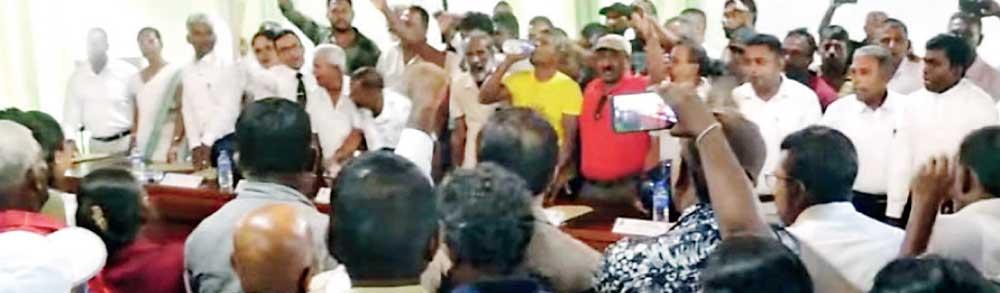
Party Supporters raiding the Weligama Pradeshiya Sabha
 Sri Lanka’s recent local government elections have laid bare a striking paradox. The JVP/NPP, the dominant force in national politics following their landslide victory at the last General election, has now run into unexpected headwinds—created not by their political rivals, but by an electoral system they themselves once strongly endorsed.
Despite an overwhelming electoral performance across the country—where they secured the highest number of ward-level victories in nearly every district—the JVP/NPP has been unable to convert this grassroots mandate into unchallenged control of local councils. The reason? The very proportional representation system that the party supported during its years in opposition.
Chaos and abductions
The dirty politics of yesteryear is once again raising its ugly head. The inaugural meeting of the Weligama Pradeshiya Sabha, presided over by the Commissioner of Local Government for the Southern Province, had to be postponed after chaos erupted in the council chamber. According to the JVP media unit, two NPP members, who were on their way to attend the meeting to elect the Chairman, were abducted. Tensions escalated further when unruly party supporters stormed the venue, disrupting the proceedings and creating mayhem. Amid the disorder, officials announced that the council meeting would only resume once the two abducted NPP members are located and returned safely.
Had the elections been held under the traditional first-past-the-post system, electoral analysts agree the JVP/NPP would have swept all 340 local bodies with ease. The margin of victory at the ward level was so decisive that, under the old system, every local authority would have been unambiguously won, establishing uniform control under the JVP/NPP. Each ward victory would have translated directly into council dominance, eliminating the need for post-election coalition-building or administrative compromises.
Political intimidation
Instead, the PR system—intended to reflect vote share more equitably—has enabled opposition parties to cling to council seats despite losing all or most wards in many areas. As a result, dozens of councils have ended up “hung,” with no single party enjoying a working majority.
This has created an unusual—and politically fraught—situation. In many areas, voters see that their chosen party has clearly won the ward-level vote but still lacks control of the council. This disconnect has eroded public confidence and raised fundamental questions about the fairness and logic of Sri Lanka’s current electoral architecture. Ironically, it was the JVP/NPP’s own advocacy for proportional representation (PR), aimed at reducing majoritarianism and enhancing inclusivity, that now hinders them from translating popular will into local authority.
Local Government Commissioners—appointed across Sri Lanka’s nine provinces—were given the authority to establish administrative control over hung councils. However, the Local Government Elections Act does not specify clear procedures for electing council chairs or mayors in these scenarios. In the absence of statutory clarity, the Ministry issued a 28-page circular recommending that “each member be consulted, and the method of voting be decided accordingly”. This vague instruction opened the door to wildly inconsistent practices across provinces.
For instance, in the Western Province, commissioners insisted on secret ballots, citing the need to protect councillors from party pressure. But in Uva, North Central, and North Western provinces, open voting was allowed, often at the insistence of the majority of members.
This lack of uniformity reached a breaking point at the Seethawakapura Urban Council. There, 14 of the 25 elected members requested an open vote to elect the chairperson. However, the Commissioner overruled the request and insisted on a secret ballot. In protest, all 14 members walked out, paralysing the council’s administrative setup.
A mayoral battle
The Colombo municipal council election became a flashpoint of political intrigue. NPP candidate Balthazaar won the mayoral seat with 61 votes, edging out SJB’s Zarook, who secured 54. Despite starting with just 48 seats, the NPP gained support from minor parties and independents through closed-door negotiations. While hailed by supporters as a strategic win, critics noted it contradicted the NPP’s promise to end backroom deals and political horse-trading.
Party disciplinary crackdowns
The fallout from this political manoeuvring has been swift. Several political parties, facing internal defections and unexpected alliances, have responded with disciplinary action. The SLPP suspended Galle’s Sahabandu after he voted with the NPP. The SJB went further, expelling two Kolonnawa members while suspending six other councillors from Dambulla. SJB General Secretary confirmed the moves, stating that these members “acted in defiance of the party and betrayed the trust of our voters”. These disciplinary actions underscore the growing tension within opposition parties as they grapple with how to respond to the NPP’s assertive local strategy and widespread popularity.
Amid the confusion and political manoeuvring, allegations of corruption have begun to surface. SJB MP Mujibur Rahuman accused Western Province Commissioner Sarangika Jayasundara of deliberately favouring the NPP by enforcing secret ballots in Colombo, thereby shielding defecting councillors from public scrutiny.
The March 12 Movement, a civil society watchdog, alleged that some councillors were bribed to cross party lines and support NPP-led administrations. While they acknowledged that concrete evidence remains scarce, the group emphasised that “widespread public perception” suggests financial incentives are playing a role in shaping council control. Manjula Gajanayake, Executive Director of the Institute for Democratic Reforms and Electoral Studies, has voiced grave concern over the situation. According to him, the inconsistent application of rules by Local Government Commissioners has created “an environment of confusion and severe erosion of public trust”.
Gajanayake further noted that the May 6 local government elections saw the JVP/NPP lose approximately 2.3 million votes compared to the previous general election—a staggering 18.3 per cent decline. This, he argued, underscores the importance of coalition-building at the local level and the need for clear procedural frameworks. In the midst of this unfolding drama, a senior government minister made a telling statement: “We will use all powers to establish JVP/NPP administrations. We will align with anybody; irrespective of their loyalties.”
This candid admission reveals a stark strategic shift. Once vocal critics of opportunistic alliances, the NPP now seems willing to adopt similar tactics in pursuit of local administrative control. It is a move many see as contradicting the moral high ground that formed the bedrock of the party’s campaign. The NPP had pledged to dismantle the very system of crossovers and backroom deals that they now appear to be embracing.
The price of power
Critics argue that the government, buoyed by a decisive parliamentary majority, should focus on delivering the constitutional and electoral reforms it promised. These include abolishing the executive presidency, introducing a new constitution, and modernising outdated voting systems—all reforms that could address the systemic roots of the current crisis. Instead, by engaging in the same political practices they once condemned, the NPP risks alienating segments of its own base, particularly the youth and reform-minded voters who rallied to its vision of transformative change.
The JVP/NPP’s inability to translate its national mandate into local control reveals a broader dysfunction in Sri Lanka’s multi-tiered electoral system. The disconnect between popular support and actual administrative power at the local level has triggered frustration, procedural paralysis, and political cynicism. What is urgently needed is a clear, uniform set of rules for forming local governments under PR, coupled with constitutional reforms that bring greater coherence between national and local governance structures. Until then, even the most decisive electoral victories may continue to be undermined by the very democratic frameworks that were meant to uphold fairness.
(The writer can be reached at [email protected])
08 Jun 2026 3 hours ago
08 Jun 2026 3 hours ago
08 Jun 2026 3 hours ago
08 Jun 2026 3 hours ago
08 Jun 2026 5 hours ago