28 Feb 2026 - {{hitsCtrl.values.hits}}
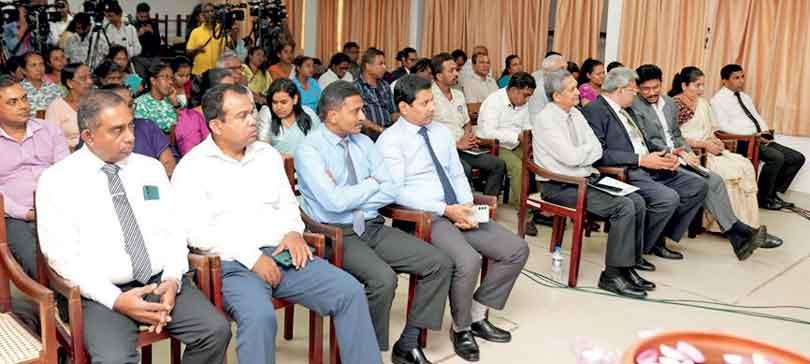
Segment of the audience
By Dhaneshi Yatawara
The history of Sri Lanka is ravaged by multiple man-made conflicts. The three-decade long armed conflict, youth insurrections and strikes have emerged due to multiple reasons – a stagnant economy, a highly stratified social system, eroded human rights and rule of law etc. Yet the destruction, as a result of these conflicts, have gone beyond people and property. It has blunted peoples’ sensitivity and morality.
Understanding the magnitude of the destruction, and identifying early warnings of conflict situations has become a priority globally. Recognising the necessity in Sri Lankan context, the Office for National Unity and Reconciliation (ONUR) together with the Ministry of Digital Economy launched an Early Warning and Early Response System this month.
A special ceremony was held at the Sri Lanka Institute of Development Administration, with the Justice Minister attorney-at-law Harshana Nanayakkara attending as the chief guest. Speaking at the event, Minister Nanayakkara said that the aim of the Government is not simply establishing a country without war and conflict, but to move beyond that and lay the foundation for a sustainable peace with multiple factors taken into consideration.
Further addressing the gathering, Minister Nanayakkara pointed out that previously, interventions happened after a conflict, but by then much damage had happened.
“But with the new Early Warning and Early Response System, we can now identify precursors to conflicts and prevent them from happening,” he added, further noting that the system has paid serious attention in protecting personal data and freedom.
The Early Warning and Early Response System (EWER) was established as a joint effort through ONUR (under the Ministry of Justice and National Integration) and the Ministry of Digital Economy.
Deputy Minister of Digital Economy, Eng. Eranga Weeraratne speaking at the event pointed out that implementing the National Digital Economy Strategy 2030 and digitally transforming the country’s entire governance system is a key responsibility, and partnering with ONUR is a crucial component of this broader digital ecosystem.
ONUR Chairperson Vijith Rohan Fernando and Director General Sanduni Ariyawansa also addressed the gathering.
Early Warning and Early Response System operates on community reporting, and digitally identifying locations with potential crises enabling authorities to take preventative measures.
Through real-time data analytics, the new system enables the early identification of potential conflict ‘flashpoints’, said ONUR Assistant Director Chamara Lakmal. As he further added, upon receiving an alert, the system incorporates a coordinated response mechanism, where ONUR works jointly with religious and community leaders and security forces to intervene in the situation in a non-violent manner.
“Even though this seems a novel method for Sri Lanka, this is a standard global practice in mitigating conflicts and crises,” said Lakmal.
The fundamental bricks of the EWER are ONUR’s Co-existence Societies established at each Grama Niladhari division of the country.
“At least 10 members are in one Co-existence Society in each GN division, representing the diverse nature of the local community. It also includes community leaders and elders – those who are recognised as community influencers in their societies. Being at the grass root level, they are placed in a better position to sense and identify emerging crises and conflict situations at their earliest stages. This team is trained and empowered to update the EWER at the ground level,” he explained.
ONUR has deployed National Integration officers (NIOs) at each District Secretariat and the Co-existence Societies work in coordination with the NIOs.
“We have trained the district officers on the EWER and the tech know-how is transferred to the local groups through them,” explained Lakmal.
Unfolding previous experiences in crisis resolution, Lakmal elaborated on the few instances they were successful in ending a crisis identified early. Apart from scattered incidents that ONUR mitigated during Digana, Kandy communal violence in 2018, Lakmal also recalled another instance where they, with the local community, managed to intervene and terminate an emerging conflict situation following a bus accident in a rural area in the Southern Province.
“EWER is currently launched as a pilot project, and with its progress we are hoping to expand and upgrade it,” he further added.
Referring to the current situation of the country, Sri Lanka Engagement Consultant of the Human Rights Measurement Initiative, Damith Chandimal said that while immediate actions can be taken to prevent incidents of communal violence if identified early, it is also important to ask the question why similar incidents reoccur.
“Deep rooted inequalities, resource gaps, discrimination faced by certain communities, stereotypes and misinformation that exist in the societal system, as well as issues such as impunity often contribute to the continuation of these very issues,” Chandimal pointed out. Chandimal added that In the Sri Lankan context addressing communal conflicts requires immediate, mid-term and long term and holistic interventions that understand the communities, as well as broader socio-political and structural issues such as poverty, corruption, lack of accountability of institutions.
Highlighting that community-based approaches are the most ideal way to address these issues, he noted that they also fail to sustain in the absence of sufficient and long-term resource allocation, and committed institutions.
07 Jun 2026 9 hours ago
07 Jun 2026 07 Jun 2026
07 Jun 2026 07 Jun 2026
07 Jun 2026 07 Jun 2026
07 Jun 2026 07 Jun 2026