09 Sep 2017 - {{hitsCtrl.values.hits}}
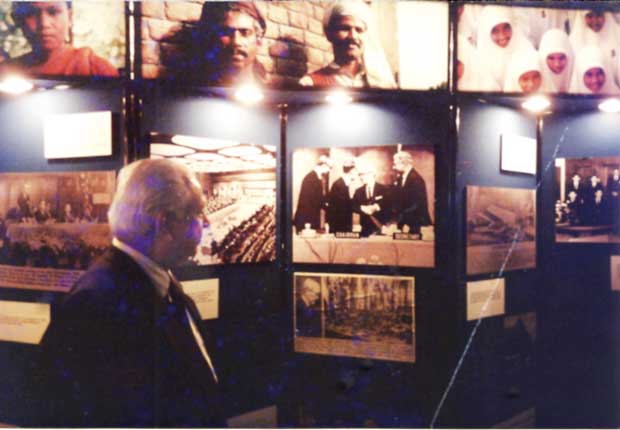
Douglas Gunasekera (1917), was an Economist and administrator in the realms of Public Banking and Finance. When in the Treasury, he was the Secretary of the Committee whose Report in 1949 was the base and foundation for the Central Bank.
In the Central Bank, Douglas started, by preference as Chief Accountant, an apolitical post.
He was very proud of the Central Bank which he left after becoming Deputy Governor.
Three key features he keenly placed in and safeguarded were firstly that it should be the place of best research (intellectual meant research to him). So such persons should have “cradle to grave” security. Then that it should be independent within the nationalist tenure of the time. So the Central Bank notes were signed by the Minister of Finance as well as the Governor.
Further, the Central Bank was set up under a Monetary Board, the classic principles of a Currency Board, as safeguarding the international value of money was its central role.
The Government had two very different advisors from whom to choose the first Governor.
Douglas worked closely with both. One was John Exter an American Academic from Harvard, who was later a Gold Bug Right Wing Economist in the US.
The other was Cyril Hawker, from the Bank of England, who later combined the Standard and Chartered Banking Groups and N. M. Rothschild to create a powerful Bank in London.
The Government chose Exter.
The Korean War was an unexpected event. It forced a massive use of natural rubber in the transport of US troops. Rubber prices soared. In Asia, the British Malay States and independent Ceylon benefited. Unlike in Malaya, Ceylon wished to spend the sudden riches on expenditure. Governor Exter supported this, calling it a windfall. It ended the Bank’s profile of independence and brought in a new Profligacy to national policy and politics.
In 1958, Douglas was Sri Lanka’s Director/ alternate director at the World Bank/IMF sharing offices with Japan, India and Burma. The Malay States and British Africa were not yet independent. Japan and India led a group of large Asian countries to form a Development Bank of their own feelings.
Douglas, who had several negotiations as with China, was chosen as Secretary of the Group and made Manager of the project. The Asian Development Bank was its result.
The key aspect was to give the economic reality of Asia an expression, unlike the Washington institutions’ view. Douglas suffered many privations in the creation stage but he delivered, placing in similar key aspects as for the Central Bank and also a slim chain of executive action from a Japanese President through an Indian Vice President to him as Secretary. After a clear run of five to six years, however, the financial powers, America and Europe and allies, began the painful process of taking the ADB back with Douglas playing a role in keeping some spirit of “the revolution” alive. Looking back, Douglas was very proud of the Asian Development Bank.
For the ADB, as with many UN institutions as UN-HABITAT, UNDP, UNIDO, the early views and ambitions of the founders had to give way to the Economic and Political realities of our times. There are no Islands of Paradise. Though in Douglas’ phrase, “there can be Gilded Cages.”
Once retired from each institution, Douglas did not go back. He went on in what his mind and circumstance mattered. But he reflected increasingly. He could see that he had lived in a very stirring time. When a people, the colonial under class people, went through an epochal change, which is still ongoing.
The certainties of every moment soon turned to dust. And he could see through it. A philosophy of seeing the past happily but truthfully came to reside in him. But there was less and less one could discuss except with certain friends.
An active intellectual mind wants to discuss the present not with the sentiments of the past but with the clarity from experience. He needed friends who could rise above the present.
Such is a long and active life. As one epoch transmutes the next, Power is the intellect’s final challenge. Being active, Douglas could see a great deal. He was too close to the highs and lows to want to truthfully write about the subjects. But many came to chat. For them, time had made understanding easier and clearer.
-Dr. Darin Gunesekera
01 Jul 2026 2 hours ago
30 Jun 2026 5 hours ago
30 Jun 2026 5 hours ago
30 Jun 2026 5 hours ago
30 Jun 2026 5 hours ago