30 Jul 2025 - {{hitsCtrl.values.hits}}
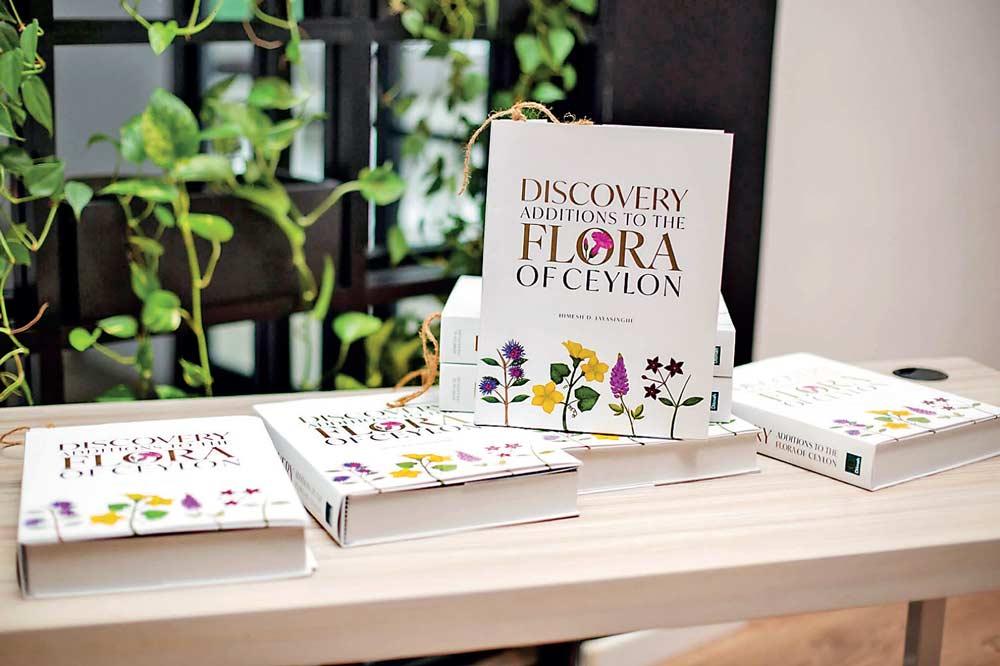
‘Discovery - Additions to the Flora of Ceylon’ turns a new chapter in Sri Lanka’s botanical history (Pics by Dilmah Conservation)
 ‘Discovery – Additions to the Flora of Ceylon’ is a book that reminds us that nature still holds surprises and that time is running out
The book is penned by Dr. Himesh Jayasinghe and edited by Dr. Rohan Pethiyagoda
Dilmah came forward to fund the fieldwork required for Dr. Jayasinghe’s mission to explore and document unknown species of flora of Ceylon
The discovery of 150 arguably new species of flowering plants by an individual in any country is unprecedented in the 21st century
According to Dr. Jayasinghe the reference books he had used had no illustrations, hence the challenges in identification even just one tree had taken years
Dr. Jayasinghe says that it would be encouraging to have interested groups researching on new plant species
|
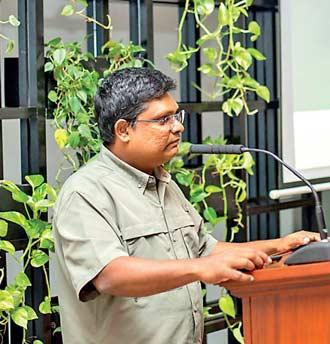
Dr. Himesh Jayasinghe, principal researcher and author of the book, at the book launch |
The recently launched botanical masterpiece ‘Discovery – Additions to the Flora of Ceylon’ is a landmark in Sri Lanka’s botanical history which reveals nearly 200 plant species, previously unknown or unrecorded, and is more than just a scientific reference. The work of Dr. Himesh Jayasinghe, principal researcher and author of the book, is considered a ‘once-in a century phenomenon’, documenting many floral species of Ceylon with corresponding photographs. Dr. Jayasinghe was supported by one of the brightest minds in biodiversity, Linnaean Medal Winner Dr. Rohan Pethiyagoda. This masterpiece is referred to as a love letter to the country’s vanishing forests at stake when 95% of the country’s wet zone forests are gone and extinction lists are growing longer and longer. This carefully documented work of labour spanning over 600 pages is a reminder that nature still holds surprises and that time is running out. It turns a new chapter in botanical discovery and is a message from the heart of Sri Lanka’s forests to those who will shape the future.
Speaking at the launch Dilmah Ceylon Tea Chairman Dilhan C. Fernando reiterated the foundations on which Dilmah as a business was built. “My father had no business philosophy because he couldn’t go to business school, but he did have my grandmother’s principle of kindness. So he built the business on a foundation of integrity with a heart of kindness. There were two dimensions to that heart of kindness – people and nature,” he said.
It was Dilmah that came forward to fund the fieldwork required for Dr. Jayasinghe’s mission to explore and document unknown species of the flora of Ceylon. Speaking further, Fernando said that if you were to ask most Sri Lankans what is it that makes their country, so incredibly special, I would guess that less than 10% might answer biodiversity. He said that 90 out of 121 prescription drugs for cancer are derived from plants. “Over 50% of the FDA approved drugs in the world are directly or indirectly derived from nature. If you look at global GDP, over 50% of global GDP directly depends on biodiversity and nature. If you take it little closer to home, over 50% of global tourism is dependent on nature.
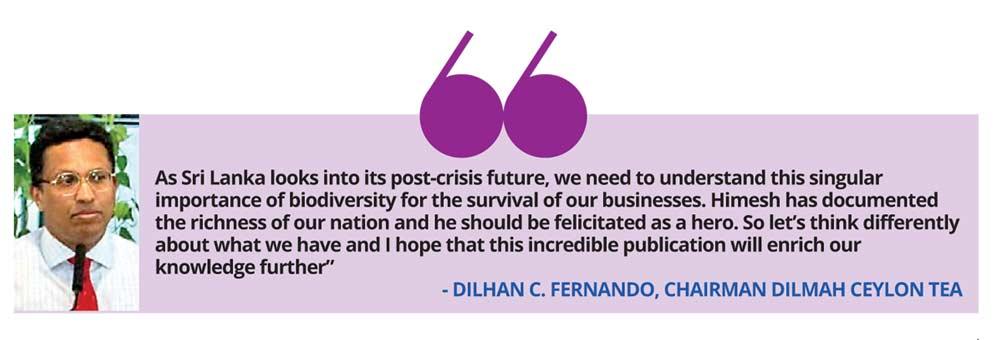
The obvious Himesh is presenting in this magnificent book, edited by Dr. Rohan Pethiyagoda, is the value of something we have taken for granted in the past. Himesh has spent many days and months to document this book. It’s a book that would help us understand the rich Sri Lankan heritage. As Sri Lanka looks into its post-crisis future, we need to understand this singular importance of biodiversity for the survival of our businesses. Himesh has documented the richness of our nation and he should be felicitated as a hero. So let’s think differently about what we have and I hope that this incredible publication will enrich our knowledge further,” Fernando added.
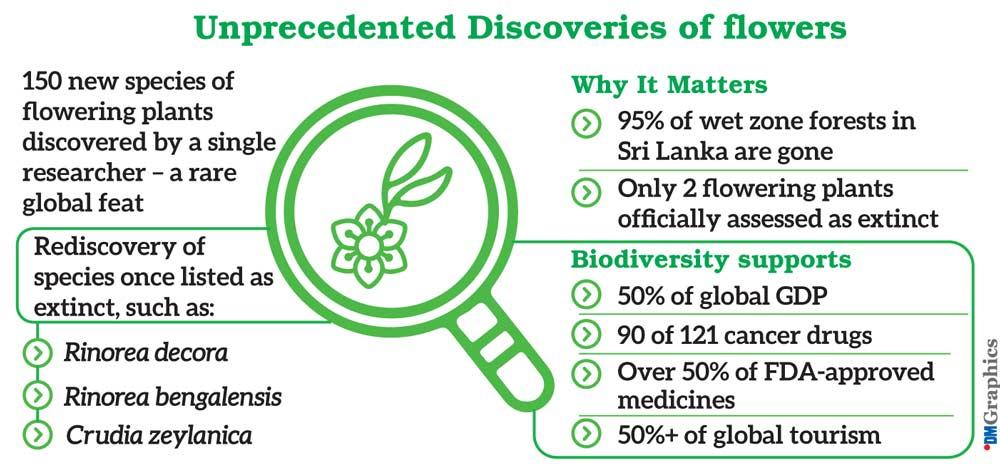 As mentioned in the book, the discovery of 150 arguably new species of flowering plants by a single individual in any country, even in a tropical Global Biodiversity Hotspot is unusual and perhaps unprecedented in the 21st century. The 2012 National Red List listed five species as extinct and two as extinct in the wild and 177 critically endangered. None of these had been reported in the wild for over a century. But in the course of surveys three of the five extinct species – Rinorea decora, R. bengalensis and Crudia zeylanica were rediscovered in the wild. Only two species of Sri Lankan flowering plants – Strobilanthes caudata and Blumea angustifolia are now assessed formally as Extinct. In his remarks, Prof. Siril Wijesundara, former Director General of the National Botanical Gardens and fellow of the National Academy of Sciences said that in conservation one of the most important questions, whether it is an elephant or a plant is whether it exists. “We have to know whether a particular exists or not. This is why we need perseverant environmentalists like Himesh who can actually withstand all difficulties, visit those places and document them. There are certain plants which we rediscovered during the course of this journey. That’s why we find it as a unique occasion to celebrate this achievement. One of the biggest disadvantages of our country is that our flora has been extensively botanized. Even at the time of the British, our vegetation was very heavily botanized. Probably during the 1890s we had the best flora in the entire British Empire. That is the biggest disadvantage because people think that it was done and that there’s nothing more to find. This is a big misunderstanding. That was proven wrong by Himesh where he found so many new species,” he said.
Reflecting on the history of documenting the flora of Ceylon, Dr. Rohan Pethiyagoda recalled and appreciated the work of Paul Hermann, Johannes Burman and Carolus Linnaeus. Each one of these world’s greatest botanists published three books on the Flora of Ceylon in the 18th Century. He appreciated the work of Dr. Wijesundara, who created the Seethawaka Botanical Garden in the wet zone and the Hambantota Botanical Garden in the dry zone after a hiatus of many years from 1876 to 2015. He said that “Sri Lanka’s official work on flora is a 15-16 module spanning over 6300 pages and written by over 73 international authors from 12 different countries. But this work was completed in about 2006 and it never had the benefit of an illustrated work. There’s no reference to what these species look like. But with Himesh’s photographs of Sri Lanka’s 3000 odd plant species you now have an illustrated companion of the flora of Ceylon,” he added.
 Sharing bits and pieces of his expeditions to identify the extinct or critically endangered flora of Ceylon, Dr. Jayasinghe said that the reference books he had to refer to had no illustrations. He went into detail about the technical aspects of various plant species and challenges in identification. “Sometimes it took years to identify just one tree,” he said. Dr. Jayasinghe explained how it was difficult to find the locations of certain species. “There were ambiguous explanations to certain locations. In certain references the location was Ceylon, so we had to find it somewhere in this country. On the other hand there were several variations of the same species. None of these were mentioned in earlier reference books. So it took some time to determine whether all samples belonged to the same species. In certain species the shape of petals, the way it had grown, differed from species to species. While determining differences in certain species we learned how they vary due to shade, exposure to sunlight, variations depending on the size of tree and so on. In certain instances we differentiated between two plants just by crushing the leaves to determine the chemical composition coming from the smell. Some plant species varied in shape and composition due to pollinators. But the beauty of this research is that we continue to find new species and we need to keep documenting and analyzing new species and information. It would be encouraging to have interested groups researching on new plant species and we have all resources at hand to encourage future botanists to get a hands-on experience,” he added.
08 Jun 2026 8 hours ago
08 Jun 2026 8 hours ago
08 Jun 2026 8 hours ago
08 Jun 2026 8 hours ago
08 Jun 2026 08 Jun 2026