12 Sep 2017 - {{hitsCtrl.values.hits}}
 The next world wars will be fought over water, experts have predicted. Many countries in the world are destined to fight over the limited sources available in the future. Since they are living in an island, Sri Lankans might never be in a situation where they will have to fight with other countries over water. But a matter to be concerned of is that Sri Lankans are incapable of managing their water resources wisely. This is because the islanders are selling their water to multinational companies and also engaging in deep drilling activities to obtain ground water, endlessly. Sri Lanka’s human rights are violated by exporting water, because this activity deprives citizens of a basic need.
Pope Francis has warned that we could be moving toward “a major world war over water”. The Pontiff made these comments when he addressed participants at the concluding session of an international seminar on “the human right to water,” held at the Vatican’s Pontifical Academy of Sciences.
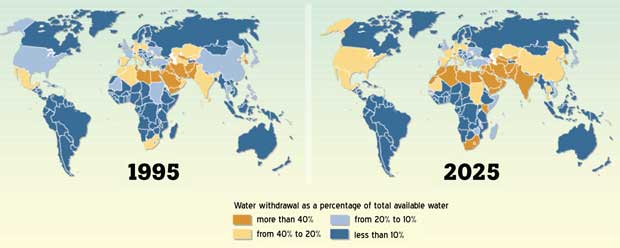
In 2015, NASA’s satellite data revealed that 21 of the world’s 37 large aquifers are severely water-stressed. With growing populations and increased demands from agriculture and industry, researchers indicated that this crisis could worsen.
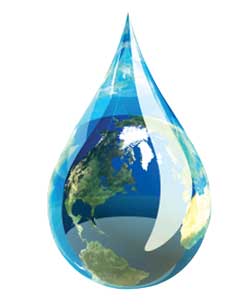
 Water covers 71% of the Earth’s surface. It is vital for all known forms of life. On Earth, 96.5% of the planet’s crust water is found in seas and oceans, 1.7% in groundwater, 1.7% in glaciers and the ice caps of Antarctica and Greenland, a small fraction in other large water bodies, and 0.001% in the air as vapor, clouds (formed of ice and liquid water suspended in air), and precipitation. Only 2.5% of this water is freshwater. 98.8% of that water is in the form of ice (excepting ice in clouds) and groundwater. Less than 0.3% of all freshwater is in rivers, lakes, and the atmosphere, and an even smaller amount of the Earth’s freshwater (0.003%) is contained within biological bodies and manufactured products. A greater quantity of water is found in the earth’s interior.
(Wikipedia)
Leaking Uma Oya
Ground water aquifers in Heeloya area in Badulla have been damaged and water is leaking in to the Uma Oya tunnel. Four out of seven cracks have paved the way for water to leak in to the tunnel. Three more cracks are expected in the future. Many buildings, located on both sides of the tunnel, are collapsing. This is the pathetic sight within a 15 km area away from the tunnel.
 The destroyed aquifers were naturally created millions of years ago. Therefore they won’t replenish in the same speed at which their contents are being sucked by the thirst-driven humans. As a result the chemical content in underground water reaches harmful levels. The ground water level is descending further deeper due to the impact of tube wells.
The ground water aquifers help to steady the earth to some extent. And when it is parched the ground becomes unstable. This is what has happened in Badulla now. Engineers have suggested that villagers close thousands of cracks with mud. But the mud plasters will be washed away with the arrival of the next heavy rains. Meanwhile politicians are planning to distribute water to the villagers using tube wells.
Politicians are taking water from Badulla to Hambantota. People in Badulla people have protested over losing what they possess while Hambantota residents have protested against not having water. Politicians are playing tricks on civilians.
Residents of Kalutara and Galle have encountered a serious issue regarding drinking water. This is because rivers in the south are being dug up regularly to obtain sand. This activity has paved the way for salt water to flow into the land which in turn mixes with coastal aquifers. Water projects and water bottling activities are also increasing in the area. There are around 40 tube wells in a place where the ground water is not suitable for consumption. Water is undrinkable in Anuradhapura and Kurunegala. Water in Hambantota contains a high level of calcium carbonate and a high fluoride level. People used natural filtering materials like bricks and limestone in past to make the water fit for consumption.
Safety of water
It is said that there are 103 rivers in Sri Lanka. Therefore people have mistaken that this country is gifted with pure water. The tank system, paddy fields and lowlands have been destroyed. The surface water alone can’t fulfill the water requirement of the population. Water bodies, forests and paddy fields are necessary to keep the ground water table healthy and replenished. This is what helps recharge the ground water table.
Deep drilling
Other countries in the world don’t permit deep drilling activities like in Sri Lanka. They have identified the importance of water as well as preserving it.
Recently the Water Resource Board introduced a new law to register water drilling activities. This rule applies to anyone pumping more than 30,000 litres of water. But this law doesn’t apply to those pumping water using tube wells.
Tube wells in the dry zone
More than 4980 tube wells have been drilled in Anuradhapura and the dry zone exceeding the limit specified for a square kilometer. Such activities destroyed wells during the regime of the previous president. Sri Lankans assume that they have clean water for sanitation,. Yet the sanitation level in Sri Lanka was clarified during discussions on sustainable development. Estate residents are directing sewage from their toilets into water streams, polluting water in rivers.
Sometimes in urban and areas not falling in to this category the toilet and the well are located close by. This is the set-up in homes where the land is not bigger than 10 perches. This set-up makes living unsafe because contents in the septic tank could leak into the well. Nearly 47% of water available in the country is unsafe due to various leakages.
Tax, water and controversies
Sajeewa Chamikara - a Naturalist in MONLAR (Movement for National Land and Agricultural Reform) speaks about Water privatization
A number of attempts were made to privatize water in Sri Lanka after taxes were imposed on this commodity. Taxes made water a consumer product. Water is a common resource. If anyone privatized water the public lost the right they had to water. It is easier to prevent an act from being passed rather than defeating the powers which want to maintain water as a commodity with a price. A number of institutions, mostly companies which generate profits through the sale of water, are debating about the quality of the water. These institutions are doing their best to promote public opinion that “Drinking bottled water is safe”. These institutions took the water act into consideration for their advantage, but their views were defeated. This was due to the presence of several “controversies” such as taxing the wells and the quality of water. The controversy regarding tax on water was deeper than what it appeared to be. There was a controversy regarding the sale, taxing and destroying the irrigation systems and agriculture in Sri Lanka.
The present situation in Colombo and suburbs
Hemantha Withanage - Executive Director Centre for Environmental Justice (CEJ), Senior Environmental Scientist
“The ground water in Colombo and suburban areas are completely polluted up to Maharagama. Water in some areas smells of kerosene. There is also a presence of heavy metals in the polluted water,” Withanage said.
Water in Rathupaswala is too acidic. Water in Udugampola, Minuwangoda, and Mirigama areas has been affected by tube wells maintained by Indian water bottling companies. These wells suck up ground water and sell it to Indian companies that produce soft drinks.
Negombo is also in grave danger after the Muthurajawela wetland was turned in to a waste-yard. Garbage enters the water and seeps in to the lagoon. Close to 3000 fishermen make a living off the lagoon. Jagath Senarathna of the University of Peradeniya did a research on the chemical levels in human hair found in the Negombo lagoon. The research revealed that 4.77 micrograms of mercury were found in their hairs. This reading far exceeds the level of mercury supposed to be in human hair. Arsenic and Mercury have both been identified in lagoon water.
Soft drink products
Many foreign investors are interested in investing in Sri Lanka. This is due to globalization. The Coca Cola company banned in India is in the process of relocating here in Horana. This is after this company set its sights on the ground water sources in Sri Lanka. Research done by the CSE on ground water revealed the presence of pesticides in the water released by the company.
The forceful pumping of water by several Indian companies, to make soft drinks, is recorded in the Udugampola area. The soft drink product, made using ground water in Sri Lanka, was sent to India. Nobody has to pay for ground water in Sri Lanka, hence these companies are by force using our precious water to make profits. This is a violation of a basic human right of Sri Lankans.
An EIA should be compiled to discourage any company that is pumping huge volumes of water. Ground water sources can’t be controlled. This is because ground water is a vast table. The more one obtains ground water, the more ground water comes to fill that space, until the table dries up. Many Indian and local factories located in Ja-Ela are using ground water for their productions. Lack of laws and regulations to control overusing and misusing of water has paved the way for this grave problem in Sri Lanka.
More than 4000 factories located along the Kelani River bank are releasing waste water into the river. Almost 2000 factories don’t possess a license. More than 45% of toilets, located in Kaduwela, don’t have toilet pits. As a result a lot of waste has been released into the Kelani River. The PH level of acid in the Kelani Basin reads 2.3.
Acidic water in Rathupaswala
It is true that the water in Rathupaswala area is too acidic. People carried water samples to the PHI. That was the only way to determine the acidity in water. The Environmental Authority and the WRB had to check the water in this area and figure out what was wrong with the water. This is the responsibility of the authorities. If there was some other chemical leak in Rathupaswala, the Environmental Authority should have done a research. There could have been a problem in the factory. There is also a possibility that the real reason behind the contamination of water could have been something else. There were no scientific conclusions regarding the water contamination in Rathupaswala.
Too much acidity is present when heavy metals dissolve in the water. When the PH level reads a figure between 2-3, the water is undrinkable. Water can’t be purified once it gets contaminated with heavy metals.
No scientific background
No scientific explanations have been produced yet with regard to most of the issues associated with water contamination. Most importantly this is true with environment related issues. Unscientific people are providing scientific explanations and solutions for issues like water contamination. Even if people with a scientific background air their views the public doesn’t trust them. This is because they believe that scientists and experts are biased. Other professionals who speak regarding these issues aren’t very sure about what they are saying.
Even regarding other environmental issues like the leakage in the Jaffna power plant, water pollution and kidney disease in Rajarata, no one is able to provide a scientific explanation.
Surface water
There is no methodology to collect surface water. It is better if one can store water as much as possible.
Tanks unused and misused
Some tanks in North Central Province aren’t being used for irrigation purposes. Certain minor tanks help recharge bigger ones. “Kalu Wewa” for instance is in a silt blocking stage while the “Biso Wewa” is to be used instead of Maha Wewa’s when it’s water levels decrease. The water discharging from paddy fields goes through the “Ketala”, “Kohila”, “Nelum” and “Kumbuk” cultivation ( hydro remedial plants). As a result harmful substances are absorbed and the water is purified before it pours in to the next tank (wewa). The tanks in dry zone are a complicated network. The ancestors took good use of these tanks, something that the present people have forgotten.
Save the environment
It is said that middle-class people destroy the environment. This happens mostly because they fail to understand the value of a balanced ecosystem.
Illegal ownership
Natural resources in our country don’t have legal ownership. The river belongs to none, but all. Therefore anyone can do anything with the rivers. Nobody maintains the catchments in the rivers as well.
Digging of tube wells can be controlled if the authorities charge a fee. In the 90’s a tax was to be imposed regarding private wells. Actually this decision was aimed at doing some good, but eventually it turned out to be not so good. Businessmen operating on a large scale should pay tax and not civilians.
The irrigation projects like Mahaweli are launched to unsure that all the canals are fully concreted. This is done under the pretext that otherwise water will be wasted. If the earth absorbs water through the canals, the ground water table is subject to charged. When water is passed to a tank using a fully concreted canal, it prevents the ground from absorbing water. This in turn makes it easier to fix water metres with regards to agriculture. A natural canal is an ecosystem that has rich volumes of ground water. The safety of croplands depends on the surrounding ground water level.
Many companies are obtaining water from the ground water table for the use in factories. Some factories sell ground water to other factories. Drilling deep tube wells has had its consequences. This has been the case in the Matara District. Deep wells draw ground water in large quantities. Water has already become a profitable consumer product in the North and East.
Privatization of water is done very tactfully. The North-Western Local Government has already approved this act. In this area there is a scarcity of water. Bottling water is not the best solution to address the pollution of water.
There are a number of institutions responsible for the protection of water in Sri Lanka. There are no standards when releasing waste water. Many release water violating the National Environment Act. Some butcheries are functioning close to waterways. The Central Environment Authority (CEA) and Local Government Institutions possess the same power to take action and prevent the privatization of water. The water issue is centered around humans. When it becomes a commodity people are deprived of the right to have it. The Z canal is one such example. Many elephants die falling into it while trying to drink water.
Water is fast becoming a limited resource in the world. Meanwhile, using of pesticides has become an unstoppable process in Rajarata. It is difficult to change the mindset of the farming generation. Polluted drinking water, pollutants and pesticides could be reasons for kidney disease in Rajarata.
‘Wayamba Ela’ is to be constructed using concrete. If this is done it will deprive the right other animals’ to consume water. This canal runs through the Kahalla - Pallekale sanctuary. Global institutions like World Bank and Asian Development Bank (ADB) are handling those activities through Government institutions and approve loans. Sri Lanka became the prey of Agro chemicals through the activity of International Monetary Fund (IMF).
01 Jul 2026 2 hours ago
30 Jun 2026 5 hours ago
30 Jun 2026 5 hours ago
30 Jun 2026 5 hours ago
30 Jun 2026 5 hours ago