18 Nov 2025 - {{hitsCtrl.values.hits}}

17th century Sinhalese flintlock
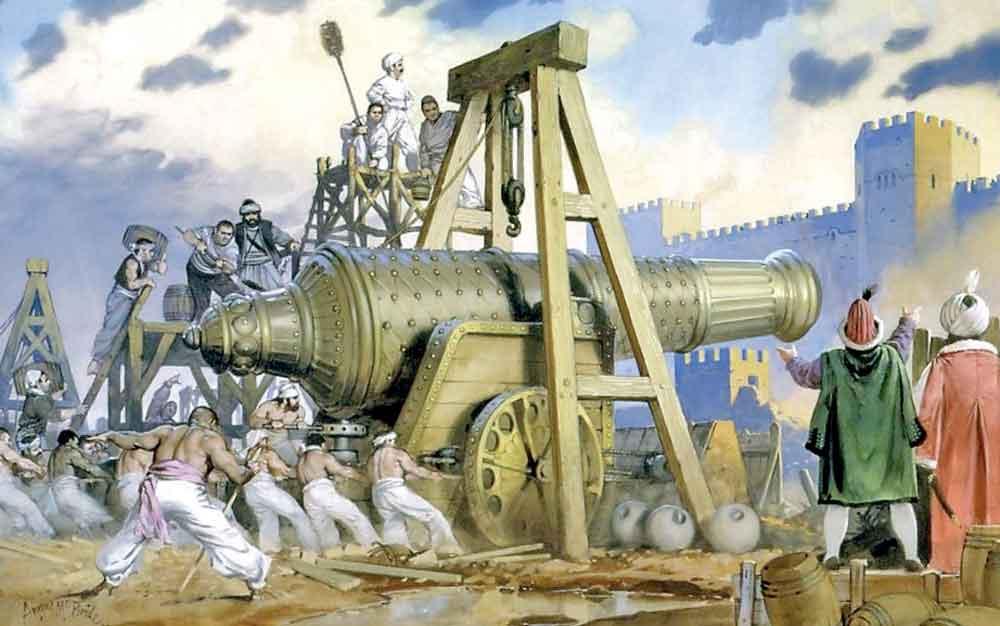
Ottoman siege artillery
 Western colonial powers, starting with the Portuguese, ruled the coastal regions of Sri Lanka from the early 16th century AD to the early 19th century, when the British extended their rule over the entire country in 1815.
There were repeated attempts by the Sinhalese rulers of Sitawaka and Kandy to oust the colonial powers. These wars were directed mainly against the Portuguese. As the Dutch followed a more conciliatory policy, there were fewer wars during Dutch rule.
Although Kandyan kings nearly succeeded in annihilating Portuguese power several times, these attempts ultimately failed, and the Portuguese were always able to regain their power and control of the coastal regions.
The reason – their formidable, stone-walled, canon-equipped fortresses. Seapower was a factor, but the fortresses had to hold out till help arrived, and they did. The first Portuguese fortress on the island was a simple stockade made of earth and wood, built in 1517. This was made bigger and strengthened later, and included the present Main Street and Pettah area within its walls.
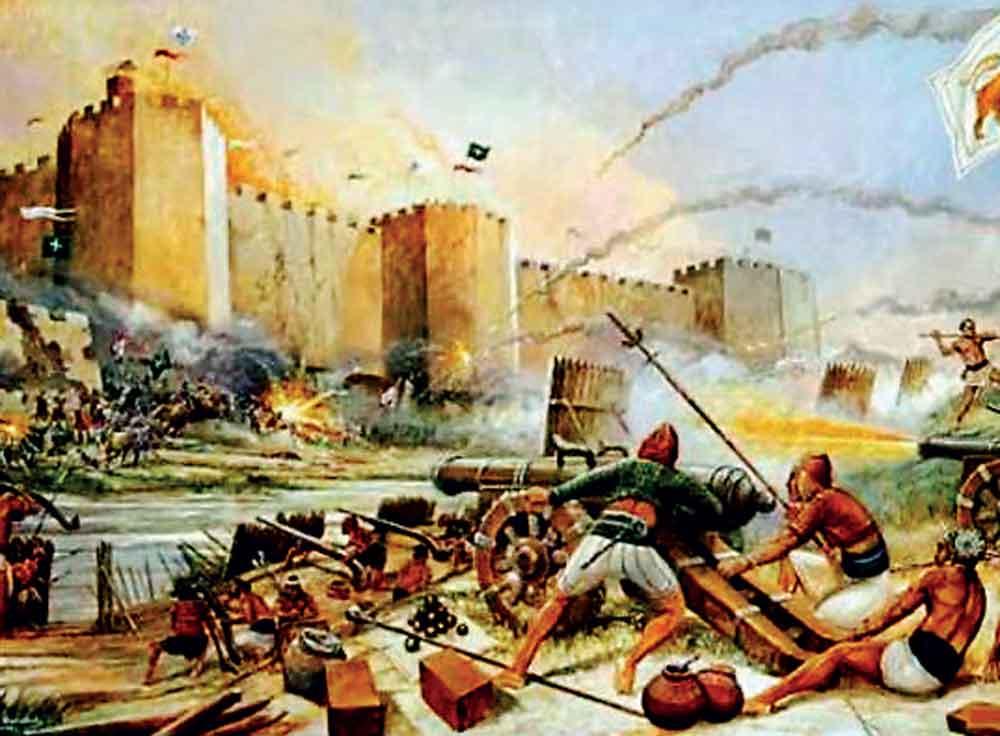
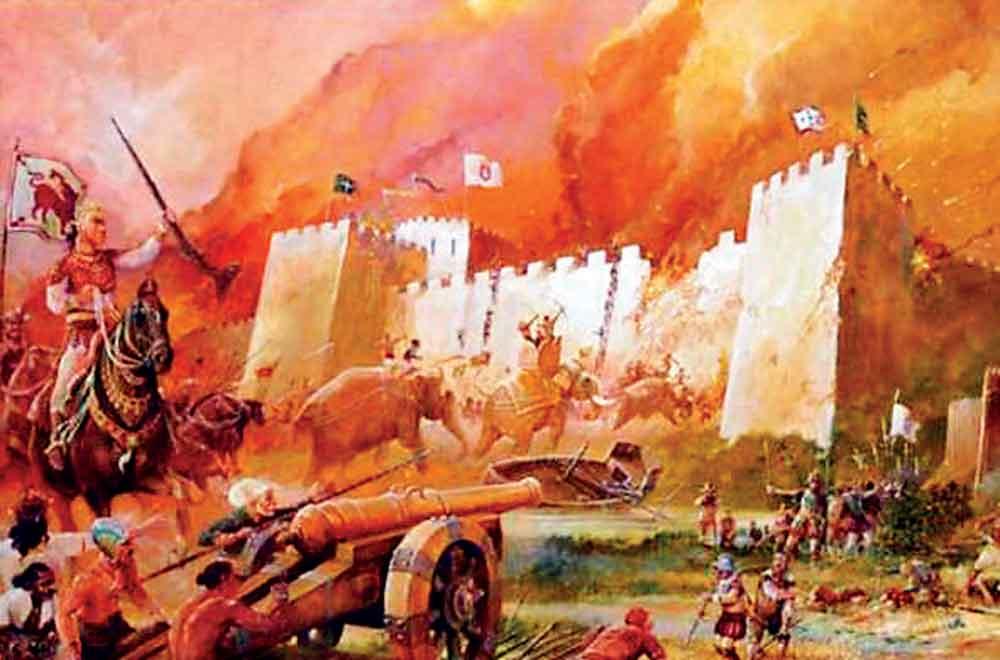
The first major siege of Colombo was carried out by King Rajasinghe I of Kandy. The second followed the destruction of Portuguese Captain General Constantino de Sá de Noronha and his army at Randeniwela in August 1630. Seeing a golden opportunity to end Portuguese rule in the island, King Senarat sent his forces to besiege Colombo during September-October 1630.
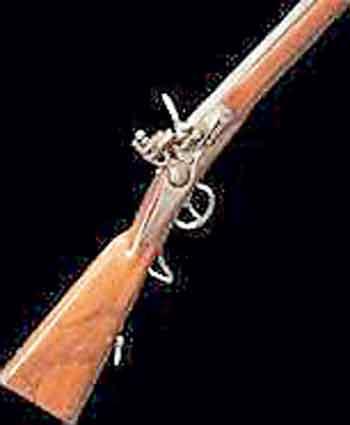 |
| Close up of a Portuguese musket |
Lack of artillery
Both these sieges failed because the Sinhalese forces did not have enough artillery to bombard and break down fortress walls. We may note that even the final and successful siege of Colombo by combined Dutch-Kandyan forces in 1656 was long and difficult, even with regular bombardment by Dutch artillery as well as a complete Dutch naval blockade. It took seven months before the Portuguese garrison surrendered.
Even with siege artillery, strongly built fortresses were hard to destroy. We may take as an example the extraordinary siege of the Hungarian fortress of Eger in 1552, by 40,000 Ottoman troops with heavy siege guns. Eger was a small fortress with only 800 soldiers. Its small cannon could not counter the Ottoman siege guns, which fired 300 lb cannon balls. Constantinople fell to the Ottomans in 1453 after a two-month bombardment by such powerful guns.
We can understand what that means compared to the size of the Dutch cannon which bombarded Colombo a century later – according to historian R. L. Brohier, these were 18, 20, 23 and 28 pounders. The Sinhalese cannon was much smaller.
If King Senarat’s forces had a few of those Ottoman siege guns, the outcome of this siege battle could have been very different.
But there is a human factor beyond artillery power and other military calculations – the resilience of the defenders. Though outnumbered and starved, Eger’s defenders fought on bitterly (just as the Portuguese did when Colombo was besieged), repairing battered walls with earth and wood, and pouring hot water on Ottoman soldiers who scaled the walls with ladders.
When the Ottomans dug tunnels, aiming to blow up the walls from below, the Hungarians did counter-mining, attacking Ottoman miners with swords and knives. They also fell back on ruses, letting the Ottomans believe that a relief army was approaching. Though a wall was finally breached, the Ottoman attacks were repulsed during three long months, and the exhausted Ottoman army finally withdrew with winter approaching.
Though lacking in siege guns, Kandyan forces attacking Portuguese forts used similar techniques, draining moats, digging tunnels, and scaling walls with ladders. But we must concede that the lack of heavy artillery was always a mitigating factor. Using elephants to attack was an outdated method by the 16th century, but war elephants were used in both of these sieges. In his book ‘The Portuguese in Ceylon 1617-1638’, historian C. R. de Silva notes that Senarat lacked war elephants in sufficient numbers to break down the fortress gates. Portuguese artillery must have taken a heavy toll of them.
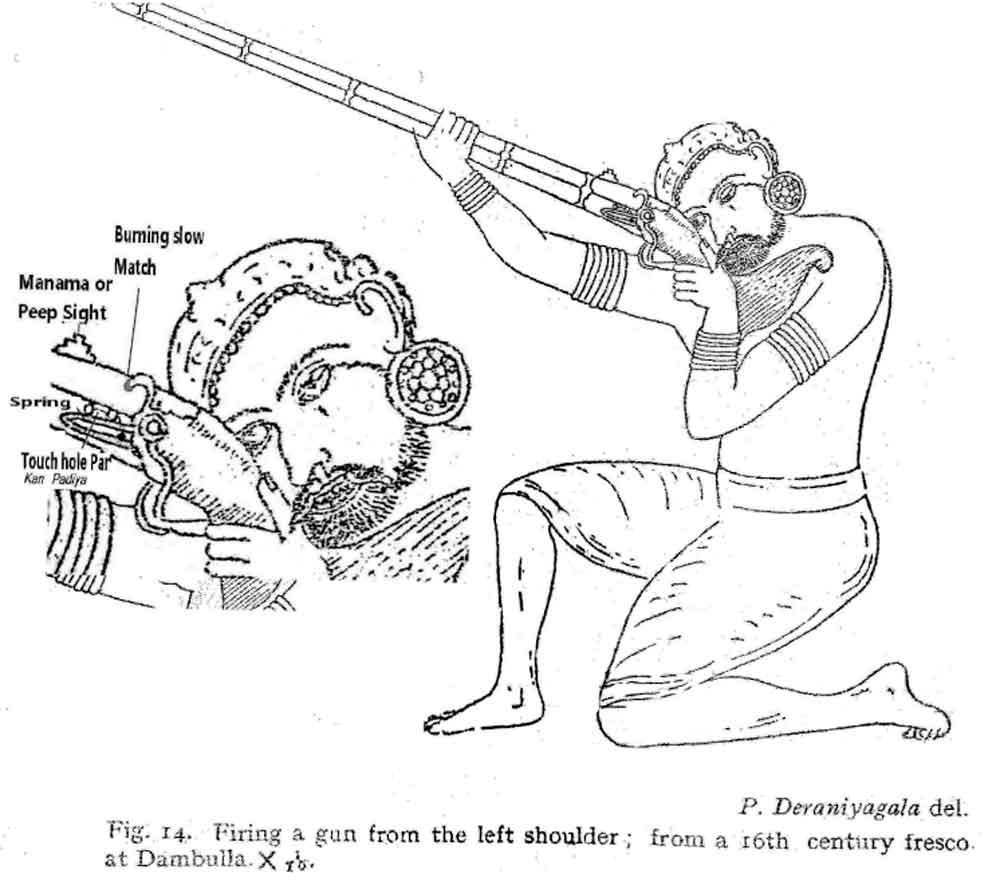
16th century fresco of Sinhalese soldier
In fact, Sinhalese forces lacked even muskets in sufficient numbers. This was still a bow-and-arrow, sword and lance army, supplemented by a small number of infantry muskets and very few artillery guns. Initially, such firearms were supplied by Muslim rulers of South India, such as the Zamorin of Calicut (in South India), when Mayadunne waged war against the Portuguese from Sitawaka.
After the power shifted to the Kandyan kingdom, smiths in the hills were able to manufacture muskets and gunpowder. But we must assume that the output was limited, and a musket would have been a prized possession in the Sinhalese army. Senarat’s force besieging Colombo numbered 15,000, and it isn’t known how many of these soldiers were musketeers. The numbers must have been small. At Randeniwela, Senarat’s forces numbered 12,000, with only one thousand musketeers.
According to C. R. de Silva, News of the disaster at Randeniwela reached Colombo only on August 27, 1630, leaving the Portuguese only eleven days to prepare defences. Lancarote de Seixas was appointed the new captain general, and he began strengthening the fort’s defences. Most of the walls needed repairs, while parts of the Beira Lake in front of Colombo were unprotected.
De Seixas had the walls repaired or strengthened with coconut and arecanut trunks. Trees near the walls were cut down. Twenty-nine new watch towers and stockades were built on the walls to supplement and support the eleven bastions (fortlets).
The new captain general was lucky. An Achinese gallery captured by the Portuguese arrived in Colombo at this crucial moment, and its captain agreed to help with guns, ammunition and men. It had eight artillery pieces. When Senarat’s forces arrived, the Portuguese had forty artillery guns and many additional muskets.
All details of the defences can’t be given in this short article. Only a dozen lascarins (Sinhalese soldiers in the Portuguese army, usually converts) were put to guard the rocky south western coast, as there was no danger of a naval invasion. The bastion of Santa Cruz, which defended the harbour, was defended by customs officials and Jesuits. Ten other Portuguese and their servants were appointed to watch the seaside, mainly to stop deserters.
As the wall to the east, towards the Beira Lake, had collapsed, sixteen stockades and guard towers were built. Moats protected the walls to the north, northwest and south, open to direct attack. Two reserve companies were organised to rush to any troubled spot. Smiths could make about four barrels of gunpowder a day. De Seixas had about 350 Portuguese to defend, but the loyalty of the 1300 lascarins was less certain (De Sá was doomed at Randeniwela when his lascarin force went over to the Kandyans). There were too, 2000 slaves and 1000 servants of the resident Portuguese.
Altogether, the Portuguese had 4,650 men to defend the fortress. Against this, the Kandyans had four divisions consisting chiefly of men of Matara, Sabaragamuwa, Four Korales and the Seven Korales. Each division was strengthened by a detachment of Kandyan soldiers. The commanders had names like Dom Cosmo, Dom Balthazar, Dom Aleixo and Dom Jeronimo Rajapakse as they were former lascarin commanders.
Next week, we shall look at how the battle started and continued for two months.
07 Jun 2026 07 Jun 2026
07 Jun 2026 07 Jun 2026
07 Jun 2026 07 Jun 2026
07 Jun 2026 07 Jun 2026
07 Jun 2026 07 Jun 2026