28 Feb 2026 - {{hitsCtrl.values.hits}}
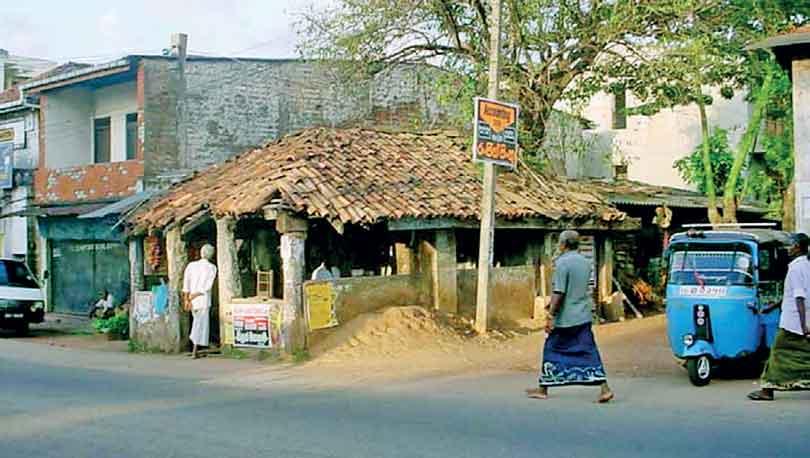
Kotte ambalama before restoration
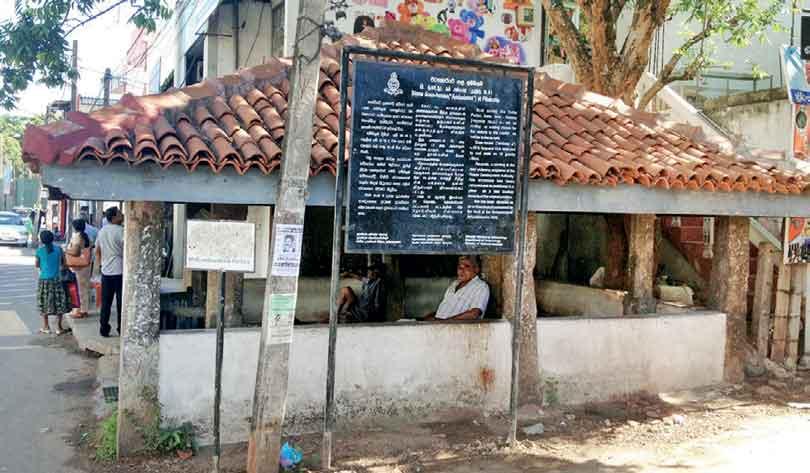
After restoration
 Like in the city of Colombo, the Kotte area too, remains largely unexcavated. These places are so built up now that methodical excavations would be very difficult
With proper research, the interior could be reconstructed, making it an interesting site for people to visit
 Preservation of archaeological sites is a much publicised subject in Sri Lanka, and a considerable amount of money has been spent on it. But the focus has been on the ancient civilisations – from Anuradhapura and Polonnaruwa to the Kandyan period. There is a lot of literally buried history in the Western Province, in Colombo, and other cities and towns along the Western coast and the interior, in Kotte, Manikkadawara, Kalutara, Hanwella and along the Kelani river. Other objects and specimens of archaeological interest are about to be buried by neglect and the passage of time.
This situation arises due to a misconception – that archaeology means only the classical civilisations. But what is left from more recent events too, are of archaeological interest. What is unearthed from a civil war site in the north east (I’m not talking about mass graves which is a human rights issue) is as important as, say, anything found at a 2nd century AD site in Anuradhapura where the king’s army fought an invading force.
The colonial period starting from the 16th century AD offers a very different archaeological narrative, offering glimpses of conflict as well as cultural renewal as a result of startling East-West contact.
The city of Colombo and the Kotte area, site of the Kotte kingdom which was Sri Lanka’s main political entity known as Sri Jayawardenepura when the Portuguese arrived early in the 16th century, is a good example of neglected archaeology. Today, there are two towns known as Etul Kotte and Pita Kotte, but many outsiders (and even residents) are only vaguely aware of their history and importance, that they were the main administrative centre and its outer defence perimeter of the Kotte kingdom.
Like in the city of Colombo, the Kotte area too, remains largely unexcavated. These places are so built up now that methodical excavations would be very difficult. But one doesn’t necessarily have to dig to find what may be buried beneath. Archaeologists use non-invasive, high tech tools to locate buried artefacts without digging. Related technologies include Ground Penetrating Radar (GTPR), magnetometers to detect metallic objects and resistance meters to measure soil conductivity, supported by drone photography and 3D modelling.
Such technology would be expensive, perhaps not feasible at a time when even the medical sector is running short. But it could have been procured when the country was running high (at least on borrowed money) and building useless airports. A modern, progressive nation needs not only highways and infrastructure. It needs the arts and a profound awareness of its culture in the broadest (and not in the narrow Sinhala Buddhist sense), and archaeology is a vital component of this awareness.
Returning to Kotte, the most visible site of archaeological interest is the ambalama (or travellers’ rest) at the Pita Kotte junction. This picture was taken in 2019 after restoration, but now it looks neglected, inhabited by beggars.
It’s history is vague. Sir Paul Pieris attributed it to the Kotte Period and called it the Mati Ambalama – hence, what we see now isn’t the original structure. But clearly, what is there now isn’t properly protected. Dr. Ananda Kumaraswamy detailed in his ‘Medieval Sinhalese Art’ what the interior of a Kandyan period ambalama was like. The Kotte ambalama may not have differed a great deal from that.
With proper research, the interior could be reconstructed, making it an interesting site for people to visit. The present, tiny Kotte archaeological museum can be expanded (within the same premises) with audio-visual material including video commentary to give visitors a precise idea of the layout and architecture of Etul Kotte and Pitta Kotte, attracting visitors.
Display boards should be placed at junctions and key points with maps and reconstructed views of 16th century Kotte. That will raise awareness and help conservation.
This is but one example of what can be done. Many examples of even more neglected 19th and 20th century archaeology can be found in Colombo.
Let’s keep exploring.
08 Jun 2026 3 hours ago
08 Jun 2026 3 hours ago
08 Jun 2026 3 hours ago
08 Jun 2026 3 hours ago
08 Jun 2026 4 hours ago