20 Aug 2025 - {{hitsCtrl.values.hits}}
 The general who wins the battle makes many calculations in his temple before the battle is fought. The general who loses makes but few calculations beforehand.
By Chanuka Wattegama
 The ancient Chinese military strategist and philosopher Sun Tzu famously wrote: “The general who wins the battle makes many calculations in his temple before the battle is fought. The general who loses makes but few calculations beforehand.”
This book review explores the story of that highly successful general, focusing on the meticulous calculations and strategic foresight that led to his victory. It also provides an in-depth look at his exceptional leadership style, offering insights into the qualities that defined him as a leader par excellence.
First, let’s refresh our minds with details we know so well. The Sri Lankan Northeastern conflict lasting from 1983 to 2009, was rooted in decades of deep-seated ethnic tensions between the country’s Sinhalese majority and the Tamil minority. The Liberation Tigers of Tamil Eelam (LTTE) emerged as the dominant militant group, employing guerrilla warfare and suicide bombings, which led to their classification as a terrorist organisation by several countries.
The war was characterised by a cycle of violence, failed peace accords, and significant human rights abuses on both sides. It had a devastating impact on the civilian population, resulting in tens of thousands of deaths, mass displacement, and immense destruction of infrastructure.
The conflict ultimately came to a brutal end in May 2009 with the military defeat of the LTTE and the death of its leader, Velupillai Prabhakaran, marking a decisive but highly controversial chapter in Sri Lanka’s post-colonial history.
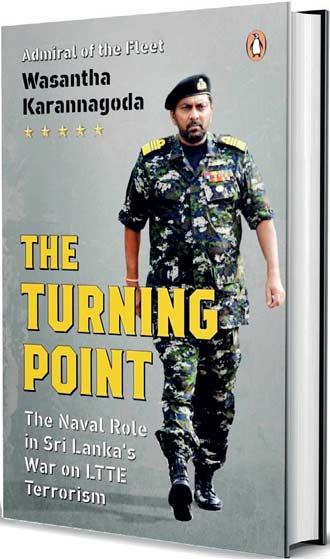
Admiral of the Fleet Wasantha Karannagoda’s memoir, Turning Point: The Naval Role in Sri Lanka’s War on LTTE Terrorism (2025), published by Penguin India, presents a critical account of the final stages of the thirty-year-old Sri Lankan conflict.
The book offers a firsthand perspective from a pivotal military figure who served as the Commander of the Sri Lankan Navy during this decisive period. It details the strategic naval operations and logistical challenges faced in combating the LTTE maritime capabilities.
The memoir aims to provide a unique military-centric narrative, shedding light on the crucial role the Sri Lankan Navy played in isolating the LTTE’s supply lines, which was a key factor in their eventual defeat. This publication thus serves as a significant historical document, providing valuable insights into the military strategy and command decisions from a leader directly involved in the conflict’s conclusion.
Turning Point also chronicles Admiral of the Fleet Wasantha Karannagoda’s 38-year naval career, with a focus on his tenure as Commander of the Sri Lankan Navy from 2005 to 2009. The book details his strategic innovations, such as the “Small Boat Concept,” which revolutionised coastal warfare, and the interception of over ten LTTE arms shipments in international waters, significantly weakening the LTTE’s Sea Tigers.
Admiral of the Fleet Karannagoda’s influence extended beyond his military command. He was known for his strategic engagement with political leaders, often undertaking significant risks in pursuit of national security objectives. A notable example is the well-documented relationship he forged with the late Foreign Minister Lakshman Kadirgamar, who was an opposition Member of Parliament at the time, particularly during the controversial ceasefire period.
“Since I gave him the thirty-five copies of the Trinco map, Kadiragamar used to call me whenever he wanted to clarify any matter related to the maps I prepared and the unfolding security situation in Trinco.’ writes Karannagoda,
“During one of those telephone conversations, he told me that he had briefed the heads of the leading newspapers in the country as well as the leaders in India about the threat posed to regional security due to the LTTE strengthening itself. During these conversations, I realised he was very close to some of the Indian leaders including the Gandhi family.’
Karannagoda’s effort is praised for its clarity and firsthand perspective, avoiding political discourse to focus on military strategy and personal experiences. The book also recounts dramatic incidents, such as Karannagoda’s narrow escape from death in 1995 when an LTTE attack downed an aircraft he was meant to board.
Karannagoda begins his narrative with the brief history of the conflict. The LTTE, formed in 1976 by Vellupillai Prabhakaran, sought an independent Tamil state in the north and east.
Under Karannagoda’s leadership, the Navy transformed from a “brown water” force, operating in coastal waters, to a “blue water” navy capable of deep-sea operations. One key strategy was intercepting LTTE “floating warehouse ships” over 3,200 km from Sri Lanka, near Indonesian and Australian waters. These efforts crippled the LTTE’s supply lines, paving the way for their defeat in 2009.
Karannagoda meticulously pens the efforts he has taken to transform the Sri Lankan Navy into a formidable force.
“I identified several weak areas in the Navy that needed immediate attention and drastic improvements.’ goes the narrative, “The most important was Human Resource development. With my experience of over thirty-five years of service in the Navy (at that time), I believed that in any organisation HR is the most important element. In a military organisation, one could be provided with the most sophisticated weapons but if the person behind it is not mentally prepared to do what is expected of him or her, when the time comes, then the objectives of that organisation will not be met.’
“The morale of the naval personnel was at a very low ebb, due to the humiliation suffered at the hands of the LTTE, the ceasefire agreement that was in force and several other reasons, such as lack of basic facilities, insufficient fighting capabilities, lack of leadership and lack of confidence in the senior officers, on the part of the junior officers and the sailors.’
“Each of these areas was important in terms of improving the navy’s fighting efficiency. I took steps to address these aspects on a priority basis, without delay.’
“The Naval Civil Engineering Department was expanded and entrusted with the responsibility of undertaking all civil construction in the Navy. The department had well qualified civil engineers, other technical specialist and skilled sailors. However, they were underutilized and the responsibilities and the work given to them at the time were mainly to supervise the outsources civil engineering contracts and the maintenance work of the existing buildings. Since the outside contractors never completed their work on time, to reduce the cost, the awarding of civil engineering contracts to private contractors or other organisations was totally stopped.’
“The strength of the civil engineering department increased almost six-fold, with the civil engineering sailors exempted from other service duties. Many incentives, including additional food, unlimited tea/coffee and soft drinks were given when they were working at the construction sites and their hard work was given due recognition and appreciation.’
The book is particularly relevant today as Sri Lanka grapples with significant national challenges, including economic recovery, ethnic reconciliation, and regional security.
Turning Point offers valuable lessons in adaptability, leadership, and national unity that are highly applicable to these contemporary issues. For instance, the memoir’s detailed account of innovative strategies can serve as a source of inspiration for young entrepreneurs and policymakers seeking creative solutions to economic hurdles. Similarly, its emphasis on a unified national purpose can motivate youth to advocate for inclusive policies that help bridge long-standing ethnic divides.
The book is a vital contribution to Sri Lanka’s post-war literature, providing a firsthand account of the Navy’s pivotal role in defeating the LTTE.
Its educational value, combined with its lessons in leadership and strategy, and its emphasis on national unity, makes it a powerful tool for inspiring and informing future generations. As the country moves forward, Turning Point offers both inspiration and crucial cautionary lessons for building a peaceful and prosperous future.
Due to its profound insights into strategic and operational decision-making, the book is considered a compelling read and is highly recommended for serious readers, particularly those in management studies.
08 Jun 2026 6 hours ago
08 Jun 2026 6 hours ago
08 Jun 2026 6 hours ago
08 Jun 2026 6 hours ago
08 Jun 2026 8 hours ago