15 Aug 2025 - {{hitsCtrl.values.hits}}
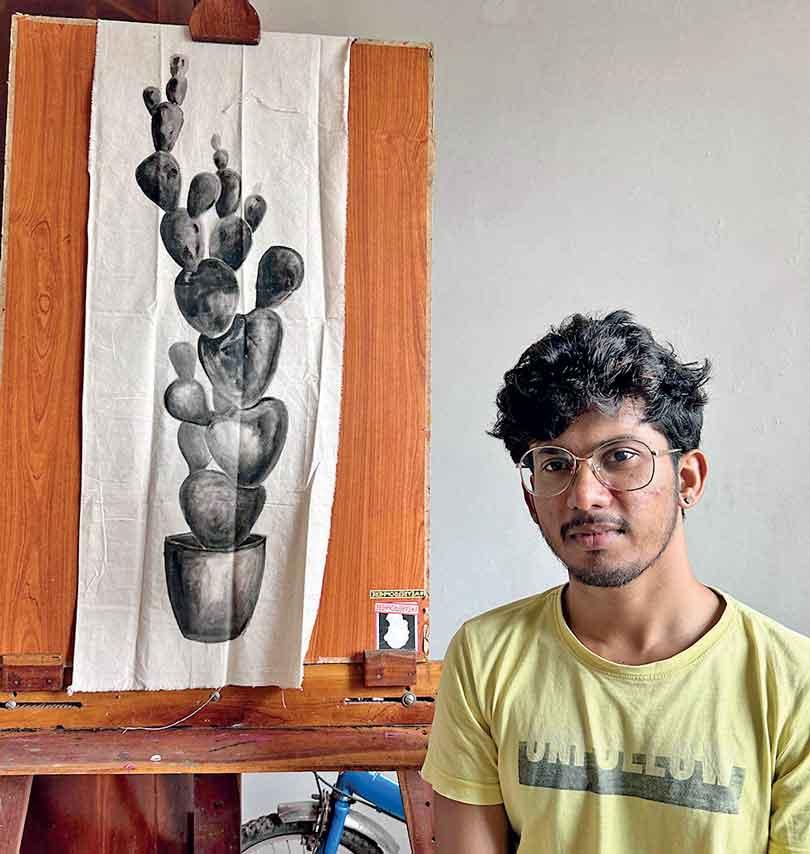
Lojithan Ram
(Picture Credits: Abdullah Firdousi)
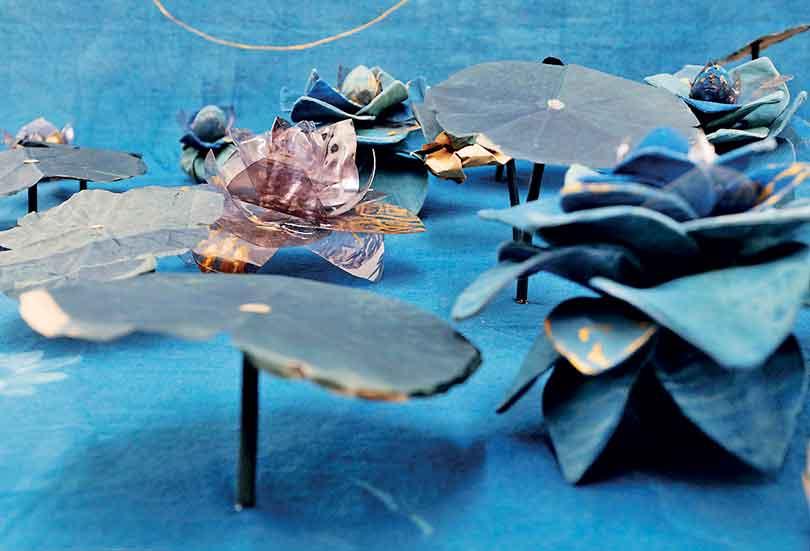
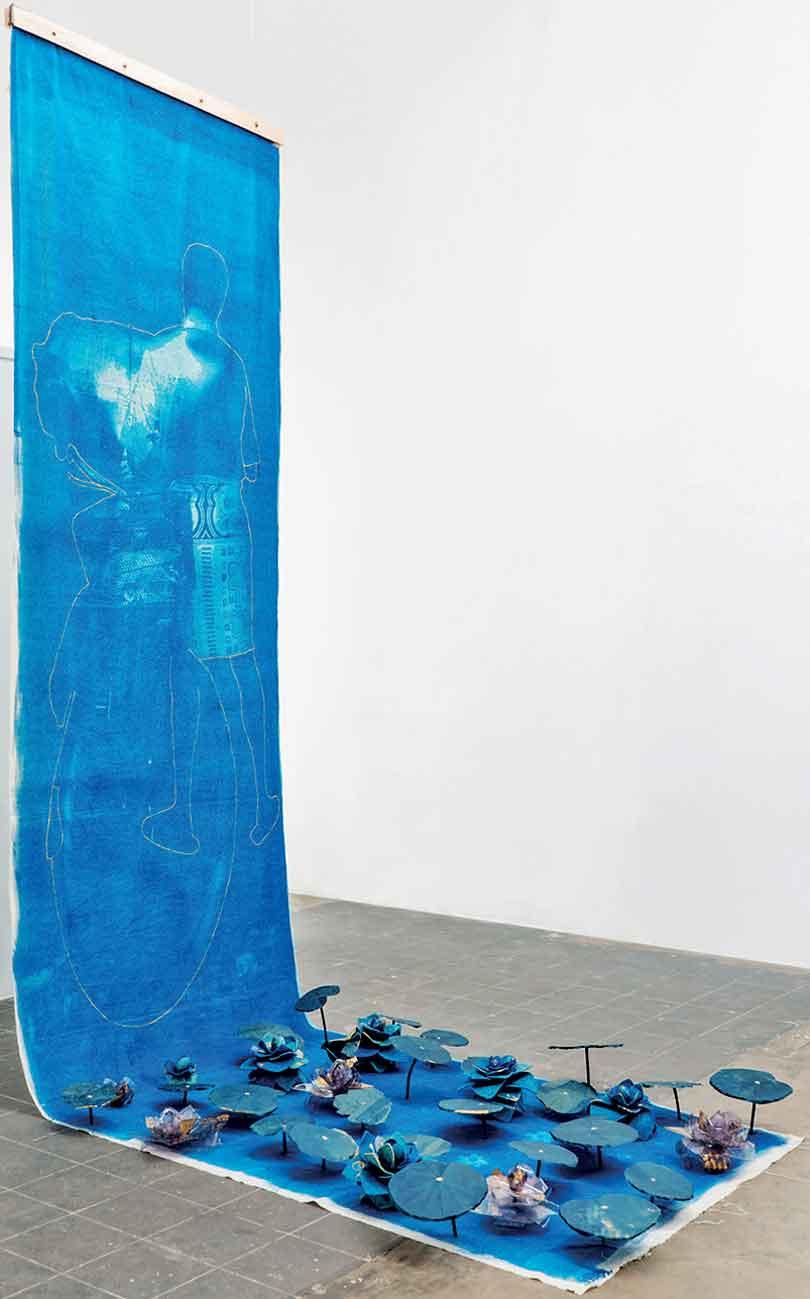
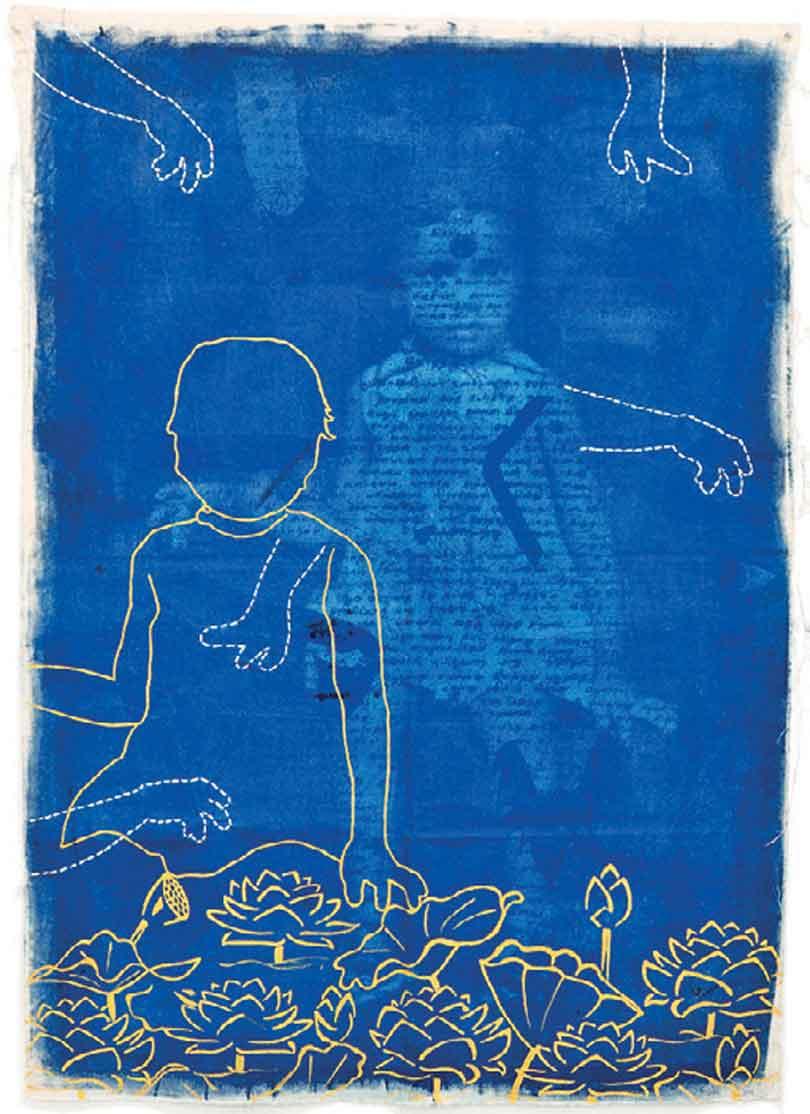
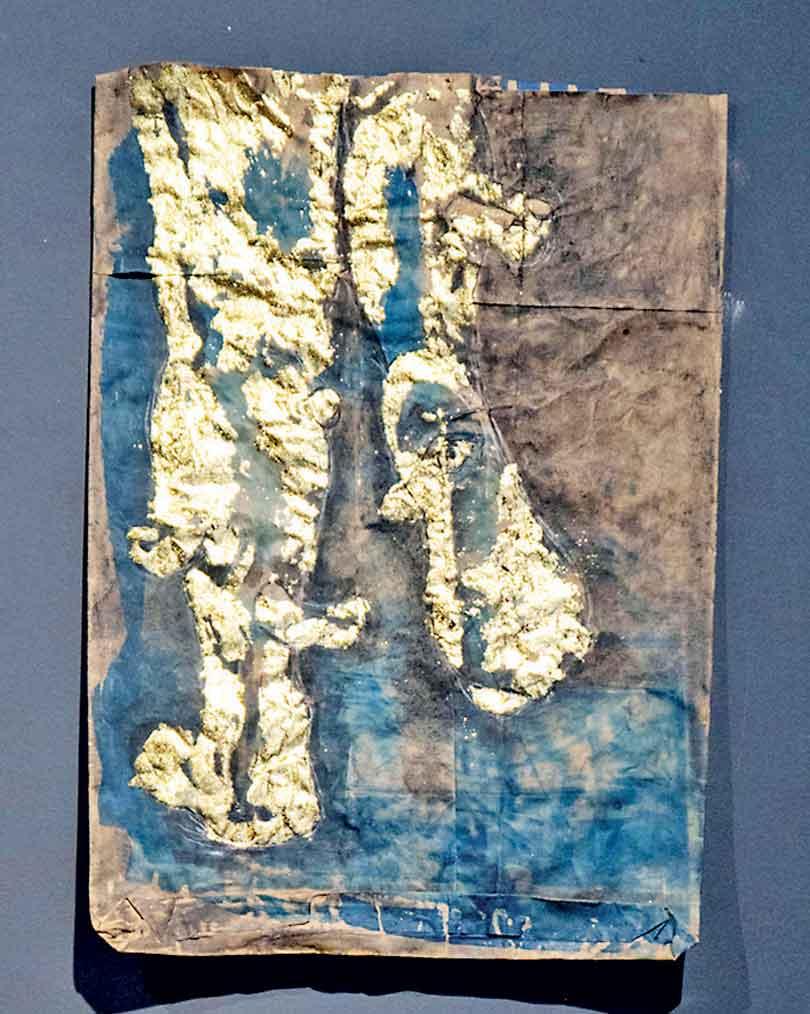
Selections from Lojithan Ram’s cyanotype artworks
By Aakil Riyaz
Parilojithan Ramananathan, better known as Lojithan Ram, held his solo art exhibition ‘Arra Kuļamum, Kottiyum, Āmpalum’, at the Paradise Road Saskia Fernando Gallery from May 23rd to June 23rd. Borrowing its title from the verses of Tamil poetess Avvaiyar, the exhibition touched on powerful themes such as memory and remembrance against a rich tapestry of literature and mythology.
A graduate of the Ramanathan Academy of Fine Arts, University of Jaffna, Lojithan Ram truly is an artist out of this world. His work has been exhibited at the Ceylon Literary & Arts Festival in 2025, Colombo scope 2024, Chennai Photo Biennale & Dhaka Art Summit in 2023, 5th Kochi-Muziris Biennale in 2022.
Despite not venturing beyond his hometown Batticaloa, Lojithan held a deep yearning within his heart for travel. It wasn’t until he began his undergraduate studies at the University of Jaffna that he began to travel to other parts of Sri Lanka to visit friends. For him travelling wasn’t just about the journey, but also the process of building genuine human connections with people from different parts of the country. This yearning for adventure was soon to play a pivotal role in Ram’s future.
As he neared the completion of his undergraduate studies, Ram was required to secure a work placement with an experienced artist, hence Lojithan set out on an odyssey of his own to find a mentor. With an inherent fondness for grassroots level activism, he knew in his heart of hearts that this was something he intended to showcase through his art.
“You have to find someone engaged in community based projects, only then will you be able to explore your complete depth as an artist”, says Lojithan.
Getting in touch with a friend who was a budding artist in Colombo, Ram intended to explore and witness the intricacies of the Slave Island area first hand. He was in complete rapture at the people, the shops, alleyways and the area’s historic ties all the way to the Colonial era.
Putting down roots away from home
Lojithan moved to Modara, Wattala, Mount Lavinia (where he lived in several houses), followed by Kalutara and then back to Mount Lavinia once again. This gave Lojithan a powerful sense of connection to his identity and the places he had resided in. “When we move from place to place, we only carry the tangible things with us, yet we leave a good amount of our emotions behind”, Lojithan says, referring to memory as a powerful form of imprinting one’s presence at a certain place and point in time.
Having experienced the power of memory and its value as a repository of human experiences, Lojithan set out to build a foundation on his work basing memory as a key cornerstone. With a grounded foundation on Tamil stories and mythology, Lojithan understood that migration and displacement played a pivotal role within these stories. He gradually began to translate this knowledge into his photography and art.
“Being able to connect and narrate the experience of non-belonging and displacement from my perspective was something I felt that I had to do”, Ram remarks.
Experimenting with Cyanotypes
Cyanotype also known as the ‘blueprint process’ was invented in 1842 by Sir John Herschel. Blue is the default colour of cyanotype prints. For Lojithan, the colour blue represents a personal and allegorical meaning, and that’s why he began experimenting with it in 2021.
Through a series of trial and error, Lojithan made his breakthrough with cyanotype art. He thereby began exploring it with different methods, mediums and surfaces. “Cyanotypes are used for creating botanical prints in addition to blueprints”, Lojithan explains.
Just like Elton John’s song ‘I Guess That’s Why They Call It The Blues’, Lojithan aims to invoke a certain magnitude of melancholic nostalgia through his art, one that is very reflective of his own experiences. “When you feel down, you say that, I’m feeling ‘blue,’ right? The colour has this feeling of nostalgia and it also has a certain level of richness that can be attributed to memory’, Ram mentions.
Photography as a medium of art
Lojithan mentions that with the advancement and sophistication of technology, the propensity to channel one’s inner energy into creating pure art is slowly declining.
‘The real understanding of photography is not just about operating a machine. It is also about your creative eye for taking pictures. Whether it is photographing nature or a human being, you have to try and tell a story. Only by experiencing and bearing witness to what you intend to relate to an audience will you be able to accomplish your goal as a photographer,’ Lojithan mentions.
Incorporating his profound knowledge in photography and his ongoing experiments with cyanotype art, Ram began an alchemical process of his own.
Arra Kuļamum, Kottiyum, Āmpalum: the process
The title of the exhibition can be attributed to the verses of the poetess Avvaiyar, wherein she uses a dried pond as a metaphor for absence, with its inhabitants Kotti, Āmpal, and Neythal (aquatic plants), deeply rooted into arid soil. The last vestiges of a once lively environment. The interpretation of the poem, aptly fits in with Lojithan’s own vision of memory and impermanence, which he effectively channels into all his cyanotype artworks. This process of threading the needle between archiving and memory with the colour blue has greatly worked in this regard.
Ram reaches out into the abyss of memory, and draws forth not just his own familial experiences, but along with it the collective histories of the families residing in his hometown. He uses the silent echoes of memory to paint a mural rooted in remembrance, bridging the divide between the past and present.
The road to Arra Kuļamum, Kottiyum, Āmpalum took around 18 months to reach completion. Putting forward an exhibition with equal parts of technicality and thematic areas is no mean feat. Understanding the cyanotype process and transmuting it with his vision required rigorous planning.
‘It was necessary for me to apply the chemicals on the surface of the material and expose it to a UV light source. I used direct sunlight instead. Every second is precisely calculated and I cannot risk a second too late or too soon, and the end result will be the print not forming properly’, Lojithan explains the cyanotype process and the challenges that came with it.
Lojithan also had to hire an artist to assist him in creating the cyanotype prints because working on them solo was nigh impossible. Having moved his studio space from Mount Lavinia to Kalutara, Lojithan had the additional burden of getting his friends to commute to the area, which many refused due to the distance. This period of isolation gave Lojithan a good amount of perspective and reflection, which he used to perfect his artworks.
The stories Ram relates through his artworks are those rooted within his psyche, and showcasing them on a colour deeply personal to him: blue brings with it a personal and heartfelt touch. Through Arra Kuļamum, Kottiyum, Āmpalum, Lojithan officiates himself not just as the archivist of his family legacy, but by creating through his vision an untenable legacy for himself as a multi-dimensional artist.
08 Jun 2026 14 minute ago
08 Jun 2026 17 minute ago
08 Jun 2026 24 minute ago
08 Jun 2026 32 minute ago
08 Jun 2026 2 hours ago