05 Mar 2026 - {{hitsCtrl.values.hits}}
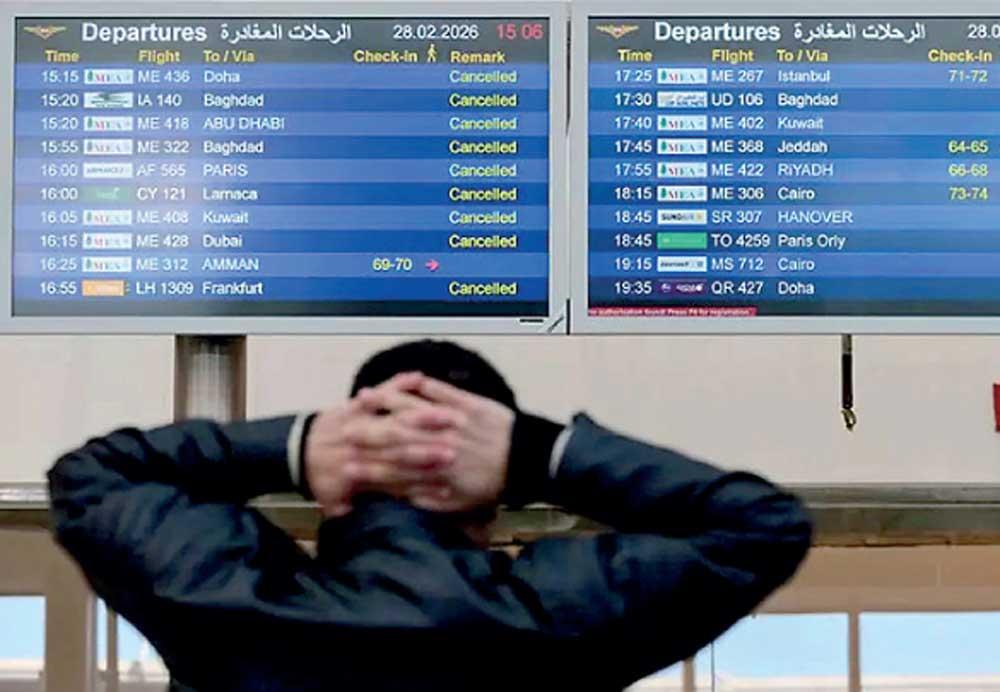
Passengers left stranded as flights across the Middle East have been cancelled. PIC COURTESY: AP
Sri Lanka’s tourism sector recorded a massive milestone in February 2026, welcoming 279,328 international visitors during the month. The figure marks a solid 16.2 percent year-on-year growth, compared to the 240,217 arrivals registered in February 2025.
The cumulative arrivals for the first two months of the year reached 556,655, reflecting a steady year-to-date increase from the 492,978 tourists welcomed during the same period in 2025.
The robust influx of visitors has injected substantial momentum into the local economy, keeping the island firmly on track to meet its broader annual tourism targets.
A detailed breakdown of the source markets highlights strong performances across several key regions. India maintained its position as the top contributor, bringing in 47,679 tourists in February 2026, a notable increase from the 35,728 Indian arrivals recorded in the same month last year. The United Kingdom followed as the second-largest market, with 30,788 arrivals, up from 25,528 in February 2025.
The other key European and Asian markets also showed a remarkable year-on-year growth, with Germany contributing 22,566 tourists, compared to 17,233 last year and China surging to 20,180 arrivals, from just 11,690 in the previous year.
However, the Russian Federation saw a dip, recording 23,099 arrivals in February 2026, down from 30,295 in February 2025.
The impressive growth in February was significantly catalysed by Sri Lanka co-hosting ICC Men’s T20 World Cup 2026. The influx of international cricket fans travelling to the island to witness the matches translated into a massive surge in demand for accommodation and hospitality services.
The hotels in Colombo, serving as a major venue hub for the tournament, reported nearly 100 percent occupancies throughout the month.
This sporting event not only provided a direct boost to the local hotel revenues but also stimulated spending across the broader service sector, reaffirming the immense economic potential of sports tourism for the country.
Despite the record-breaking performance, the industry is navigating severe headwinds stemming from the escalating geopolitical crisis in the Middle East. The recent outbreak of conflict led to sweeping airspace closures and widespread flight cancellations across major global transit hubs. With over 200 flights to and from the Middle East initially cancelled at Bandaranaike International Airport, the disruption threatened to throttle the vital European tourist pipeline, which heavily relies on the Middle Eastern carriers for transit. However, slight reprieves have emerged this week as airspace restrictions partially ease. The local carriers have initiated a measured resumption of services, with FitsAir becoming the first to restore scheduled flights between Colombo and Dubai, followed closely by SriLankan Airlines, which recommenced its daily Colombo-Dubai routes.
International carriers are also cautiously returning to the skies; Emirates has begun operating a limited number of passenger flights to accommodate customers with earlier bookings, while Air Arabia has resumed select departures to Sharjah.
Conversely, airlines such as Qatar Airways remain temporarily suspended, pending further safety clearances. The government has stepped in to offer free 14-day visa extensions to stranded tourists.
An analysis of tourist arrivals by their last port of departure and airline choice reveals the overwhelming role of the Gulf region as the primary aerial crossroads for Sri Lanka tourism.
During January 2026, the combined arrivals from Dubai, Doha, Abu Dhabi and Sharjah totalled approximately 94,459 visitors, accounting for over 34 percent of all tourist traffic. This dominance is largely because these Middle Eastern cities function as the world’s busiest long-haul transit hubs, with the passengers originating from Europe, the Americas and Middle East connecting through to Colombo.
The competitive landscape of airlines facilitating this traffic further mirrors this dependency. Major Gulf carriers collectively form the second pillar of Sri Lanka’s air connectivity behind the national carrier.
Qatar Airways, Emirates, Etihad Airways, Fly Dubai and Air Arabia together brought in approximately 93,858 passengers in January, representing about 33.8 percent of all arrivals.
This connectivity is particularly critical for the long-haul European source markets such as the United Kingdom, Germany, France and Poland, where the travel patterns show significant reliance on the Middle Eastern airlines for flexible one-stop options.
However, this heavy reliance has now exposed a critical vulnerability for the island’s tourism sector, amid the escalating geopolitical crisis in the Middle East.
With the recent conflict outbreaks triggering sweeping airspace closures and over 200 flight cancellations to and from Colombo, the vital European tourist pipeline is under severe threat.
The disruption to the essential Gulf hubs means that the European tourists, who generate substantial volume for the island, are facing stranded itineraries and severed travel routes. (NF)
19 Jul 2026 1 hours ago
19 Jul 2026 1 hours ago
19 Jul 2026 3 hours ago
19 Jul 2026 5 hours ago
19 Jul 2026 6 hours ago