17 Jul 2025 - {{hitsCtrl.values.hits}}
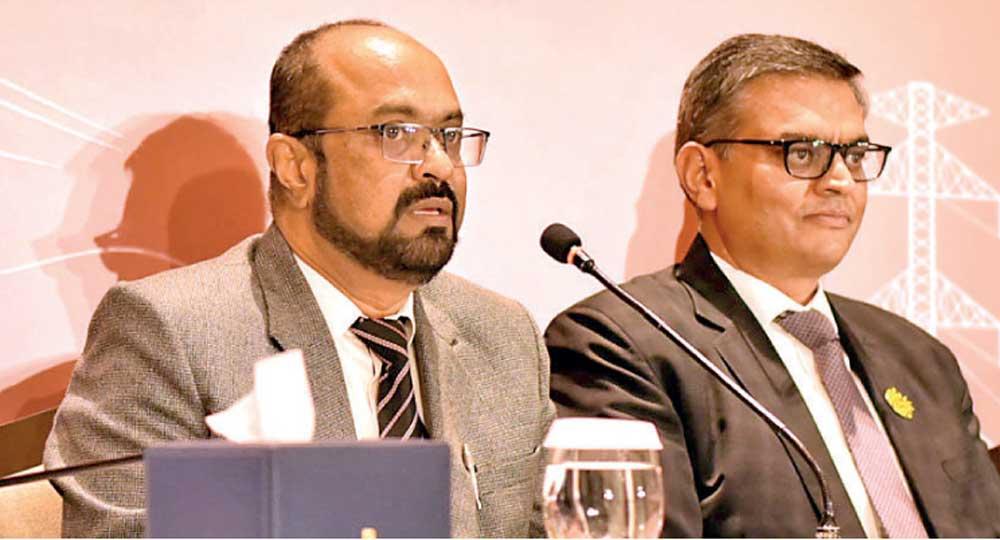
Power and Energy Minister Kumara Jayakody addresses media while International Solar Alliance Director General Anish Khanna looks on
PIC BY NISAL BADUGE
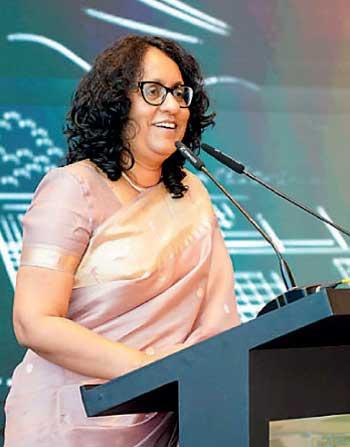 |
| Prime Minister Dr. Harini Amarasuriya delivers keynote address |
Sri Lanka is turning to energy storage systems, including battery and hydro-based solutions, to address the growing imbalance between solar energy supply and demand, a move the government said is critical to sustaining the island’s renewable energy ambitions.
Power and Energy Minister Kumara Jayakody yesterday said storage is a necessary component of the country’s clean energy transition but acknowledged that the cost remains a hurdle, given the ongoing economic recovery.
“... solution is storage. That is a known solution and there are two types: battery storage and hydro storage. But considering our economic situation, that is not cheap,” Jayakody said, speaking at the Seventh International Solar Alliance (ISA) Regional Committee Meeting for Asia and the Pacific, held in Colombo.
He pointed out that Sri Lanka has introduced a solar-with-battery tariff and would soon tender a 160-megawatt battery storage system. In addition, a detailed design for a 600-megawatt pumped hydro storage project is underway. The government is also promoting electric vehicle charging during daytime hours as another means of energy storage.
The push for storage follows increased solar installations across the country, supported by initiatives such as the Battle for Solar Energy campaign, which includes expanding rooftop solar systems and a broader policy commitment to achieve 70 percent renewable energy by 2030.
The discussions, held under the theme ‘Advancing Solar Cooperation Across a Region of Diversity and Opportunity’, also saw regional officials stress the importance of aligning national solutions with regional strategies to enhance scale and affordability.
ISA Director General Anish Khanna noted that cost reduction in solar procurement can be achieved through joint tendering and regional pooling of projects. He shared India’s experience where solar bid prices fell by 70 percent over a decade, largely due to standardised contracts and digital auction mechanisms.
“This is something which is our main value proposition. Economies of scale bring down the cost of supply and you also help each other learn how to do it faster,” Khanna said.
Meanwhile, Prime Minister Dr. Harini Amarasuriya, delivering the keynote address, said that while the energy transition holds a significant potential for transformation, ensuring that it is “just, accessible and affordable for all” remains a core challenge.
“If the 20th century was defined by fossil fuel, then the 21st century must be led by the promise of sunlight, clean, abundant and universally accessible,” she said, calling for deeper regional partnerships and innovative, scalable strategies.
The ISA meeting brought together the policymakers, industry stakeholders and regional partners where Sri Lanka served as vice chair of the high-level dialogue. Discussions focused on strengthening solar cooperation, mobilising climate finance and building institutional capacity across the member countries.
21 Jul 2026 2 minute ago
21 Jul 2026 8 minute ago
21 Jul 2026 40 minute ago
21 Jul 2026 44 minute ago
21 Jul 2026 48 minute ago