19 May 2026 - {{hitsCtrl.values.hits}}
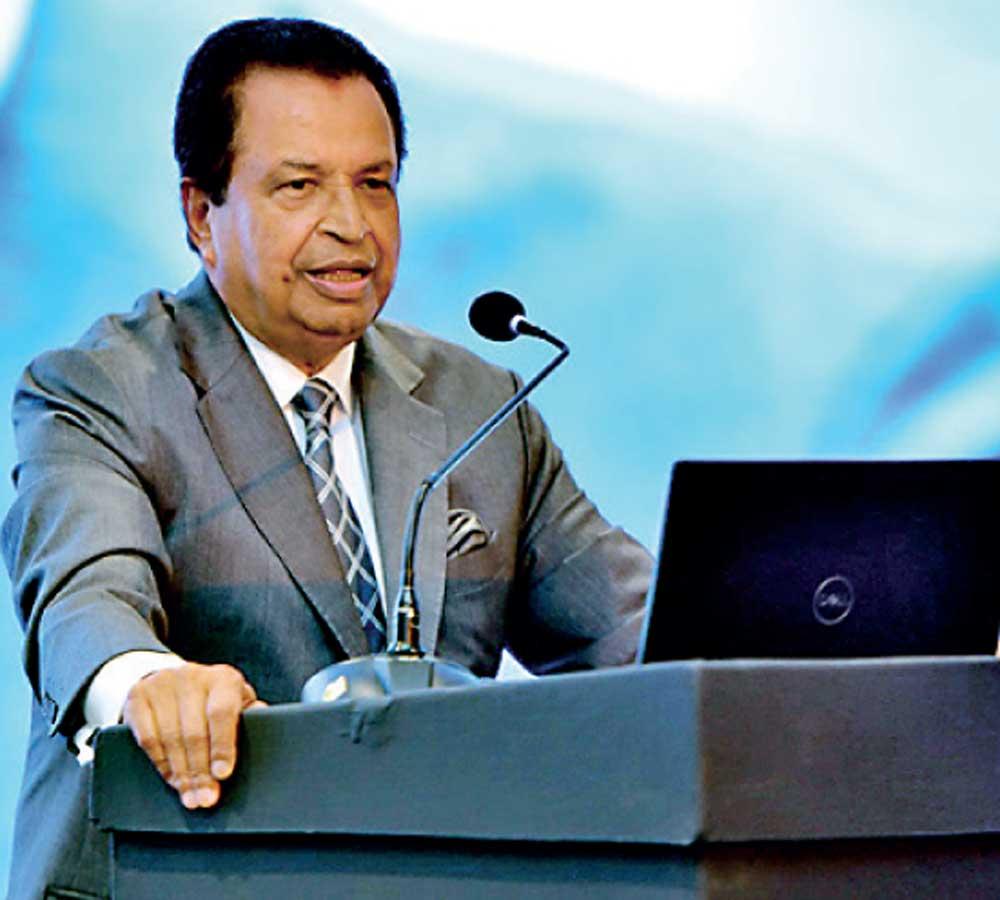
Binod Chaudhary
PIC BY SAMANTHA PERERA
If ever I had to choose to live outside my own country, Kathmandu, it would be
Sri Lanka
- Binod Chaudhary
By Shabiya Ali Ahlam
Nepalese billionaire Binod Chaudhary last week delivered a powerful endorsement of Sri Lanka’s long-term investment story, saying he repeatedly chose to back the country at moments when fear, instability and crisis had paralysed investor sentiment.
He said Sri Lanka’s darkest periods often created the strongest opportunities for long-term investors, citing the country’s resilience, entrepreneurial depth and institutional continuity.
“If ever I had to choose to live outside my own country, Kathmandu, it would be Sri Lanka,” Chaudhary said, while reflecting on nearly three decades of business ties with the country. He shared his comments while speaking at the Chairman’s and CEO Forum, hosted by Union Bank and the Sri Lanka Institute of Directors, in Colombo.
The billionaire businessman, whose CG Corp Global spans hospitality, banking, food and infrastructure, recalled how his first major investment in Sri Lanka came in 1998, during one of the country’s most volatile periods, shortly after the bombing of aircraft at Bandaranaike International Airport.
“What I saw was pretty scary. It was around the same time when the six aircraft had been bombed. Even the Sri Lankans, with due respect, including Sri Lankan hoteliers, successful entrepreneurs and even Taj’s own partners, were not prepared to make more investments. Two wings of the Samudra were shut down. Hotel rooms were being sold at US $ 20 a night and even then, there was barely any meaningful business.”
Despite the uncertainty, Chaudhary said he chose to proceed with the investment, after becoming convinced that crises often create the best long-term opportunities.
“I always believed in the fundamentals of Sri Lanka. I knew it was only a matter of time,” he said. He described Sri Lanka as a country that “keeps coming back”, even after severe disruptions.
“So, I would say that there are very few countries where I can confidently say there are such distinct characteristics, distinct advantages, a distinct trust factor and above all, resilience,” Chaudhary said.
Chaudhary also highlighted Sri Lanka’s appeal to regional investors seeking opportunities in tourism, banking and partnerships with established local conglomerates.
He pointed to his later investments during the 2008 financial turmoil as well as during Sri Lanka’s recent economic collapse, when his group pursued negotiations linked to Union Bank, despite the soaring interest rates and currency instability. “The worst thing one could do at that time was to enter the financial services sector,” he said, referring to the height of the crisis in 2022 and 2023, when the interest rates surged to as high as 30 to 40 percent and the rupee sharply depreciated. “Yet, even then, we listened to our hearts rather than our minds and the advice of our M&A experts and advisors. We decided we had to continue the journey.”
He also praised Sri Lanka’s private sector leadership and business culture, specifically highlighting John Keells Holdings, MJF Group, Jetwing and the Ceylon Chamber of Commerce network, with whom he said he had built longstanding partnerships over the years.
Chaudhary further said Sri Lanka retained advantages over several countries in the region, due to the stronger institutional continuity and a more stable bureaucracy.
“You all are lucky in that respect,” he said, comparing Sri Lanka with Nepal’s frequent political transitions.
“I think Sri Lanka, Bangladesh and India all have far more stable bureaucracies. There is a degree of continuity and the judicial system works.” Chaudhary also highlighted optimism about the direction of Sri Lanka’s new administration, following a recent meeting with President Anura Kumara Dissanayake.
“I came back very encouraged after meeting the President. I think he means business. He wants to support businesses and new investments,” Chaudhary said, adding that discussions are already underway regarding the expansion of some of his existing businesses in Sri Lanka.
While acknowledging that Sri Lanka had often faced setbacks “just when the country begins to take off”, Chaudhary maintained that the country’s strategic location and entrepreneurial strength would continue to make it attractive for foreign investors over the long term.
19 Jul 2026 15 minute ago
19 Jul 2026 2 hours ago
19 Jul 2026 3 hours ago
19 Jul 2026 3 hours ago