18 Sep 2025 - {{hitsCtrl.values.hits}}
For Sri Lanka’s public sector workers, the pay raises have failed to keep pace with the soaring inflation, leaving the families struggle to cover the basic living costs, the World Bank said.
Despite the high nominal growth of wages and pensions over 2018-23, the World Bank noted that high inflation has eroded the purchasing power of the public sector employees and pensioners in recent years. In cumulative real terms, average public sector wages and pensions fell by 33 percent and 26 percent, respectively, over the past three years.
The report warns that the impact has been regressive, disproportionately affecting the low-income civil servants. Data from the 2019 and 2022 Labor Force Surveys indicate that the public sector workers in the bottom 30 percent of the income distribution lost considerably more purchasing power than their private sector counterparts.
“These results signal that the uncompensated losses in the government real wages will have contributed to a deterioration of living conditions for the most vulnerable groups in Sri Lanka,” the World Bank said in its latest report ‘Sri Lanka Public Finance Review: Towards a Balanced Fiscal Adjustment’.
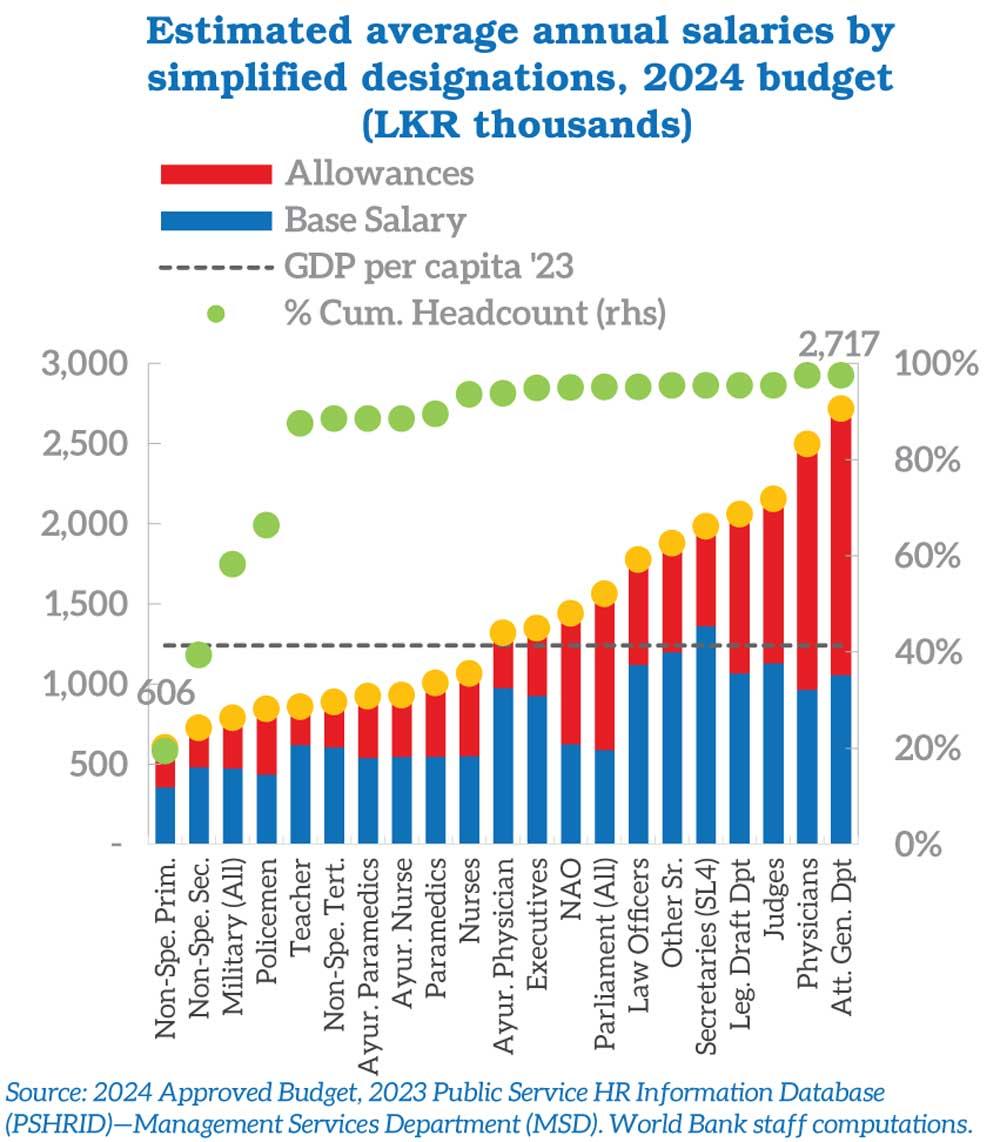
The erosion of real earnings is compounded by a widening gap between the public and private sector pay for skilled professionals. The preliminary analysis indicates that more than 90 percent of civil servants earn less than the GDP per capita and average public service wages, excluding the non-contributory retirement benefits—dropped from 88 to 62 percent of the per capita GDP between 2020 and 2023. Even when factoring in pensions, total pay fell from 116 percent to 87 percent of the per capita GDP.
The report also highlights structural inefficiencies in public sector compensation. Ad hoc allowances have become a significant component of total pay, often accounting for 30-60 percent of the final remuneration in specialised professions such as healthcare and executive roles. These allowances, while pensionable, disproportionately benefit higher-income employees, raising equity concerns.
The World Bank urged the policymakers to address both immediate and long-term challenges. Protecting the living standards of the lowest-paid public employees is critical, the report said, while reforms are needed to improve efficiency, transparency and competitiveness of the public sector wage structure.
As the government navigates fiscal consolidation and structural reforms, the report suggests that a more systematic approach to compensation, potentially through a centralised pay commission, could help ensure fairness, reduce ad hoc payments and make public sector roles more attractive for skilled professionals.
20 Jul 2026 20 Jul 2026
20 Jul 2026 20 Jul 2026
20 Jul 2026 20 Jul 2026
20 Jul 2026 20 Jul 2026
20 Jul 2026 20 Jul 2026