13 Oct 2025 - {{hitsCtrl.values.hits}}
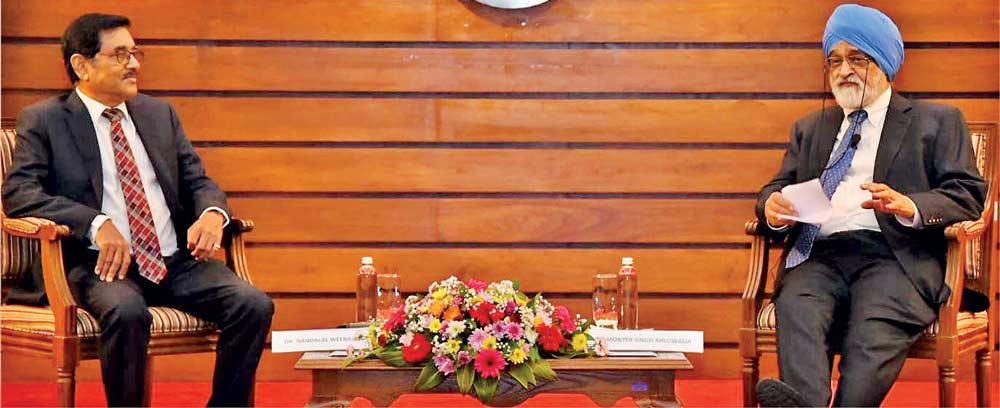
Central Bank Governor Dr. Nandalal Weerainghe (left) with Dr. Montek Singh Ahluwalia at the CBSL public lecture
Pic by Nisal Baduge
As Sri Lanka positions itself on the cusp of an AI-driven transformation, a top Indian economist has urged the island nation to look less to the West and more towards its immediate neighbour, India, whose experience with artificial intelligence offers both promise and caution for Sri Lanka’s ambitions.
Veteran economist and former Deputy Chairman of India’s Planning Commission, Dr. Montek Singh Ahluwalia, said Sri Lanka stands to reap major gains in education and information technology by learning from how India has integrated AI into its economy. Speaking at a public lecture on “Charting a Growth Strategy in a Changing Global Environment”, part of the Central Bank of Sri Lanka’s 75th anniversary celebrations, Dr. Ahluwalia said AI holds vast, untapped potential for transforming key sectors, but warned that the transition will also challenge traditional job structures. “There is more scope for AI than we have thought about earlier,” Dr. Ahluwalia said, citing India’s call-centre industry as an early example of how AI can rapidly disrupt established models of employment. “We are finding that many IT firms have scaled down new hires. This means many aspirational graduates are finding it very difficult to get jobs. This is happening in the US too.”
India’s US$283 billion outsourcing industry, one of its largest employers, saw a 10 percent decline in hiring this year as AI tools began automating large portions of customer service and back-office operations, according to media reports. Tech major Tata Consultancy Services (TCS) also announced a 2 percent workforce reduction in July 2025, affecting over 12,000 jobs, citing automation and AI-driven restructuring.
However, TCS simultaneously doubled its AI-skilled workforce to 160,000 and hired 18,500 new staff in the same quarter, underscoring that the employment landscape is shifting rather than shrinking.
“New technology has a disruptive effect. We need to recognise this and identify areas in which AI can create new jobs. Private companies are increasingly saying they want people who are comfortable using AI, they don’t necessarily have to create new technologies,” Dr. Ahluwalia added.
He noted that AI’s impact is already visible in academia and research, where tools such as ChatGPT are changing how work is conducted.
“If you were writing a research paper before, you might have hired a research assistant. Now you can ask AI to summarise existing work. While it’s not always correct, there’s no doubt people will use it in a big way,” he said.
Sri Lanka, meanwhile, is making cautious progress in its AI journey. In August 2025, the government launched a National AI Fund seeded with Rs. 100 million to nurture home-grown innovation. The move complements the recently unveiled National AI Strategy 2028, which seeks to embed AI in education, healthcare, agriculture, and public administration, combining short-term pilot projects with long-term capacity-building.
The country’s digital economy ambitions are equally bold: authorities project a fivefold expansion by 2030, with AI as a central driver. Yet experts warn that Sri Lanka lacks a cohesive policy framework linking government, academia, and the private sector, a gap that could slow adoption.
A recent study on AI literacy among Sri Lankan ICT teachers found low confidence levels in teaching AI-related content, revealing significant readiness gaps in human capital. The country also faces regulatory challenges as it adapts its data and online governance frameworks, including the Online Safety Act (2024), which has sparked debate over privacy and digital rights.
“AI is something we don’t fully understand yet because it’s changing so rapidly. When change is gradual, systems can adjust easily. But when the change is rapid, systems find it difficult to adapt, and that is what we’re now facing,” Dr. Ahluwalia said.
(SD)
20 Jul 2026 20 Jul 2026
20 Jul 2026 20 Jul 2026
20 Jul 2026 20 Jul 2026
20 Jul 2026 20 Jul 2026
20 Jul 2026 20 Jul 2026